Department of Computer Science and Technology, School of Electronics Engineering and Computer Science, Peking University, Beijing 100871, China.
Department of Biomedical Engineering, College of engineering, Peking University, Beijing 100871, China.
Nucleic Acids Res. 2020 Apr 6;48(6):2791-2806. doi: 10.1093/nar/gkaa095.
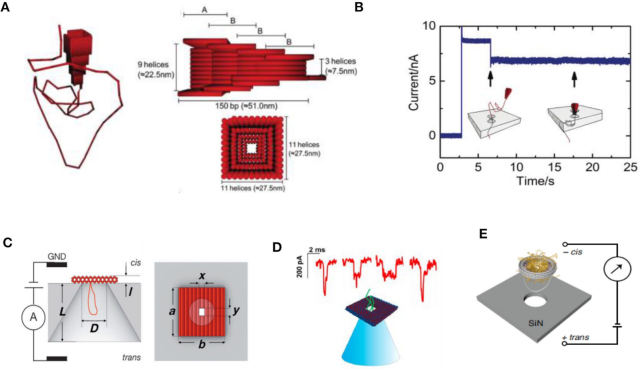
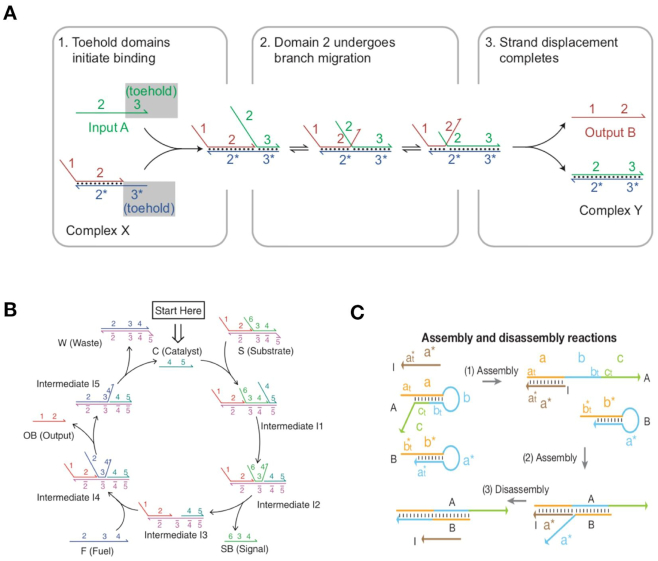
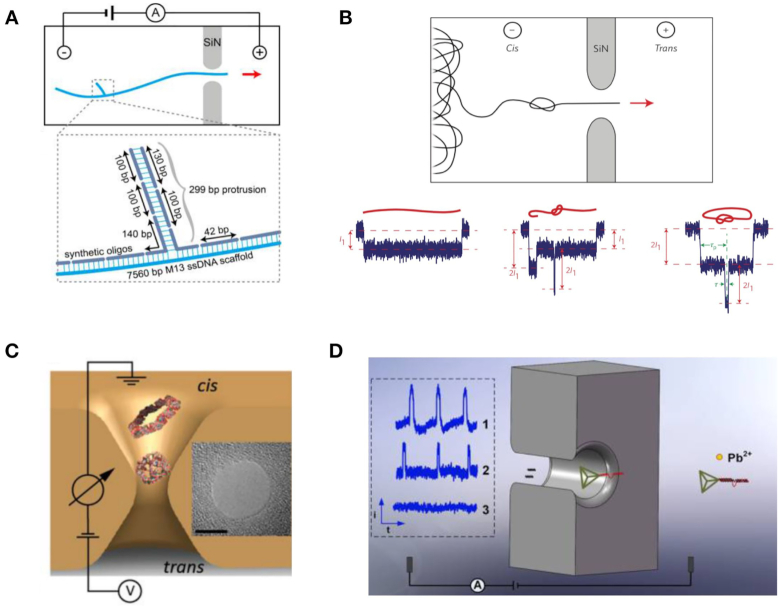
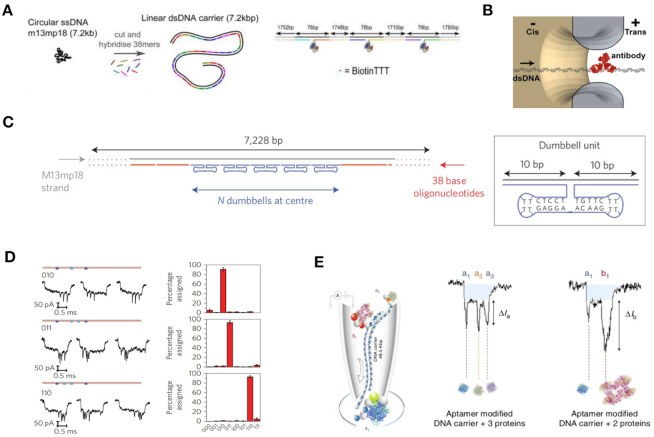
Nanopore technology is a promising label-free detection method. However, challenges exist for its further application in sequencing, clinical diagnostics and ultra-sensitive single molecule detection. The development of DNA nanotechnology nonetheless provides possible solutions to current obstacles hindering nanopore sensing technologies. In this review, we summarize recent relevant research contributing to efforts for developing nanopore methods associated with DNA nanotechnology. For example, DNA carriers can capture specific targets at pre-designed sites and escort them from nanopores at suitable speeds, thereby greatly enhancing capability and resolution for the detection of specific target molecules. In addition, DNA origami structures can be constructed to fulfill various design specifications and one-pot assembly reactions, thus serving as functional nanopores. Moreover, based on DNA strand displacement, nanopores can also be utilized to characterize the outputs of DNA computing and to develop programmable smart diagnostic nanodevices. In summary, DNA assembly-based nanopore research can pave the way for the realization of impactful biological detection and diagnostic platforms via single-biomolecule analysis.
纳米孔技术是一种很有前途的无标记检测方法。然而,其在测序、临床诊断和超灵敏单分子检测方面的进一步应用仍存在挑战。然而,DNA 纳米技术的发展为克服纳米孔传感技术的当前障碍提供了可能的解决方案。在这篇综述中,我们总结了最近与 DNA 纳米技术相关的研究进展,这些研究为开发纳米孔方法做出了贡献。例如,DNA 载体可以在预先设计的位置捕获特定的靶标,并以合适的速度将它们从纳米孔中引导出来,从而大大提高了对特定靶标分子的检测能力和分辨率。此外,还可以构建 DNA 折纸结构来满足各种设计规范和一锅组装反应,从而充当功能纳米孔。此外,基于 DNA 链置换,纳米孔还可用于对 DNA 计算的输出进行特征分析,并开发可编程智能诊断纳米器件。总之,基于 DNA 组装的纳米孔研究可以为通过单生物分子分析实现有影响力的生物检测和诊断平台铺平道路。