Department of Rheumatology and Inflammation Research, Institute of Medicine, The Sahlgrenska Academy at University of Gothenburg, Sahlgrenska University Hospital, Grona Straket 12, 413 45, Gothenburg, Sweden.
Department of Public Health and Clinical Medicine, Rheumatology, Umeå University, Umeå, Sweden.
Arthritis Res Ther. 2020 Feb 22;22(1):37. doi: 10.1186/s13075-020-2119-0.
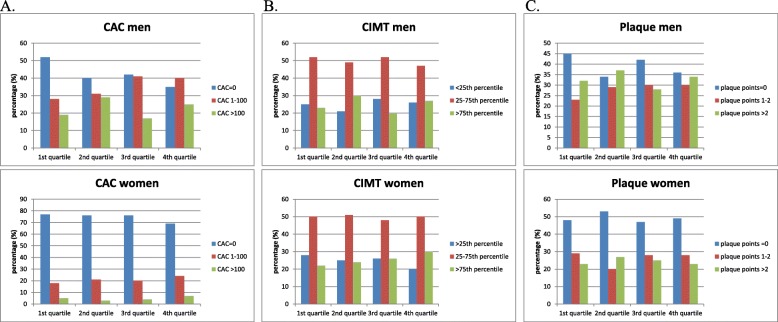
Hyperuricemia is closely associated with cardiovascular disease (CVD). However, it has not been definitively established whether this association is independent of traditional cardiovascular risk factors (CVRFs) and whether it is gender-dependent. The aim of this study was to investigate in a population-based cohort (age range, 50-64 years) stratified by sex the association between the serum urate (SU) concentration and subclinical atherosclerosis, as reflected in the coronary artery calcification (CAC) score, common carotid intima-media thickness (CIMT), and carotid plaque score.
The study involved participants in the Swedish CArdioPulmonary bioImage Study (SCAPIS) Pilot cohort (N = 1040; 48.8% males). This pilot cohort is part of the large population-based SCAPIS with 30,000 participants in the age range of 50-64 years, aimed at improving risk prediction for CVD. Subjects with a self-reported previous history of CVD (N = 68) or gout (N = 3) were excluded. The CAC score was assessed with the Agatston method using computed tomography. CIMT and carotid plaques were quantified by ultrasound. The associations between the SU quartiles and different levels of CAC, CIMT, and carotid plaques were assessed by multivariable logistic regression.
Age, BMI, education level, smoking, physical activity, hs-CRP, hypertension, and dyslipidemia showed no differences between males and females, while CAC (score > 0) and diabetes were both twice as common in men than in women (58% vs 26% and 8% vs 4%, respectively). Higher SU quartiles were in both sexes associated with BMI, hs-CRP, and the prevalence of hypertension, and in women, they were also associated with the prevalence of dyslipidemia. The three upper quartiles of SU (>308μmol/L) were linked to higher CAC scores in men, when adjusting for CVRFs, but not in women. CIMT and carotid plaques showed no correlation to SU in either sex.
Higher levels of SU are associated with the presence of CAC in men but not in women, whereas SU is not associated with CIMT or carotid plaques in either men or women. This implies that the biological effects of SU differ in men and women or that SU has varying effects on different vascular beds or during the different stages of the atherosclerotic process.
高尿酸血症与心血管疾病(CVD)密切相关。然而,目前尚不确定这种关联是否独立于传统心血管危险因素(CVRFs),以及是否存在性别依赖性。本研究旨在调查一个基于人群的队列(年龄范围 50-64 岁)中,血清尿酸(SU)浓度与亚临床动脉粥样硬化之间的关系,亚临床动脉粥样硬化反映在冠状动脉钙化(CAC)评分、颈总动脉内膜中层厚度(CIMT)和颈动脉斑块评分中。
本研究纳入了瑞典心肺生物影像研究(SCAPIS)试点队列中的参与者(N=1040;48.8%为男性)。该试点队列是具有 30000 名 50-64 岁参与者的大型人群基础 SCAPIS 的一部分,旨在提高 CVD 风险预测。排除了有自我报告的 CVD 既往史(N=68)或痛风(N=3)病史的受试者。CAC 评分采用计算机断层扫描的 Agatston 方法进行评估。CIMT 和颈动脉斑块通过超声进行量化。通过多变量逻辑回归评估 SU 四分位数与不同水平的 CAC、CIMT 和颈动脉斑块之间的关系。
年龄、BMI、教育水平、吸烟、体力活动、hs-CRP、高血压和血脂异常在男性和女性之间没有差异,而 CAC(评分>0)和糖尿病在男性中更为常见,分别为 58%和 26%,8%和 4%。在两性中,SU 四分位数越高,BMI、hs-CRP 和高血压的患病率越高,而在女性中,SU 四分位数越高,血脂异常的患病率也越高。在校正 CVRFs 后,男性的 SU 三分位数(>308μmol/L)与 CAC 评分升高相关,但女性中无相关性。在两性中,SU 与 CIMT 或颈动脉斑块均无相关性。
SU 水平升高与男性 CAC 的存在相关,但与女性无关,而 SU 与男性或女性的 CIMT 或颈动脉斑块均无相关性。这意味着 SU 的生物学效应在男性和女性中不同,或者 SU 对不同的血管床或动脉粥样硬化过程的不同阶段有不同的影响。