Department of NanoBiophotonics, Max Planck Institute for Biophysical Chemistry, 37077 Göttingen, Germany; email:
Clinic of Neurology, University Medical Center Göttingen, 37075 Göttingen, Germany.
Annu Rev Biophys. 2020 May 6;49:289-308. doi: 10.1146/annurev-biophys-121219-081550. Epub 2020 Feb 24.
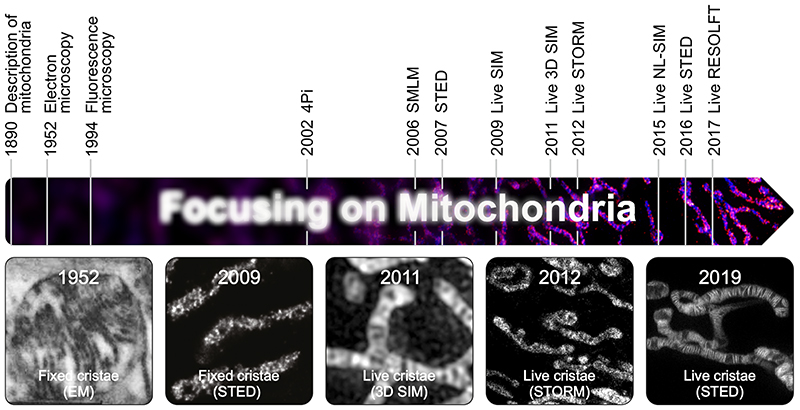
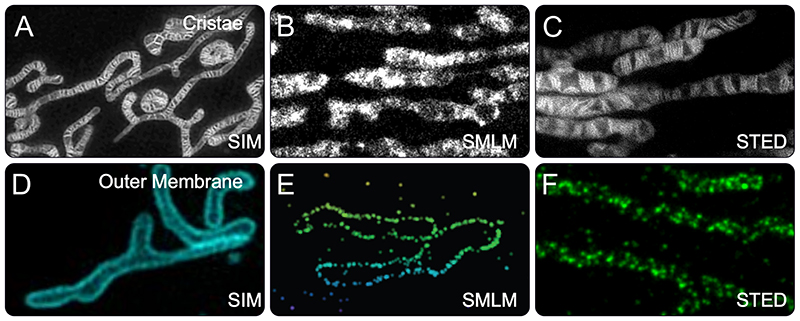
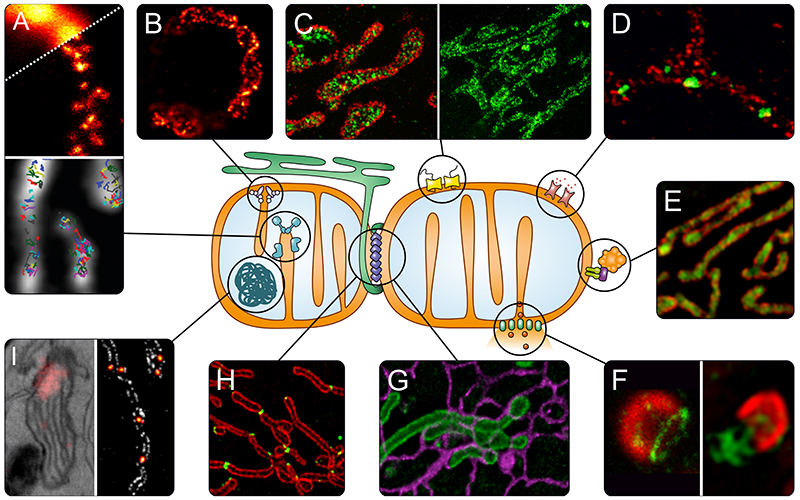
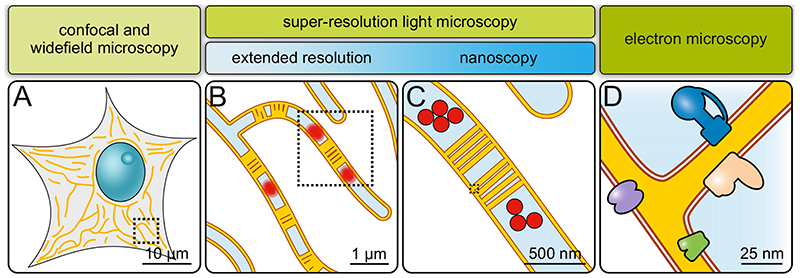
Mitochondria are essential for eukaryotic life. These double-membrane organelles often form highly dynamic tubular networks interacting with many cellular structures. Their highly convoluted contiguous inner membrane compartmentalizes the organelle, which is crucial for mitochondrial function. Since the diameter of the mitochondrial tubules is generally close to the diffraction limit of light microscopy, it is often challenging, if not impossible, to visualize submitochondrial structures or protein distributions using conventional light microscopy. This renders super-resolution microscopy particularly valuable, and attractive, for studying mitochondria. Super-resolution microscopy encompasses a diverse set of approaches that extend resolution, as well as nanoscopy techniques that can even overcome the diffraction limit. In this review, we provide an overview of recent studies using super-resolution microscopy to investigate mitochondria, discuss the strengths and opportunities of the various methods in addressing specific questions in mitochondrial biology, and highlight potential future developments.
线粒体对于真核生物的生命活动至关重要。这些双层膜细胞器通常形成高度动态的管状网络,与许多细胞结构相互作用。它们高度曲折的连续内膜将细胞器分隔开,这对线粒体的功能至关重要。由于线粒体小管的直径通常接近光显微镜的衍射极限,如果不是不可能的话,使用传统的光显微镜可视化亚线粒体结构或蛋白质分布通常是具有挑战性的。这使得超分辨率显微镜在研究线粒体方面特别有价值和吸引力。超分辨率显微镜包括一系列扩展分辨率的方法,以及可以克服衍射极限的纳米显微镜技术。在这篇综述中,我们提供了使用超分辨率显微镜研究线粒体的最新研究概述,讨论了各种方法在解决线粒体生物学特定问题方面的优势和机会,并强调了潜在的未来发展。