Nyalwidhe Julius O, Jurczyk Agata, Satish Basanthi, Redick Sambra, Qaisar Natasha, Trombly Melanie I, Vangala Pranitha, Racicot Riccardo, Bortell Rita, Harlan David M, Greiner Dale L, Brehm Michael A, Nadler Jerry L, Wang Jennifer P
Department of Microbiology and Molecular Cell Biology and Leroy T. Canoles Jr. Cancer Research Center, Eastern Virginia Medical School, Norfolk, VA 23501, USA.
Program in Molecular Medicine, University of Massachusetts Medical School, Worcester, MA 01655, USA.
Microorganisms. 2020 Feb 20;8(2):295. doi: 10.3390/microorganisms8020295.
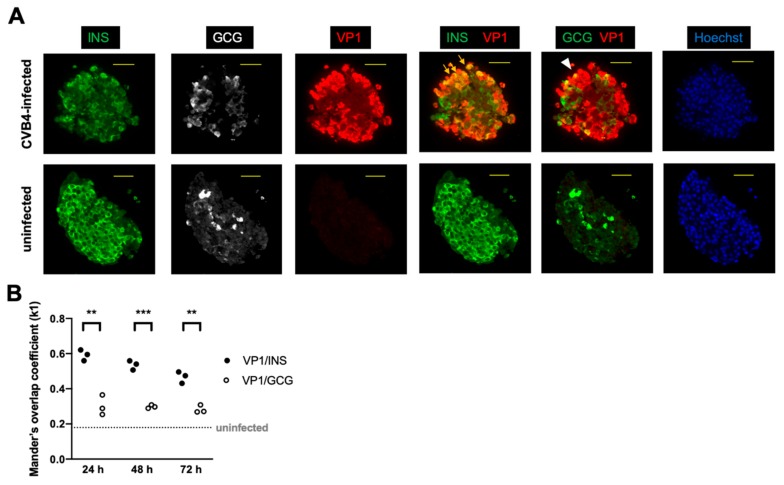
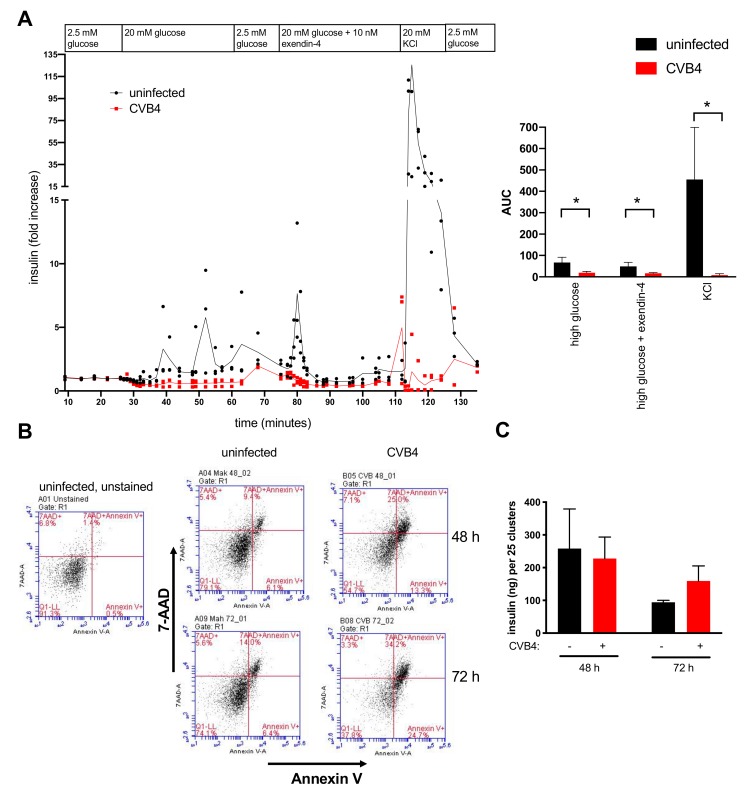
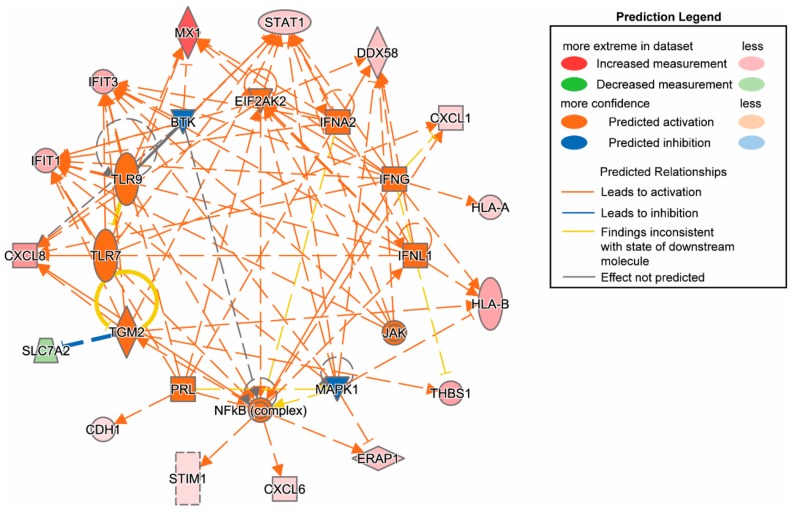
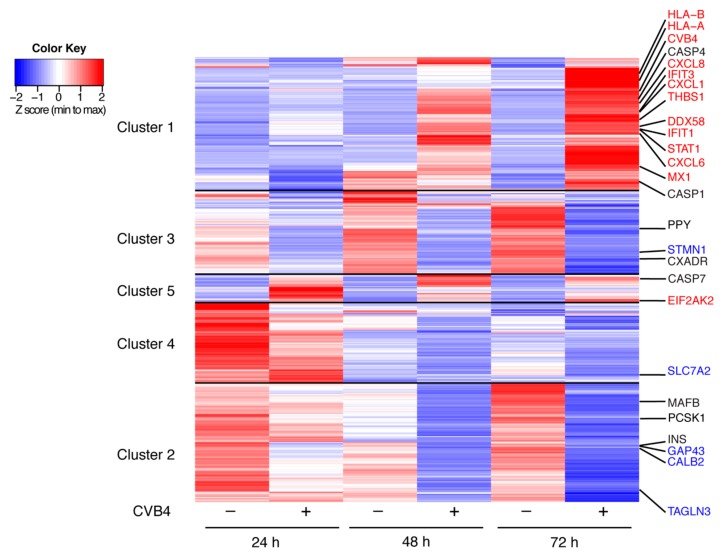
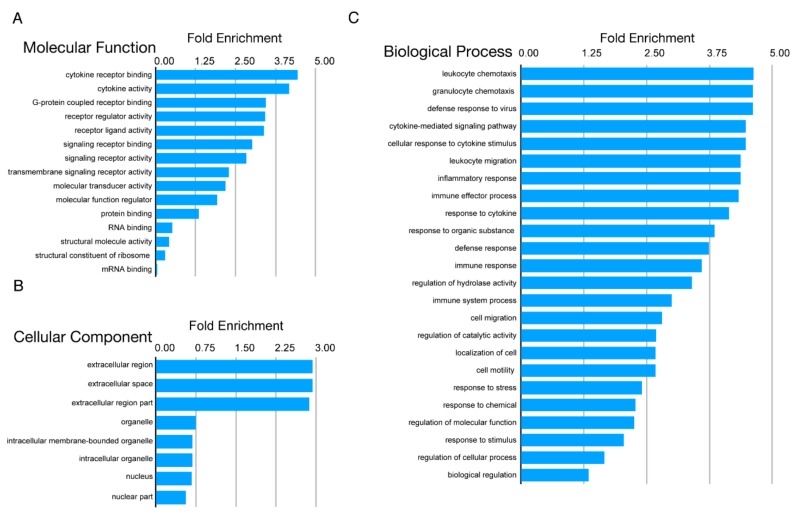
Enteroviral infections are implicated in islet autoimmunity and type 1 diabetes (T1D) pathogenesis. Significant β-cell stress and damage occur with viral infection, leading to cells that are dysfunctional and vulnerable to destruction. Human stem cell-derived β (SC-β) cells are insulin-producing cell clusters that closely resemble native β cells. To better understand the events precipitated by enteroviral infection of β cells, we investigated transcriptional and proteomic changes in SC-β cells challenged with coxsackie B virus (CVB). We confirmed infection by demonstrating that viral protein colocalized with insulin-positive SC-β cells by immunostaining. Transcriptome analysis showed a decrease in insulin gene expression following infection, and combined transcriptional and proteomic analysis revealed activation of innate immune pathways, including type I interferon (IFN), IFN-stimulated genes, nuclear factor-kappa B (NF-κB) and downstream inflammatory cytokines, and major histocompatibility complex (MHC) class I. Finally, insulin release by CVB4-infected SC-β cells was impaired. These transcriptional, proteomic, and functional findings are in agreement with responses in primary human islets infected with CVB ex vivo. Human SC-β cells may serve as a surrogate for primary human islets in virus-induced diabetes models. Because human SC-β cells are more genetically tractable and accessible than primary islets, they may provide a preferred platform for investigating T1D pathogenesis and developing new treatments.
肠道病毒感染与胰岛自身免疫及1型糖尿病(T1D)发病机制有关。病毒感染会导致显著的β细胞应激和损伤,从而使细胞功能失调并易于被破坏。人干细胞衍生的β(SC-β)细胞是产生胰岛素的细胞簇,与天然β细胞非常相似。为了更好地了解肠道病毒感染β细胞引发的事件,我们研究了受到柯萨奇B病毒(CVB)攻击的SC-β细胞的转录和蛋白质组学变化。我们通过免疫染色证明病毒蛋白与胰岛素阳性的SC-β细胞共定位,从而确认了感染。转录组分析显示感染后胰岛素基因表达下降,转录组和蛋白质组联合分析揭示了先天免疫途径的激活,包括I型干扰素(IFN)、IFN刺激基因、核因子-κB(NF-κB)及下游炎性细胞因子以及主要组织相容性复合体(MHC)I类。最后,CVB4感染的SC-β细胞的胰岛素释放受损。这些转录、蛋白质组学和功能方面的发现与体外感染CVB的原代人胰岛的反应一致。在病毒诱导糖尿病模型中,人SC-β细胞可作为原代人胰岛的替代物。由于人SC-β细胞比原代胰岛在遗传上更易于操作且更易获取,它们可能为研究T1D发病机制和开发新疗法提供一个更优的平台。