Graduate Institute of Biomedical Electronics and Bioinformatics, National Taiwan University, Taipei, 10617, Taiwan.
Taiwan AI Labs, Taipei, 10351, Taiwan.
BMC Bioinformatics. 2020 Feb 24;21(1):68. doi: 10.1186/s12859-020-3368-2.
Genome-wide association studies (GWAS) provide a powerful means to identify associations between genetic variants and phenotypes. However, GWAS techniques for detecting epistasis, the interactions between genetic variants associated with phenotypes, are still limited. We believe that developing an efficient and effective GWAS method to detect epistasis will be a key for discovering sophisticated pathogenesis, which is especially important for complex diseases such as Alzheimer's disease (AD).
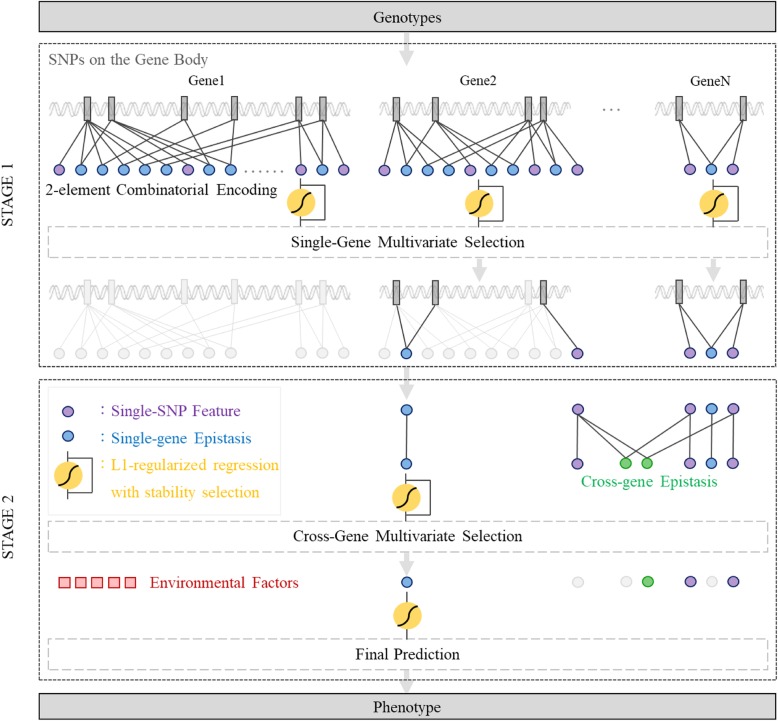
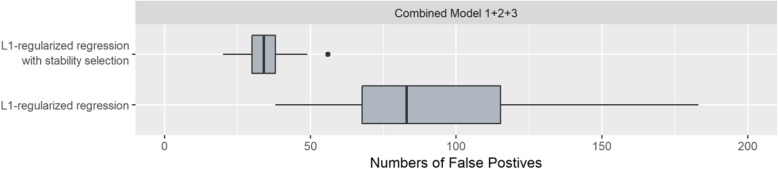
In this regard, this study presents GenEpi, a computational package to uncover epistasis associated with phenotypes by the proposed machine learning approach. GenEpi identifies both within-gene and cross-gene epistasis through a two-stage modeling workflow. In both stages, GenEpi adopts two-element combinatorial encoding when producing features and constructs the prediction models by L1-regularized regression with stability selection. The simulated data showed that GenEpi outperforms other widely-used methods on detecting the ground-truth epistasis. As real data is concerned, this study uses AD as an example to reveal the capability of GenEpi in finding disease-related variants and variant interactions that show both biological meanings and predictive power.
The results on simulation data and AD demonstrated that GenEpi has the ability to detect the epistasis associated with phenotypes effectively and efficiently. The released package can be generalized to largely facilitate the studies of many complex diseases in the near future.
全基因组关联研究 (GWAS) 提供了一种强大的方法来识别遗传变异与表型之间的关联。然而,用于检测遗传变异与表型之间相互作用的上位性的 GWAS 技术仍然有限。我们相信,开发一种有效和高效的 GWAS 方法来检测上位性将是发现复杂发病机制的关键,这对于阿尔茨海默病 (AD) 等复杂疾病尤为重要。
在这方面,本研究提出了 GenEpi,这是一种通过提出的机器学习方法发现与表型相关的上位性的计算包。GenEpi 通过两阶段建模工作流程识别基因内和基因间的上位性。在两个阶段中,GenEpi 在生成特征时采用二元组合编码,并通过具有稳定性选择的 L1-正则化回归构建预测模型。模拟数据表明,GenEpi 在检测真实上位性方面优于其他广泛使用的方法。就实际数据而言,本研究以 AD 为例,揭示了 GenEpi 发现与疾病相关的变异和具有生物学意义和预测能力的变异相互作用的能力。
模拟数据和 AD 的结果表明,GenEpi 具有有效和高效地检测与表型相关的上位性的能力。即将发布的软件包可以广泛推广,以便在不久的将来极大地促进许多复杂疾病的研究。