Tefera Tamirat, Tysnes Kristoffer R, Utaaker Kjersti Selstad, Robertson Lucy J
Laboratory of Parasitology, Department of Food Safety and Infection Biology, Faculty of Veterinary Medicine, Norwegian University of Life Sciences, Adamstuen Campus, P.O. Box 369 center, 0102 Oslo, Norway.
Food Waterborne Parasitol. 2018 Apr 21;10:23-38. doi: 10.1016/j.fawpar.2018.04.002. eCollection 2018 Mar.
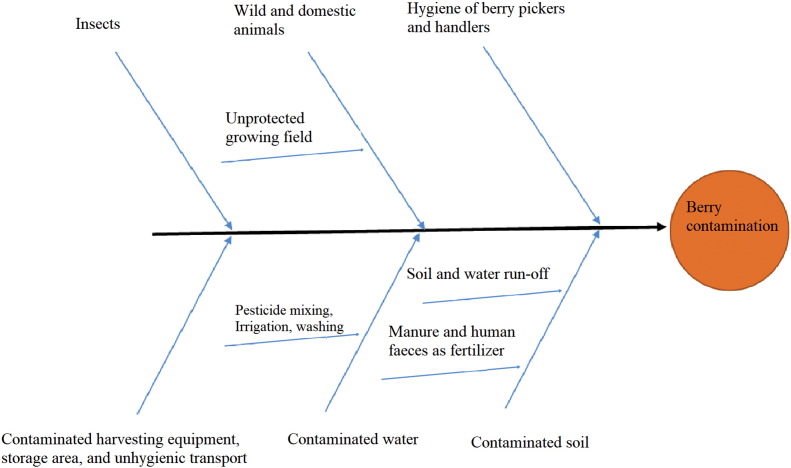
Fresh fruits and vegetables, including berries, are essential components of a healthy diet and are relevant in the prevention of chronic non-communicable diseases such as cancer and heart disease. Associations between diet and health are becoming an increasing focus of consumers, and, in response, consumption of fresh berries has been increasing rapidly in recent decades. However, increased consumption of berries may be associated with an increased risk of acquiring foodborne infections, including parasites. In this review, we describe how parasite contamination of berries may occur at several points on the farm-to-fork pathway, starting from the use of contaminated water for irrigation and pesticide application, and contact with animal and human faeces during cultivation, through contaminated harvesting equipment, and including unhygienic practices of berry pickers in the production field or others handling berries prior to consumption. Parasite transmission stages tend to be robust and therefore likely to survive from contamination in the field, through the various stages of harvesting, packaging, and sale, until consumption. We describe outbreaks of parasitic disease associated with consumption of berries - so far only described for and , both of which are briefly introduced - but also show from survey data summarised in this review that sporadic infections or undetected outbreaks associated with contaminated berries may also occur. In addition, we describe methods for assessing whether berries are contaminated with parasite transmission stages, with emphasis on the challenges associated with analysing this particular matrix. Emphasis on current possibilities for mitigation and control are addressed; avoidance of contamination and implementation of good management practices and a hazard analysis and critical control points (HACCP) approach are essential.
新鲜水果和蔬菜,包括浆果,是健康饮食的重要组成部分,对于预防癌症和心脏病等慢性非传染性疾病具有重要意义。饮食与健康之间的关联日益受到消费者关注,因此,近几十年来新鲜浆果的消费量迅速增长。然而,浆果消费量的增加可能与食源性感染风险的增加有关,包括寄生虫感染。在本综述中,我们描述了浆果在从农场到餐桌的过程中可能在多个环节受到寄生虫污染,从使用受污染的水进行灌溉和喷洒农药,到种植过程中与动物和人类粪便接触,再到通过受污染的收获设备,以及包括生产现场浆果采摘者或其他在食用前处理浆果的人不卫生的操作。寄生虫传播阶段往往具有较强的抵抗力,因此很可能在田间受到污染后,在收获、包装和销售的各个阶段存活下来,直至被食用。我们描述了与食用浆果相关的寄生虫病暴发——目前仅针对[两种寄生虫名称未给出]进行了描述,对这两种寄生虫都进行了简要介绍——但通过本综述总结的调查数据也表明,与受污染浆果相关的散发性感染或未被发现的暴发也可能发生。此外,我们描述了评估浆果是否被寄生虫传播阶段污染的方法,重点介绍了分析这种特殊基质所面临的挑战。强调了当前减轻和控制污染的可能性;避免污染以及实施良好管理规范和危害分析与关键控制点(HACCP)方法至关重要。