Nagachinta Surasa, Bouzo Belen Lopez, Vazquez-Rios Abi Judit, Lopez Rafael, Fuente Maria de la
Nano-Oncology Unit, Health Research Institute of Santiago de Compostela (IDIS), SERGAS, 15706 Santiago de Compostela, Spain.
Translational Medical Oncology group (ONCOMET), Health Research Institute of Santiago de Compostela (IDIS), SERGAS, 15706 Santiago de Compostela, Spain.
Pharmaceutics. 2020 Feb 22;12(2):189. doi: 10.3390/pharmaceutics12020189.
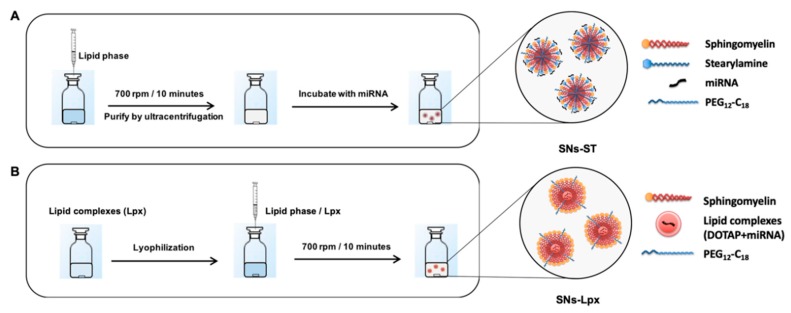
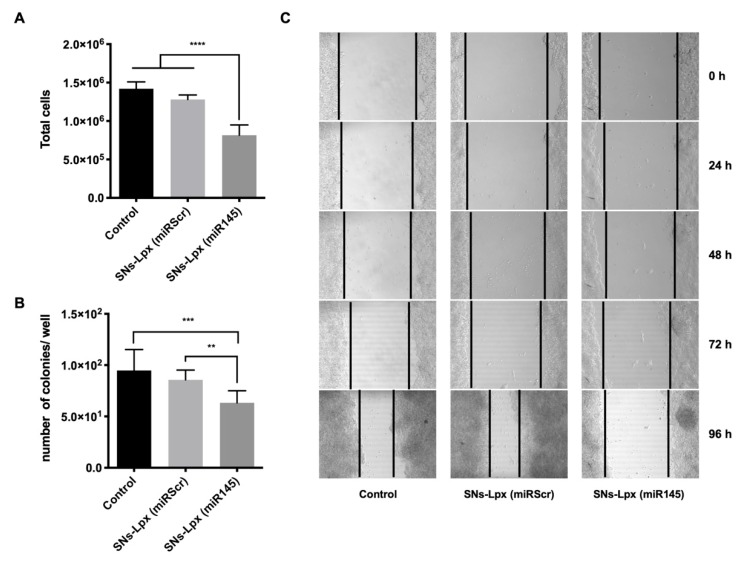
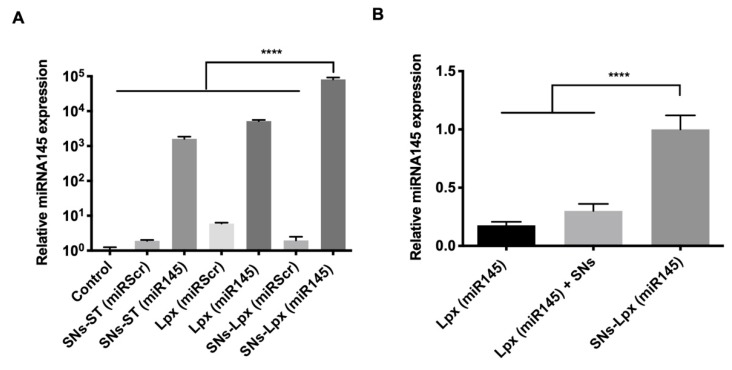
Gene replacement therapy with oncosuppressor microRNAs (miRNAs) is a promising alternative to interfere with cancer progression. However, miRNAs are highly inefficient in a biological environment, hampering a successful translation to clinics. Nanotechnology can tackle this drawback by providing delivery systems able to efficiently deliver them to cancer cells. Thus, the objective of this work was to develop biocompatible nanosystems based on sphingomyelin (SM) for the intracellular delivery of miRNAs to colorectal cancer cells. We pursued two different approaches to select the most appropriate composition for miRNA delivery. On the one hand, we prepared sphingomyelin-based nanosystems (SNs) that incorporate the cationic lipid stearylamine (ST) to support the association of miRNA by the establishment of electrostatic interactions (SNs-ST). On the other hand, the cationic surfactant (DOTAP) was used to preform lipidic complexes with miRNA (Lpx), which were further encapsulated into SNs (SNs-Lpx). Restitution of miRNA145 levels after transfection with SNs-Lpx was related to the strongest anticancer effect in terms of tumor proliferation, colony forming, and migration capacity assays. Altogether, our results suggest that SNs have the potential for miRNA delivery to develop innovative anticancer therapies.
用肿瘤抑制性微小RNA(miRNA)进行基因替代疗法是一种很有前景的干扰癌症进展的替代方法。然而,miRNA在生物环境中的效率非常低,阻碍了其成功转化到临床应用。纳米技术可以通过提供能够将它们有效递送至癌细胞的递送系统来解决这一缺点。因此,本研究的目的是开发基于鞘磷脂(SM)的生物相容性纳米系统,用于将miRNA细胞内递送至结肠癌细胞。我们采用了两种不同的方法来选择最适合miRNA递送的组合物。一方面,我们制备了基于鞘磷脂的纳米系统(SNs),其包含阳离子脂质硬脂胺(ST),以通过建立静电相互作用来支持miRNA的结合(SNs-ST)。另一方面,阳离子表面活性剂(DOTAP)用于与miRNA预先形成脂质复合物(Lpx),然后将其进一步包封到SNs中(SNs-Lpx)。在用SNs-Lpx转染后miR-145水平的恢复与在肿瘤增殖、集落形成和迁移能力测定方面最强的抗癌作用相关。总之,我们的结果表明SNs有潜力用于miRNA递送以开发创新的抗癌疗法。