Department of Ophthalmology, Konyang University College of Medicine, Daejeon, Republic of Korea.
Department of Ophthalmology, Chungnam National University College of Medicine, Daejeon, Republic of Korea.
PLoS One. 2020 Feb 26;15(2):e0229134. doi: 10.1371/journal.pone.0229134. eCollection 2020.
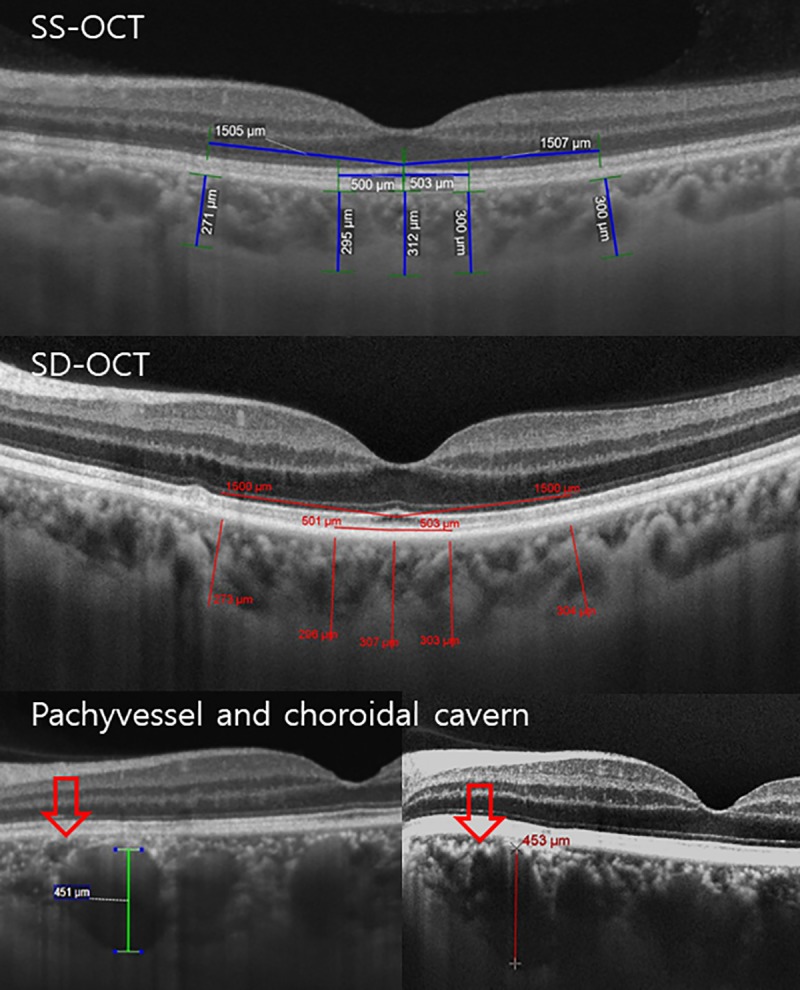
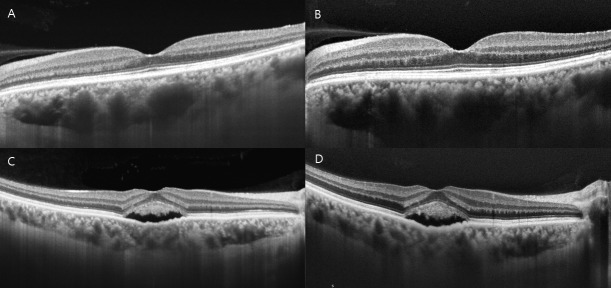
To determine the comparability of choroidal thickness (ChT) measurements using swept source (SS) and spectral domain (SD) optical coherence tomography (OCT) devices in patients with pachychoroid diseases.
Patients with pachychoroid diseases were recruited. OCT scans were performed sequentially with a Cirrus HD OCT 5000 and Plex Elite 9000. Images were analyzed by two independent observers. Each image was independently measured twice by each observer to determine the intraobserver repeatability.
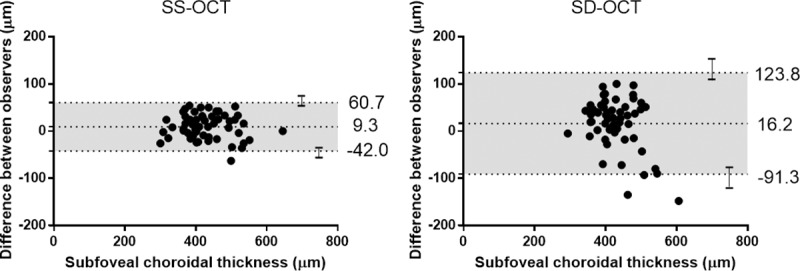
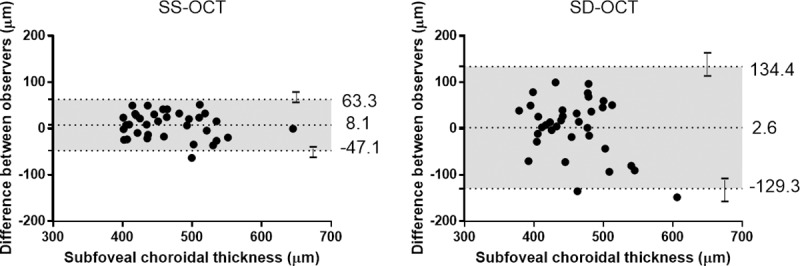
A total of 55 eyes were included. The average ChT of the subfoveal area using SS-OCT and SD-OCT was 430.5 ± 68.1 and 428.5 ± 57.9 μm, respectively, which did not show a significant result as the main effect in the repeated-measure analysis of variance (P = 0.067). Using SS-OCT, the intraobserver intraclass correlation coefficient (ICC) of both observers was > 0.950 at every measured point, and the interobserver coefficient of repeatability (CR) of the subfoveal area was 45.1 μm (95% confidence interval (CI), 40.8-49.4). Using SD-OCT, the intraobserver ICC of both observers was > 0.800, and the interobserver CR of the subfoveal area was 71.2 μm (95% CI, 64.4-78.0). Additionally, the intraobserver and interobserver CRs showed significantly better repeatability in SS-OCT than SD-OCT in F-test. In patients with ChT ≥ 400 μm, the interobserver CRs of SS-OCT and SD-OCT were 48.4 (95% CI, 42.6-54.2) and 95.2 μm (95% CI, 83.9-106.6), respectively. In patients with a subfoveal active lesion, the interobserver CRs were 44.5 (95% CI, 37.6-51.4) and 100.1 μm (95% CI, 84.6-115.5), respectively.
Although the ChT measurements were comparable between SS-OCT and SD-OCT devices in pachychoroid diseases, SD-OCT showed low reliability in patients with ChT ≥ 400 μm and subfoveal active lesions. SS-OCT would be therefore more suitable for observation and follow-up of choroidal structures in pachychoroid diseases.
确定在患有肥厚脉络膜疾病的患者中,使用扫频源(SS)和谱域(SD)光学相干断层扫描(OCT)设备测量脉络膜厚度(ChT)的可比性。
招募患有肥厚脉络膜疾病的患者。使用 Cirrus HD OCT 5000 和 Plex Elite 9000 连续进行 OCT 扫描。由两位独立观察者对图像进行分析。每位观察者独立对每张图像进行两次测量,以确定观察者内的重复性。
共纳入 55 只眼。SS-OCT 和 SD-OCT 测量的中心凹下区域平均 ChT 分别为 430.5±68.1μm 和 428.5±57.9μm,重复测量方差分析的主要效应无显著差异(P=0.067)。使用 SS-OCT,两位观察者的每个测量点的观察者内组内相关系数(ICC)均>0.950,中心凹下区域的观察者间重复性可重复性系数(CR)为 45.1μm(95%置信区间(CI),40.8-49.4)。使用 SD-OCT,两位观察者的观察者内 ICC 均>0.800,中心凹下区域的观察者间 CR 为 71.2μm(95%CI,64.4-78.0)。此外,F 检验显示,在 SS-OCT 中,观察者内和观察者间的 CR 比 SD-OCT 具有更好的重复性。在 ChT≥400μm 的患者中,SS-OCT 和 SD-OCT 的观察者间 CR 分别为 48.4μm(95%CI,42.6-54.2)和 95.2μm(95%CI,83.9-106.6)。在中心凹下有活动性病变的患者中,观察者间 CR 分别为 44.5μm(95%CI,37.6-51.4)和 100.1μm(95%CI,84.6-115.5)。
尽管在肥厚脉络膜疾病中 SS-OCT 和 SD-OCT 设备的 ChT 测量值具有可比性,但在 ChT≥400μm 和中心凹下有活动性病变的患者中,SD-OCT 的可靠性较低。因此,SS-OCT 更适合于肥厚脉络膜疾病脉络膜结构的观察和随访。