Morawin Barbara, Kasperska Anna, Zembron-Lacny Agnieszka
Department of Applied and Clinical Physiology, Faculty of Medicine and Health Sciences, University of Zielona Góra, Poland.
Department of Physiology, Faculty of Physical Education, Gorzów Wlkp.
Am J Mens Health. 2020 Jan-Feb;14(1):1557988319900829. doi: 10.1177/1557988319900829.
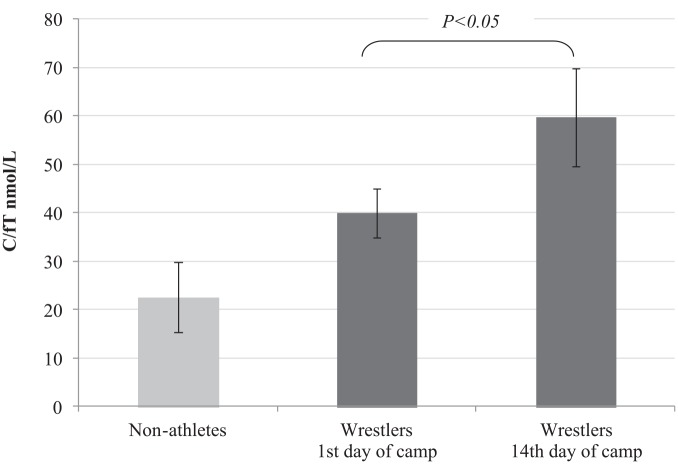
The study was designed to investigate whether sports-induced elevation of testosterone level impacts on the growth hormone/insulin-like growth factor-I (GH-IGF-I) axis and body composition, especially skeletal muscle mass. The study included 12 male wrestlers aged 21.1 ± 1.7 years and 10 male nonathletes aged 21.1 ± 1.2 years. Anthropometric and biochemical measurements in the group of nonathlete men were carried out once, while for wrestlers they were carried out twice, that is, on the 1st and 14th days of the training camp. The levels of resting free testosterone (fT), cortisol (C), and human growth hormone (hGH) were significantly higher in the athletes than in nonathletes. A 2-week sports training induced a significant reduction in fT, IGF-I, and IGF binding protein-3 (IGFBP-3) levels and a rise in C level. Increased C level and reduced fT level in the athletes' blood caused a rise in C/fT from the level of 39.95 ± 4.97 nmol/L to 59.73 ± 10.09 nmol/L ( < .05). A negative correlation was demonstrated between C/fT ratio and IGF-I level ( = -0.474, < .05), which may indicate an inhibitory impact of high C level and low fT concentration on IGF-I release in response to sports training. Sports activity induces significant changes in the C/fT ratio that can impact on the secretion of GH and IGF-I from the liver and finally on the fat-free body mass. The quantification of GH-IGF-I axis in relation to testosterone level could be a useful diagnostic tool in biochemical assessment of the regenerative ability of skeletal muscle or provide evidence of the early stages of muscle functional overload.
本研究旨在调查运动引起的睾酮水平升高是否会影响生长激素/胰岛素样生长因子-I(GH-IGF-I)轴和身体成分,尤其是骨骼肌质量。该研究纳入了12名年龄在21.1±1.7岁的男性摔跤运动员和10名年龄在21.1±1.2岁的男性非运动员。非运动员组的人体测量和生化指标仅测量一次,而摔跤运动员组则测量两次,即在训练营的第1天和第14天。运动员的静息游离睾酮(fT)、皮质醇(C)和人生长激素(hGH)水平显著高于非运动员。为期2周的运动训练导致fT、IGF-I和IGF结合蛋白-3(IGFBP-3)水平显著降低,C水平升高。运动员血液中C水平升高和fT水平降低导致C/fT从39.95±4.97 nmol/L升至59.73±10.09 nmol/L(P<0.05)。C/fT比值与IGF-I水平呈负相关(r = -0.474,P<0.05),这可能表明高C水平和低fT浓度对运动训练后IGF-I释放具有抑制作用。体育活动会引起C/fT比值的显著变化,这可能会影响肝脏中GH和IGF-I的分泌,最终影响去脂体重。与睾酮水平相关的GH-IGF-I轴定量分析可能是生化评估骨骼肌再生能力的有用诊断工具,或为肌肉功能超负荷早期阶段提供证据。