Department of Preventive Medicine, School of Medicine, Kyungpook National University, Daegu, Korea.
Department of Biomedical Science, Kyungpook National University Graduate School, Daegu, Korea.
J Korean Med Sci. 2020 Mar 2;35(8):e50. doi: 10.3346/jkms.2020.35.e50.
Lack of sunlight exposure is the primary reason for the worldwide epidemic of vitamin D deficiency. Although recommended sunlight exposure guidelines exist, there is no evidence regarding whether current guidelines are optimal for increasing vitamin D levels among individuals with vitamin D deficiency.
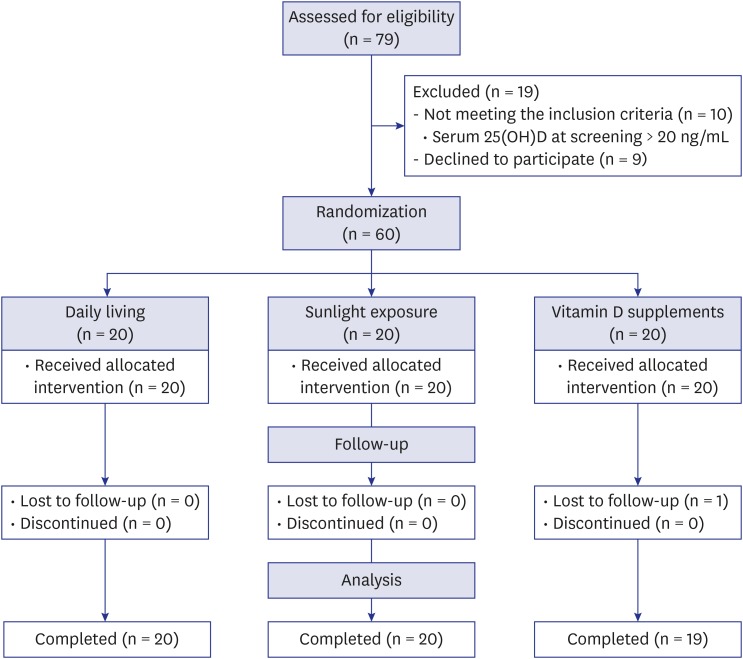
Sixty Korean adults aged 20-49 years with serum 25-hydroxyvitamin D (25[OH]D) levels of < 20 ng/mL were randomly assigned to three groups: sunlight exposure (n = 20), vitamin D supplementation groups (n = 20), and daily living (n = 20) for 1 month. The sunlight exposure group had sunlight exposure on 20% to 30% of their body surface areas for 30-60 minutes per day, 3 times a week during the summer season. Vitamin D supplementation was prescribed with 800 IU/day of vitamin D. The serum levels of 25(OH)D were measured at baseline and at 1-month follow-up examinations.
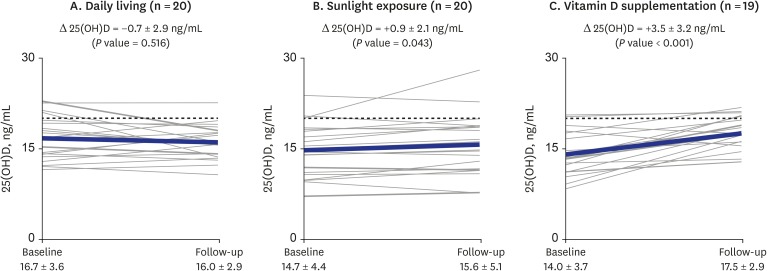
The largest change in serum 25(OH)D was observed among the vitamin D supplementation group (+3.5 ng/mL, < 0.001). The sunlight exposure group showed a slight increase in serum 25(OH)D level, but the absolute increase was less than one-third that of the vitamin D supplementation group (+0.9 ng/mL, = 0.043). Only two participants in the sunlight exposure reached serum concentrations of 25(OH)D ≥ 20 ng/mL at follow-up. The daily living group showed no difference in vitamin D levels (-0.7 ng/mL, = 0.516).
Sunlight exposure was not sufficient to overcome vitamin D insufficiency or deficiency in the current study subjects. Effectiveness of current sunlight exposure guidelines among various populations should be reassessed in larger clinical studies.
Clinical Research Information Service Identifier: KCT0002671.
缺乏阳光照射是导致全球维生素 D 缺乏症流行的主要原因。尽管存在推荐的阳光照射指南,但尚无证据表明目前的指南是否有利于增加维生素 D 缺乏个体的维生素 D 水平。
将 60 名年龄在 20-49 岁之间、血清 25-羟维生素 D(25[OH]D)水平<20ng/ml 的韩国成年人随机分为三组:阳光照射组(n=20)、维生素 D 补充组(n=20)和日常生活组(n=20),持续 1 个月。阳光照射组在夏季每周 3 次,每次在身体 20%-30%的表面积上暴露于阳光 30-60 分钟。维生素 D 补充剂的处方剂量为 800IU/天。在基线和 1 个月随访检查时测量血清 25(OH)D 水平。
血清 25(OH)D 变化最大的是维生素 D 补充组(+3.5ng/ml,<0.001)。阳光照射组血清 25(OH)D 水平略有升高,但绝对增加量不到维生素 D 补充组的三分之一(+0.9ng/ml,=0.043)。只有两名阳光照射组的参与者在随访时达到血清 25(OH)D 浓度≥20ng/ml。日常生活组的维生素 D 水平没有差异(-0.7ng/ml,=0.516)。
在当前研究对象中,阳光照射不足以克服维生素 D 不足或缺乏。在更大的临床研究中,应重新评估当前阳光照射指南对不同人群的有效性。
临床研究信息服务标识符:KCT0002671。