• 文献检索
  • 文档翻译
  • 深度研究
  • 学术资讯
  • Suppr Zotero 插件Zotero 插件
  • 邀请有礼
  • 套餐&价格
  • 历史记录
应用&插件
Suppr Zotero 插件Zotero 插件浏览器插件Mac 客户端Windows 客户端微信小程序
定价
高级版会员购买积分包购买API积分包
服务
文献检索文档翻译深度研究API 文档MCP 服务
关于我们
关于 Suppr公司介绍联系我们用户协议隐私条款
关注我们

Suppr 超能文献

核心技术专利:CN118964589B侵权必究
粤ICP备2023148730 号-1Suppr @ 2026

文献检索

告别复杂PubMed语法,用中文像聊天一样搜索,搜遍4000万医学文献。AI智能推荐,让科研检索更轻松。

立即免费搜索

文件翻译

保留排版,准确专业,支持PDF/Word/PPT等文件格式,支持 12+语言互译。

免费翻译文档

深度研究

AI帮你快速写综述,25分钟生成高质量综述,智能提取关键信息,辅助科研写作。

立即免费体验

移动应用评级量表的阿拉伯语版本:开发与验证研究。

The Arabic Version of the Mobile App Rating Scale: Development and Validation Study.

机构信息

Department of Health Promotion and Community Health, Faculty of Health Sciences, American University of Beirut, Beirut, Lebanon.

Department of Epidemiology and Population Health, Faculty of Health Sciences, American University of Beirut, Beirut, Lebanon.

出版信息

JMIR Mhealth Uhealth. 2020 Mar 3;8(3):e16956. doi: 10.2196/16956.

DOI:10.2196/16956
PMID:32130183
原文链接:https://pmc.ncbi.nlm.nih.gov/articles/PMC7078658/
Abstract

BACKGROUND

With thousands of health apps in app stores globally, it is crucial to systemically and thoroughly evaluate the quality of these apps due to their potential influence on health decisions and outcomes. The Mobile App Rating Scale (MARS) is the only currently available tool that provides a comprehensive, multidimensional evaluation of app quality, which has been used to compare medical apps from American and European app stores in various areas, available in English, Italian, Spanish, and German. However, this tool is not available in Arabic.

OBJECTIVE

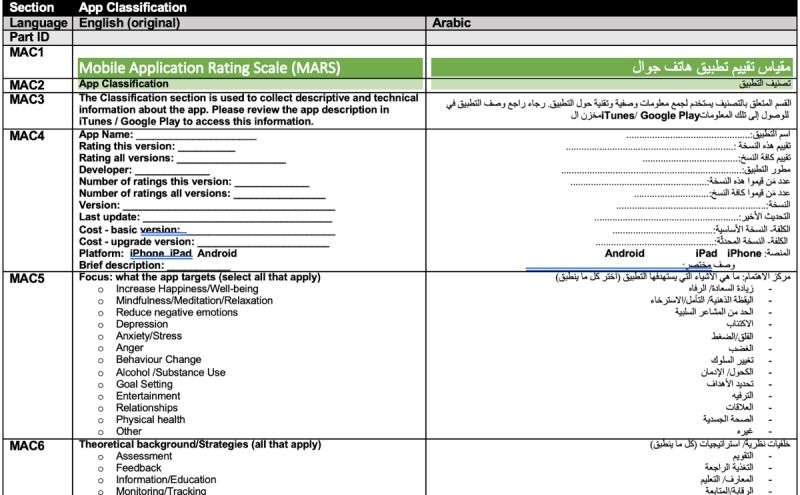
This study aimed to translate and adapt MARS to Arabic and validate the tool with a sample of health apps aimed at managing or preventing obesity and associated disorders.

METHODS

We followed a well-established and defined "universalist" process of cross-cultural adaptation using a mixed methods approach. Early translations of the tool, accompanied by confirmation of the contents by two rounds of separate discussions, were included and culminated in a final version, which was then back-translated into English. Two trained researchers piloted the MARS in Arabic (MARS-Ar) with a sample of 10 weight management apps obtained from Google Play and the App Store. Interrater reliability was established using intraclass correlation coefficients (ICCs). After reliability was ascertained, the two researchers independently evaluated a set of additional 56 apps.

RESULTS

MARS-Ar was highly aligned with the original English version. The ICCs for MARS-Ar (0.836, 95% CI 0.817-0.853) and MARS English (0.838, 95% CI 0.819-0.855) were good. The MARS-Ar subscales were highly correlated with the original counterparts (P<.001). The lowest correlation was observed in the area of usability (r=0.685), followed by aesthetics (r=0.827), information quality (r=0.854), engagement (r=0.894), and total app quality (r=0.897). Subjective quality was also highly correlated (r=0.820).

CONCLUSIONS

MARS-Ar is a valid instrument to assess app quality among trained Arabic-speaking users of health and fitness apps. Researchers and public health professionals in the Arab world can use the overall MARS score and its subscales to reliably evaluate the quality of weight management apps. Further research is necessary to test the MARS-Ar on apps addressing various health issues, such as attention or anxiety prevention, or sexual and reproductive health.

摘要

背景

随着全球应用商店中数千种健康应用程序的出现,由于这些应用程序可能会对健康决策和结果产生影响,因此对其质量进行系统而全面的评估至关重要。移动应用程序评级量表(MARS)是唯一一种可提供应用程序质量全面多维评估的工具,已用于比较来自美国和欧洲应用商店的各种医学应用程序,可提供英语、意大利语、西班牙语和德语版本。然而,该工具在阿拉伯语中不可用。

目的

本研究旨在将 MARS 翻译和改编为阿拉伯语,并使用针对肥胖症和相关疾病管理或预防的健康应用程序样本对该工具进行验证。

方法

我们采用了一种经过充分确立和定义的“普遍主义”跨文化适应过程,采用混合方法。工具的早期翻译,并通过两轮单独讨论进行内容确认,被包括在内,并最终形成了一个最终版本,然后将其反向翻译回英语。两名经过培训的研究人员使用从 Google Play 和 App Store 获得的 10 个体重管理应用程序,对阿拉伯语版的 MARS(MARS-Ar)进行了测试。采用组内相关系数(ICC)确定重测信度。在确定信度后,两名研究人员独立评估了另外 56 个应用程序。

结果

MARS-Ar 与原始英语版本高度一致。MARS-Ar(0.836,95%置信区间 0.817-0.853)和 MARS 英语(0.838,95%置信区间 0.819-0.855)的 ICC 值良好。MARS-Ar 子量表与原始量表高度相关(P<.001)。相关性最低的是可用性领域(r=0.685),其次是美学(r=0.827)、信息质量(r=0.854)、参与度(r=0.894)和整体应用程序质量(r=0.897)。主观质量也高度相关(r=0.820)。

结论

MARS-Ar 是评估阿拉伯语健康和健身应用程序用户应用程序质量的有效工具。阿拉伯世界的研究人员和公共卫生专业人员可以使用整体 MARS 评分及其子量表来可靠地评估体重管理应用程序的质量。需要进一步研究来测试 MARS-Ar 在针对注意力或焦虑预防或性和生殖健康等各种健康问题的应用程序上的应用。
https://cdn.ncbi.nlm.nih.gov/pmc/blobs/e48c/7078658/2fd696d6af10/mhealth_v8i3e16956_fig4.jpg
https://cdn.ncbi.nlm.nih.gov/pmc/blobs/e48c/7078658/930bc069c8e2/mhealth_v8i3e16956_fig1.jpg
https://cdn.ncbi.nlm.nih.gov/pmc/blobs/e48c/7078658/c7c12fb40b29/mhealth_v8i3e16956_fig2.jpg
https://cdn.ncbi.nlm.nih.gov/pmc/blobs/e48c/7078658/e0a082df53a9/mhealth_v8i3e16956_fig3.jpg
https://cdn.ncbi.nlm.nih.gov/pmc/blobs/e48c/7078658/2fd696d6af10/mhealth_v8i3e16956_fig4.jpg
https://cdn.ncbi.nlm.nih.gov/pmc/blobs/e48c/7078658/930bc069c8e2/mhealth_v8i3e16956_fig1.jpg
https://cdn.ncbi.nlm.nih.gov/pmc/blobs/e48c/7078658/c7c12fb40b29/mhealth_v8i3e16956_fig2.jpg
https://cdn.ncbi.nlm.nih.gov/pmc/blobs/e48c/7078658/e0a082df53a9/mhealth_v8i3e16956_fig3.jpg
https://cdn.ncbi.nlm.nih.gov/pmc/blobs/e48c/7078658/2fd696d6af10/mhealth_v8i3e16956_fig4.jpg

相似文献

1
The Arabic Version of the Mobile App Rating Scale: Development and Validation Study.移动应用评级量表的阿拉伯语版本:开发与验证研究。
JMIR Mhealth Uhealth. 2020 Mar 3;8(3):e16956. doi: 10.2196/16956.
2
The Persian Version of the Mobile Application Rating Scale (MARS-Fa): Translation and Validation Study.移动应用程序评分量表波斯语版本(MARS-Fa):翻译与验证研究。
JMIR Form Res. 2022 Dec 5;6(12):e42225. doi: 10.2196/42225.
3
Development and validation of the Italian version of the Mobile Application Rating Scale and its generalisability to apps targeting primary prevention.意大利语版移动应用程序评分量表的开发与验证及其对初级预防应用程序的通用性
BMC Med Inform Decis Mak. 2016 Jul 7;16:83. doi: 10.1186/s12911-016-0323-2.
4
Promoting Health via mHealth Applications Using a French Version of the Mobile App Rating Scale: Adaptation and Validation Study.使用法语版移动应用评分量表通过移动健康应用促进健康:改编与验证研究
JMIR Mhealth Uhealth. 2021 Aug 31;9(8):e30480. doi: 10.2196/30480.
5
Mobile Phone Apps for Food Allergies or Intolerances in App Stores: Systematic Search and Quality Assessment Using the Mobile App Rating Scale (MARS).应用商店中针对食物过敏或不耐受的手机应用程序:使用移动应用评级量表(MARS)进行系统搜索和质量评估。
JMIR Mhealth Uhealth. 2020 Sep 16;8(9):e18339. doi: 10.2196/18339.
6
Japanese Version of the Mobile App Rating Scale (MARS): Development and Validation.日本版移动应用评分量表(MARS)的开发与验证。
JMIR Mhealth Uhealth. 2022 Apr 14;10(4):e33725. doi: 10.2196/33725.
7
Popular Evidence-Based Commercial Mental Health Apps: Analysis of Engagement, Functionality, Aesthetics, and Information Quality.流行的循证商业心理健康应用程序:参与度、功能、美学和信息质量分析。
JMIR Mhealth Uhealth. 2021 Jul 14;9(7):e29689. doi: 10.2196/29689.
8
The German Version of the Mobile App Rating Scale (MARS-G): Development and Validation Study.移动应用评级量表(MARS-G)的德文版:开发与验证研究。
JMIR Mhealth Uhealth. 2020 Mar 27;8(3):e14479. doi: 10.2196/14479.
9
Development and validation of the Turkish version of the Mobile App Rating Scale - MARS-TR.开发并验证了土耳其版的移动应用程序评分量表 - MARS-TR。
Int J Med Inform. 2022 Oct;166:104843. doi: 10.1016/j.ijmedinf.2022.104843. Epub 2022 Aug 10.
10
Mobile Apps for Common Noncommunicable Disease Management: Systematic Search in App Stores and Evaluation Using the Mobile App Rating Scale.移动应用程序用于常见非传染性疾病管理:在应用商店中的系统搜索和使用移动应用程序评级量表进行评估。
JMIR Mhealth Uhealth. 2024 Mar 12;12:e49055. doi: 10.2196/49055.

引用本文的文献

1
A Systematic Assessment of the Quality of Smartphone Applications for Gastroesophageal Reflux Disease.胃食管反流病智能手机应用程序质量的系统评估
Gastro Hep Adv. 2023 Mar 9;2(5):733-742. doi: 10.1016/j.gastha.2023.03.001. eCollection 2023.
2
A Web-Based and Mobile Intervention Program Using a Spaced Education Approach for Workplace Mental Health Literacy: Cluster Randomized Controlled Trial.一项基于网络和移动设备的采用间隔教育方法提高职场心理健康素养的干预项目:整群随机对照试验。
JMIR Ment Health. 2024 Apr 23;11:e51791. doi: 10.2196/51791.
3
Utilization of patient portals: a cross-sectional study investigating associations with mobile app quality.

本文引用的文献

1
The German Version of the Mobile App Rating Scale (MARS-G): Development and Validation Study.移动应用评级量表(MARS-G)的德文版:开发与验证研究。
JMIR Mhealth Uhealth. 2020 Mar 27;8(3):e14479. doi: 10.2196/14479.
2
Spanish adaptation and validation of the Mobile Application Rating Scale questionnaire.西班牙语版移动应用评定量表问卷的适应性和验证。
Int J Med Inform. 2019 Sep;129:95-99. doi: 10.1016/j.ijmedinf.2019.06.005. Epub 2019 Jun 5.
3
Trends in user ratings and reviews of a popular yet inaccurate blood pressure-measuring smartphone app.
患者门户的利用:一项横断面研究,调查与移动应用程序质量的关联。
BMC Med Inform Decis Mak. 2023 Sep 5;23(1):177. doi: 10.1186/s12911-023-02252-x.
4
An Integrated Model for Evaluating the Sustainability of Gamified Mobile Health Apps: An Instrument Development and Validation.一种用于评估游戏化移动健康应用可持续性的综合模型:工具开发与验证
Healthcare (Basel). 2023 Apr 6;11(7):1051. doi: 10.3390/healthcare11071051.
5
Greek validation of the user version of the Mobile Application Rating Scale (uMARS).移动应用程序评分量表用户版(uMARS)的希腊语验证。
J Int Med Res. 2023 Mar;51(3):3000605231161213. doi: 10.1177/03000605231161213.
6
The Persian Version of the Mobile Application Rating Scale (MARS-Fa): Translation and Validation Study.移动应用程序评分量表波斯语版本(MARS-Fa):翻译与验证研究。
JMIR Form Res. 2022 Dec 5;6(12):e42225. doi: 10.2196/42225.
7
Evaluating and rating HIV/AIDS mobile apps using the feature-based application rating method and mobile app rating scale.采用基于功能的应用程序评级方法和移动应用程序评级量表评估和评级 HIV/AIDS 移动应用程序。
BMC Med Inform Decis Mak. 2022 Oct 30;22(1):281. doi: 10.1186/s12911-022-02029-8.
8
Turkish Validation of the User Version of the Mobile Application Rating Scale.移动应用评分量表用户版的土耳其语验证
Turk J Urol. 2022 May;48(3):236-242. doi: 10.5152/tud.2022.21324.
9
Japanese Version of the Mobile App Rating Scale (MARS): Development and Validation.日本版移动应用评分量表(MARS)的开发与验证。
JMIR Mhealth Uhealth. 2022 Apr 14;10(4):e33725. doi: 10.2196/33725.
10
Spanish adaptation and validation of the User Version of the Mobile Application Rating Scale (uMARS).用户版移动应用评定量表(uMARS)的西班牙语适应性和验证。
J Am Med Inform Assoc. 2021 Nov 25;28(12):2681-2686. doi: 10.1093/jamia/ocab216.
一款广受欢迎但却不准确的血压测量智能手机应用的用户评分和评论趋势。
J Am Med Inform Assoc. 2018 Aug 1;25(8):1074-1079. doi: 10.1093/jamia/ocy060.
4
Does mobile health matter?移动健康重要吗?
Lancet. 2017 Nov 18;390(10109):2216. doi: 10.1016/S0140-6736(17)32899-4.
5
An Overview of Interrater Agreement on Likert Scales for Researchers and Practitioners.面向研究者与从业者的李克特量表评分者间一致性概述。
Front Psychol. 2017 May 12;8:777. doi: 10.3389/fpsyg.2017.00777. eCollection 2017.
6
Noncommunicable Disease Risk Factors and Mobile Phones: A Proposed Research Agenda.非传染性疾病风险因素与手机:一项拟议的研究议程。
J Med Internet Res. 2017 May 5;19(5):e133. doi: 10.2196/jmir.7246.
7
A meta-analysis of overall effects of weight loss interventions delivered via mobile phones and effect size differences according to delivery mode, personal contact, and intervention intensity and duration.一项关于通过手机进行减肥干预的总体效果以及根据传递方式、人际接触、干预强度和持续时间的效应量差异的荟萃分析。
Obes Rev. 2017 Apr;18(4):450-459. doi: 10.1111/obr.12492. Epub 2017 Feb 10.
8
Quality of Mobile Phone and Tablet Mobile Apps for Speech Sound Disorders: Protocol for an Evidence-Based Appraisal.用于语音障碍的手机和平板移动应用程序的质量:基于证据的评估方案。
JMIR Res Protoc. 2016 Nov 29;5(4):e233. doi: 10.2196/resprot.6505.
9
Mobile applications for obesity and weight management: current market characteristics.用于肥胖症和体重管理的移动应用程序:当前市场特征
Int J Obes (Lond). 2017 Jan;41(1):200-202. doi: 10.1038/ijo.2016.186. Epub 2016 Oct 26.
10
Challenges in Assessing Mobile Health App Quality: A Systematic Review of Prevalent and Innovative Methods.评估移动健康应用程序质量的挑战:对流行和创新方法的系统评价。
Am J Prev Med. 2016 Dec;51(6):1051-1059. doi: 10.1016/j.amepre.2016.07.009. Epub 2016 Sep 19.