Department of Genetics, Case Western Reserve University, Cleveland, OH.
Mass Spectrometry Laboratory for Protein Sequencing, The Lerner Research Institute, Cleveland, OH.
Mol Cell Proteomics. 2020 May;19(5):852-870. doi: 10.1074/mcp.RA119.001910. Epub 2020 Mar 4.
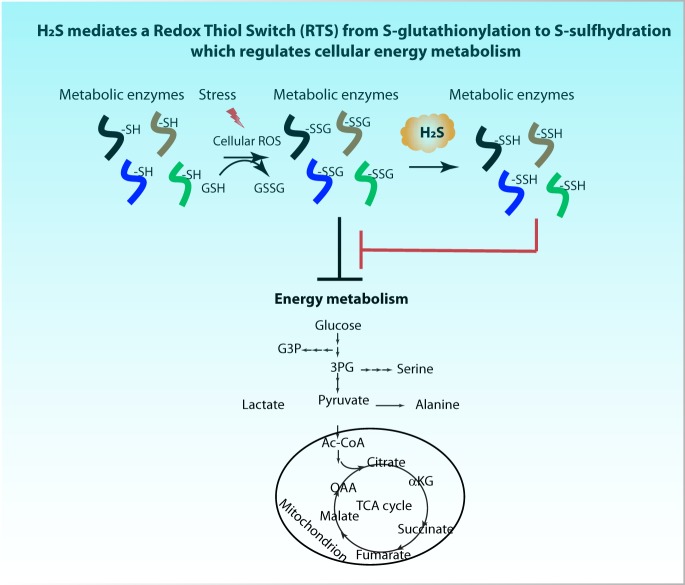
The redox-based modifications of cysteine residues in proteins regulate their function in many biological processes. The gas molecule HS has been shown to persulfidate redox sensitive cysteine residues resulting in an HS-modified proteome known as the sulfhydrome. Tandem Mass Tags (TMT) multiplexing strategies for large-scale proteomic analyses have become increasingly prevalent in detecting cysteine modifications. Here we developed a TMT-based proteomics approach for selectively trapping and tagging cysteine persulfides in the cellular proteomes. We revealed the natural protein sulfhydrome of two human cell lines, and identified insulin as a novel substrate in pancreatic beta cells. Moreover, we showed that under oxidative stress conditions, increased HS can target enzymes involved in energy metabolism by switching specific cysteine modifications to persulfides. Specifically, we discovered a Redox Thiol Switch, from protein S-glutathioinylation to S-persulfidation (RTS). We propose that the RTS from S-glutathioinylation to S-persulfidation is a potential mechanism to fine tune cellular energy metabolism in response to different levels of oxidative stress.
基于氧化还原的半胱氨酸残基修饰调节蛋白质在许多生物过程中的功能。已经表明,气体分子 HS 可以使氧化还原敏感的半胱氨酸残基发生过硫化,从而产生一种称为硫氢基的 HS 修饰的蛋白质组。用于大规模蛋白质组学分析的串联质量标签(TMT)多重化策略在检测半胱氨酸修饰方面变得越来越流行。在这里,我们开发了一种基于 TMT 的蛋白质组学方法,用于选择性地捕获和标记细胞蛋白质组中的半胱氨酸过硫化物。我们揭示了两种人类细胞系的天然蛋白质硫氢基,并在胰腺β细胞中鉴定出胰岛素作为一种新的底物。此外,我们表明,在氧化应激条件下,增加的 HS 可以通过将特定的半胱氨酸修饰转化为过硫化物来靶向参与能量代谢的酶。具体来说,我们发现了一种氧化还原硫醇开关,从蛋白质 S-谷胱甘肽化到 S-过硫化(RTS)。我们提出,从 S-谷胱甘肽化到 S-过硫化的 RTS 是一种潜在的机制,可以根据不同水平的氧化应激来微调细胞能量代谢。