Gu Dan, Wang Zhenyu, Tian Yuqi, Kang Xilong, Meng Chuang, Chen Xiang, Pan Zhiming, Jiao Xinan
Jiangsu Co-innovation Center for Prevention and Control of Important Animal Infectious Diseases and Zoonoses, Yangzhou University, Yangzhou, China.
Jiangsu Key Laboratory of Zoonosis, Yangzhou University, Yangzhou, China.
Front Vet Sci. 2020 Feb 21;7:29. doi: 10.3389/fvets.2020.00029. eCollection 2020.
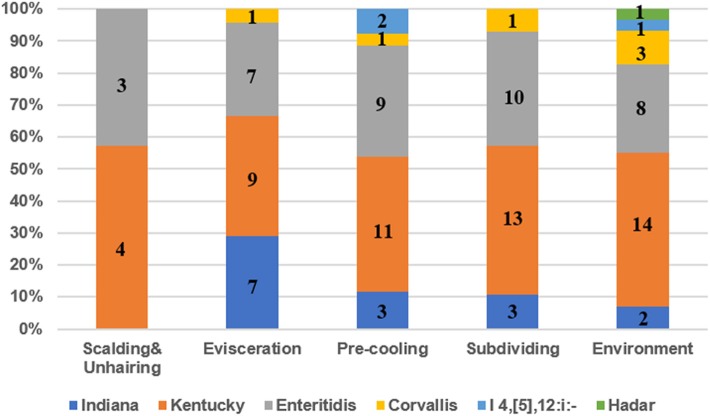
has been known as the most important foodborne pathogen, which can infect humans via consuming contaminated food. Chicken meat has been known as an important vehicle to transmit by the food supply chain. This study determined the prevalence, antimicrobial resistance, and genetic characteristics of at different chicken slaughtering stages in East China. In total, 114 out of 200 (57%) samples were positive, while contamination was gradually increasing from the scalding and unhairing stage (17.5%) to the subdividing stage (70%) throughout the slaughtering. Whole-genome sequencing (WGS) was then performed to analyze the serotype, antimicrobial resistance gene profiles, and genetic relationship of all isolates. The most common serotypes were . Kentucky (51/114, 44.7%) and . Enteritidis (37/114, 32.5%), which were distributed throughout the four slaughtering stages, and were also identified in the corresponding environments. The multilocus sequence typing (MLST) analysis revealed that seven sequence types (STs) were occupied by six different serotypes, respectively. Only . Kentucky had two STs, ST314 was the predominant ST shared by 50 isolates, while the ST198 has 1 isolate. The antimicrobial resistance gene analysis demonstrated that most of the strains belonging to . Kentucky (39/51, 76.5%) and . Indiana (15, 100%) contained over five groups of antimicrobial resistance genes. Based on the core genome analysis, 50 . Kentucky isolates were genetically identical, indicating that one . Kentucky strain with the same genetic background was prevalent in the chicken slaughtering line. Although 37 . Enteritidis isolates only had three different antimicrobial resistance gene profiles, the core genome sequence analysis subtyped these . Enteritidis isolates into five different clusters, which revealed the diverse genetic background of . Enteritidis in the slaughterhouse. The antimicrobial resistance phenotypes were consistent with the presence of the corresponding resistance genes of . Kentucky and . Enteritidis, including /, and (D87Y). Our study observed a high prevalence of in the chicken slaughter line and identified the slaughtering environment as a main source of causing cross-contamination during chicken slaughtering. Further studies will be needed to limit the transmission of in the slaughterhouse.
已知是最重要的食源性病原体,可通过食用受污染食物感染人类。鸡肉一直被认为是通过食品供应链传播的重要载体。本研究确定了华东地区不同鸡屠宰阶段的流行情况、抗菌药物耐药性及遗传特征。总共200份样本中有114份(57%)呈阳性,在整个屠宰过程中,污染从烫毛脱毛阶段(17.5%)到分割阶段(70%)逐渐增加。随后进行全基因组测序(WGS)以分析所有分离株的血清型、抗菌药物耐药基因谱及遗传关系。最常见的血清型是肯塔基(51/114,44.7%)和肠炎(37/114,32.5%),它们分布于四个屠宰阶段,在相应环境中也被检测到。多位点序列分型(MLST)分析显示,七种序列型(STs)分别由六种不同血清型占据。仅肯塔基有两种STs,ST314是50株分离株共有的主要ST,而ST198有1株分离株。抗菌药物耐药基因分析表明,大多数属于肯塔基(39/51,76.5%)和印第安纳(15,100%)的菌株含有超过五组抗菌药物耐药基因。基于核心基因组分析,50株肯塔基分离株基因相同,表明具有相同遗传背景的一株肯塔基菌株在鸡屠宰生产线中普遍存在。虽然37株肠炎分离株仅有三种不同的抗菌药物耐药基因谱,但核心基因组序列分析将这些肠炎分离株分为五个不同的簇,揭示了屠宰场中肠炎菌株的不同遗传背景。肯塔基和肠炎的抗菌药物耐药表型与相应耐药基因的存在一致,包括/,以及(D87Y)。我们的研究观察到鸡屠宰生产线中感染率很高,并确定屠宰环境是鸡屠宰过程中导致交叉污染的主要来源。需要进一步研究以限制在屠宰场中的传播。