Olisah Chijioke, Okoh Omobola O, Okoh Anthony I
Department of Pure and Applied Chemistry, University of Fort Hare, Alice 5700, South Africa.
Applied and Environmental Microbiology Research Group (AEMREG), Alice 5700, South Africa.
Heliyon. 2020 Mar 3;6(3):e03518. doi: 10.1016/j.heliyon.2020.e03518. eCollection 2020 Mar.
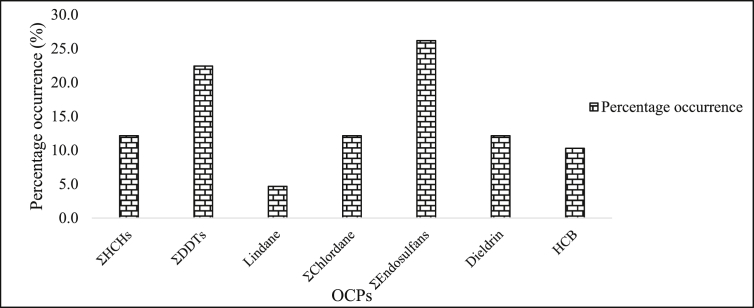
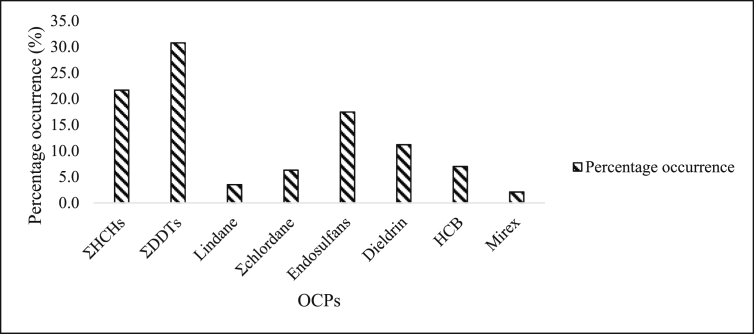
The widespread use of organochlorine pesticides (OCPs), essentially for the control of insects and the cultivation of food crops, has led to the pollution of ecosystems. Despite being banned several years ago in the developed world, extensive use remains ongoing on the African continent. This review summarizes the occurrence, distributions, sources, and trends of OCPs in seven environmental matrices (atmosphere, water, sediments, soils, biota, human fluids and food products) in Africa. Findings in this review revealed that α-HCH, β-HCH dichlorodiphenyltrichloroethane (DDTs), and endosulfans were the most persistent OCP residues in the African environment, particularly DDTs in breast milk samples occurring in levels above the WHO stipulated limits, thus indicating a call for concern. Also, there was paucity of data available on OCP concentrations in ambient air. Future research efforts should prioritize testing these pollutants in the atmosphere, especially in countries where they are used more frequently. While most POP analysis studies used gas chromatography coupled to electron capture detector or mass spectrometer, it is recommended that further studies should use more sensitive analytical techniques such as gas chromatography with tandem mass spectrometry (GC-MS/MS), or gas chromatography coupled to high-resolution mass spectrometry (GC-HRMS). These instruments allow for the detection of secondary and tertiary metabolites, especially those found in water, biota and food products, which are critical vectors of OCPs to human and animal bodies. Training of farmers and other domestic users on the handling of pesticides is proposed.
有机氯农药(OCPs)的广泛使用主要用于控制昆虫和粮食作物种植,这导致了生态系统的污染。尽管在发达国家几年前就已被禁止使用,但在非洲大陆仍在广泛使用。本综述总结了非洲七种环境基质(大气、水、沉积物、土壤、生物群、人体体液和食品)中OCPs的出现情况、分布、来源和趋势。本综述的研究结果表明,α-六氯环己烷、β-六氯环己烷、二氯二苯三氯乙烷(DDTs)和硫丹是非洲环境中最持久的OCP残留,尤其是母乳样本中的DDTs含量高于世界卫生组织规定的限值,因此值得关注。此外,关于环境空气中OCP浓度的数据也很少。未来的研究工作应优先在大气中检测这些污染物,特别是在使用频率较高的国家。虽然大多数持久性有机污染物分析研究使用气相色谱与电子捕获检测器或质谱联用,但建议进一步的研究应使用更灵敏的分析技术,如气相色谱串联质谱(GC-MS/MS)或气相色谱与高分辨率质谱联用(GC-HRMS)。这些仪器能够检测二级和三级代谢物,特别是在水、生物群和食品中发现的代谢物,这些是OCP进入人体和动物体内的关键载体。建议对农民和其他家庭用户进行农药处理培训。