Exercise and Performance Nutrition Laboratory, School of Health Sciences, Lindenwood University, Saint Charles, MO 63301, USA.
School of Kinesiology, Auburn University, Auburn, AL 36849, USA.
Nutrients. 2020 Mar 7;12(3):713. doi: 10.3390/nu12030713.
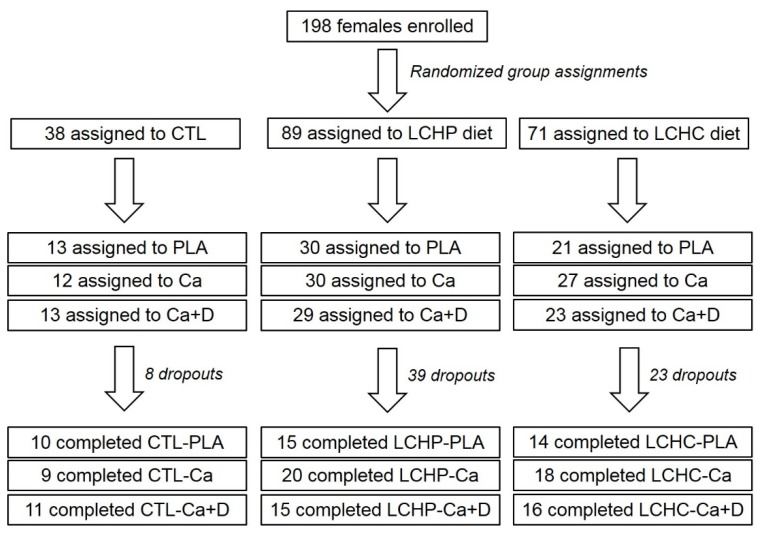
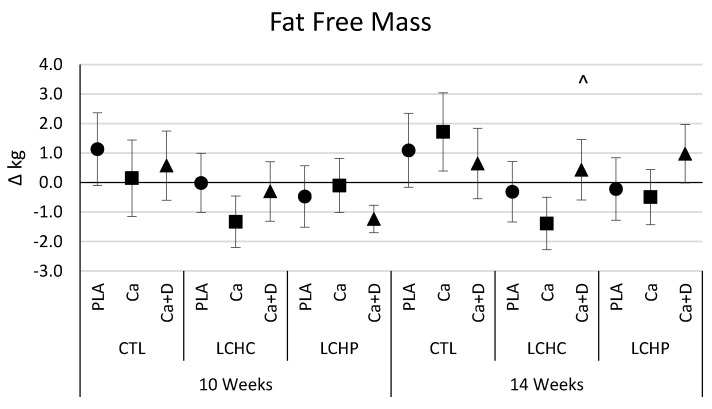
Vitamin D and calcium supplementation have been posited to improve body composition and different formulations of calcium may impact bioavailability. However, data are lacking regarding the combinatorial effects of exercise, diet, and calcium and/or vitamin D supplementation on body composition changes in post-menopausal women. Herein, 128 post-menopausal women (51.3 ± 4.5 years, 36.4 ± 5.7 kg/m, 46.2 ± 4.5% fat) were assigned to diet and supplement groups while participating in a supervised circuit-style resistance-training program (3 d/week) over a 14-week period. Diet groups included: (1) normal diet (CTL), (2) a low-calorie, higher protein diet (LCHP; 1600 kcal/day, 15% carbohydrates, 55% protein, 30% fat), and (3) a low-calorie, higher carbohydrate diet (LCHC; 1600 kcal/day, 55% carbohydrates, 15% protein, 30% fat). Supplement groups consisted of: (1) maltodextrin (PLA), (2) 800 mg/day of calcium carbonate (Ca), and (3) 800 mg/day of calcium citrate and malate and 400 IU/day of vitamin D (Ca+D). Fasting blood samples, body composition, resting energy expenditure, aerobic capacity, muscular strength and endurance measures were assessed. Data were analyzed by mixed factorial ANOVA with repeated measures and presented as mean change from baseline [95% CI]. Exercise training promoted significant improvements in strength, peak aerobic capacity, and blood lipids. Dieting resulted in greater losses of body mass (CTL -0.4 ± 2.4; LCHC -5.1 ± 4.2; LCHP -3.8 ± 4.2 kg) and fat mass (CTL -1.4 ± 1.8; LCHC -3.7 ± 3.7; LCHP -3.4 ± 3.4 kg). When compared to LCHC-PLA, the LCHC + Ca combination led to greater losses in body mass (PLA -4.1 [-6.1, -2.1], Ca -6.4 [-8.1, -4.7], Ca+D -4.4 [-6.4, -2.5] kg). In comparison to LCHC-Ca, the LCHC-Ca+D led to an improved maintenance of fat-free mass (PLA -0.3 [-1.4, 0.7], Ca -1.4 [-2.3, -0.5], Ca+D 0.4 [-0.6, 1.5] kg) and a greater loss of body fat (PLA -2.3 [-3.4, -1.1], Ca -1.3 [-2.3, -0.3], Ca+D -3.6 [-4.8, -2.5]%). Alternatively, no significant differences in weight loss or body composition resulted when adding Ca or Ca+D to the LCHP regimen in comparison to when PLA was added to the LCHP diet. When combined with an energy-restricted, higher carbohydrate diet, adding 800 mg of Ca carbonate stimulated greater body mass loss compared to when a PLA was added. Alternatively, adding Ca+D to the LCHC diet promoted greater% fat changes and attenuation of fat-free mass loss. Our results expand upon current literature regarding the impact of calcium supplementation with dieting and regular exercise. This data highlights that different forms of calcium in combination with an energy restricted, higher carbohydrate diet may trigger changes in body mass or body composition while no impact of calcium supplementation was observed when participants followed an energy restricted, higher protein diet.
维生素 D 和钙补充剂被认为可以改善身体成分,不同形式的钙可能会影响生物利用度。然而,关于运动、饮食以及钙和/或维生素 D 补充剂对绝经后妇女身体成分变化的综合影响的数据还很缺乏。在此,128 名绝经后妇女(51.3 ± 4.5 岁,36.4 ± 5.7kg/m2,46.2 ± 4.5%脂肪)被分配到饮食和补充剂组,同时参加了 14 周的监督循环式抗阻训练计划(每周 3 天)。饮食组包括:(1)正常饮食(CTL),(2)低热量、高蛋白质饮食(LCHP;1600 卡路里/天,15%碳水化合物,55%蛋白质,30%脂肪),和(3)低热量、高碳水化合物饮食(LCHC;1600 卡路里/天,55%碳水化合物,15%蛋白质,30%脂肪)。补充剂组包括:(1)麦芽糊精(PLA),(2)800 毫克/天碳酸钙(Ca),和(3)800 毫克/天柠檬酸钙和苹果酸钙和 400IU/天维生素 D(Ca+D)。检测空腹血样、身体成分、静息能量消耗、有氧能力、肌肉力量和耐力指标。数据采用混合因素方差分析和重复测量进行分析,并以从基线的平均变化[95%CI]表示。运动训练显著提高了力量、峰值有氧能力和血液脂质。节食导致体重(CTL -0.4 ± 2.4;LCHC -5.1 ± 4.2;LCHP -3.8 ± 4.2kg)和体脂(CTL -1.4 ± 1.8;LCHC -3.7 ± 3.7;LCHP -3.4 ± 3.4kg)的更大损失。与 LCHC-PLA 相比,LCHC+Ca 联合导致体重(PLA -4.1 [-6.1, -2.1],Ca -6.4 [-8.1, -4.7],Ca+D -4.4 [-6.4, -2.5]kg)的更大损失。与 LCHC-Ca 相比,LCHC-Ca+D 导致脂肪量(PLA -0.3 [-1.4, 0.7],Ca -1.4 [-2.3, -0.5],Ca+D 0.4 [-0.6, 1.5]kg)的更好保持和体脂(PLA -2.3 [-3.4, -1.1],Ca -1.3 [-2.3, -0.3],Ca+D -3.6 [-4.8, -2.5]%)的更大损失。或者,当与 PLA 相比将 Ca 或 Ca+D 添加到 LCHP 方案中时,与将 Ca 添加到 LCHP 饮食中相比,体重减轻或身体成分没有显著差异。当与能量限制、高碳水化合物饮食结合时,与 PLA 相比,添加 800 毫克碳酸钙会导致更大的体重减轻。或者,当将 Ca+D 添加到 LCHC 饮食中时,会促进更大的%体脂变化和减少无脂体重的损失。我们的研究结果扩展了关于钙补充剂与节食和规律运动对身体的影响的现有文献。这些数据强调了不同形式的钙与能量限制、高碳水化合物饮食相结合可能会引起体重或身体成分的变化,而当参与者遵循能量限制、高蛋白质饮食时,钙补充剂没有观察到影响。