Department of Health & Kinesiology, Texas A & M University, College Station, Texas 77843, USA.
Nutr Metab (Lond). 2009 May 14;6:23. doi: 10.1186/1743-7075-6-23.
To determine the safety and efficacy of altering the ratio of carbohydrate and protein in low-energy diets in conjunction with a popular exercise program in obese women.
Matched, prospective clinical intervention study to assess efficacy of varying ratios of carbohydrate and protein intake in conjunction with a regular exercise program.
One-hundred sixty one sedentary, obese, pre-menopausal women (38.5 ± 8.5 yrs, 164.2 ± 6.7 cm, 94.2 ± 18.8 kg, 34.9 ± 6.4 kg.m⁻², 43.8 ± 4.2%) participated in this study. Participants were weight stable and not participating in additional weight loss programs.
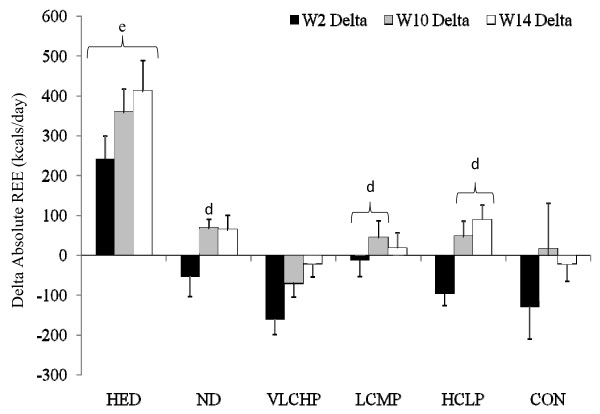
Participants were assigned to either a no exercise + no diet control (CON), a no diet + exercise group (ND), or one of four diet + exercise groups (presented as kcals; % carbohydrate: protein: fat): 1) a high energy, high carbohydrate, low protein diet (HED) [2,600; 55:15:30%], 2) a very low carbohydrate, high protein diet (VLCHP) [1,200 kcals; 63:7:30%], 3) a low carbohydrate, moderate protein diet (LCMP) [1,200 kcals; 50:20:30%] and 4) a high carbohydrate, low protein diet (HCLP) [1,200 kcals; 55:15:30%]. Participants in exercise groups (all but CON) performed a pneumatic resistance-based, circuit training program under supervision three times per week.
Anthropometric, body composition, resting energy expenditure (REE), fasting blood samples and muscular fitness assessments were examined at baseline and weeks 2, 10 and 14.
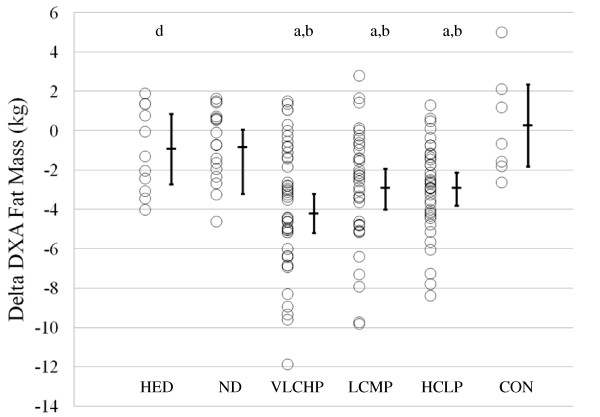
All groups except CON experienced significant reductions (P < 0.05 - 0.001) in waist circumference over 14 weeks. VLCHP, LCHP and LPHC participants experienced similar but significant (P < 0.05 - 0.001) reductions in body mass when compared to other groups. Delta responses indicated that fat loss after 14 weeks was significantly greatest in VLCHP (95% CI: -5.2, -3.2 kg), LCMP (-4.0, -1.9 kg) and HCLP (-3.8, -2.1 kg) when compared to other groups. Subsequent reductions in % body fat were significantly greater in VLCHP, LCMP and HCLP participants. Initial dieting decreased (P < 0.05) relative REE similarly in all groups. All exercise groups significantly (P < 0.05) improved in muscular fitness, but these improvements were not different among groups. Favorable but non-significant mean changes occurred in lipid panels, glucose and HOMA-IR. Leptin levels decreased (P < 0.05) in all groups, except for CON, after two weeks of dieting and remained lower throughout the 14 week program. Exercise participation resulted in significant improvements in quality of life and body image.
Exercise alone (ND) appears to have minimal impact on measured outcomes with positive outcomes apparent when exercise is combined with a hypoenergetic diet. Greater improvements in waist circumference and body composition occurred when carbohydrate is replaced in the diet with protein. Weight loss in all diet groups (VLCHP, LCMP and HCLP) was primarily fat and stimulated improvements in markers of cardiovascular disease risk, body composition, energy expenditure and psychosocial parameters.

确定在低能量饮食中改变碳水化合物和蛋白质比例并结合流行的运动方案对肥胖女性的安全性和疗效。
配对、前瞻性临床干预研究,评估改变碳水化合物和蛋白质摄入比例与常规运动方案结合的疗效。
161 名久坐不动、肥胖、绝经前妇女(38.5 ± 8.5 岁,164.2 ± 6.7cm,94.2 ± 18.8kg,34.9 ± 6.4kg·m⁻²,43.8 ± 4.2%)参加了这项研究。参与者体重稳定,不参加其他减肥计划。
参与者被分配到无运动+无饮食对照组(CON)、无饮食+运动组(ND)或四个饮食+运动组之一(以千卡表示;%碳水化合物:蛋白质:脂肪):1)高能量、高碳水化合物、低蛋白质饮食(HED)[2600;55:15:30%],2)非常低碳水化合物、高蛋白饮食(VLCHP)[1200 千卡;63:7:30%],3)低碳水化合物、中蛋白饮食(LCMP)[1200 千卡;50:20:30%]和 4)高碳水化合物、低蛋白饮食(HCLP)[1200 千卡;55:15:30%]。运动组(除 CON 外)的所有参与者均在监督下进行气动阻力为基础的循环训练计划,每周三次。
在基线和第 2、10 和 14 周时进行人体测量、身体成分、静息能量消耗(REE)、空腹血液样本和肌肉力量评估。
除 CON 组外,所有组在 14 周内腰围均显著减小(P<0.05-0.001)。VLCHP、LCHP 和 LPHC 组与其他组相比,体重也有类似但显著(P<0.05-0.001)的降低。Delta 反应表明,与其他组相比,VLCHP(95%CI:-5.2,-3.2kg)、LCMP(-4.0,-1.9kg)和 HCLP(-3.8,-2.1kg)在 14 周后的脂肪损失明显更大。随后的%体脂减少在 VLCHP、LCMP 和 HCLP 参与者中更为显著。初始节食同样显著降低(P<0.05)所有组的相对 REE。所有运动组的肌肉力量均显著改善(P<0.05),但组间无差异。血脂谱、血糖和 HOMA-IR 出现有利但非显著的均值变化。除 CON 组外,所有组的瘦素水平在节食两周后均降低(P<0.05),并在整个 14 周项目中持续降低。运动参与导致生活质量和身体形象的显著改善。
单独运动(ND)似乎对测量结果的影响很小,当运动与低能量饮食相结合时,会产生积极的结果。用蛋白质替代饮食中的碳水化合物时,腰围和身体成分的改善更大。所有饮食组(VLCHP、LCMP 和 HCLP)的体重减轻主要是脂肪,刺激了心血管疾病风险标志物、身体成分、能量消耗和心理社会参数的改善。