School of Nursing and Health Professions, University of the Incarnate Word, San Antonio, TX 78209, USA.
Exercise & Sport Nutrition Lab, Human Clinical Research Facility, Department of Health and Kinesiology, Texas A & M University, College Station, TX 77843, USA.
Int J Environ Res Public Health. 2022 Apr 17;19(8):4877. doi: 10.3390/ijerph19084877.
To compare the efficacy of two popular weight loss approaches on weight loss, body composition, and markers of health in sedentary obese women.
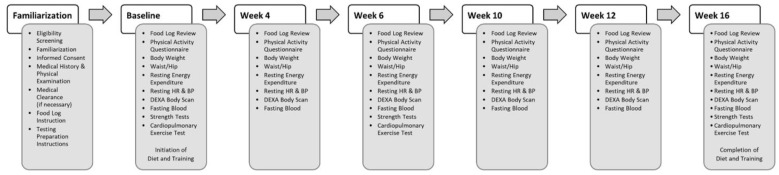
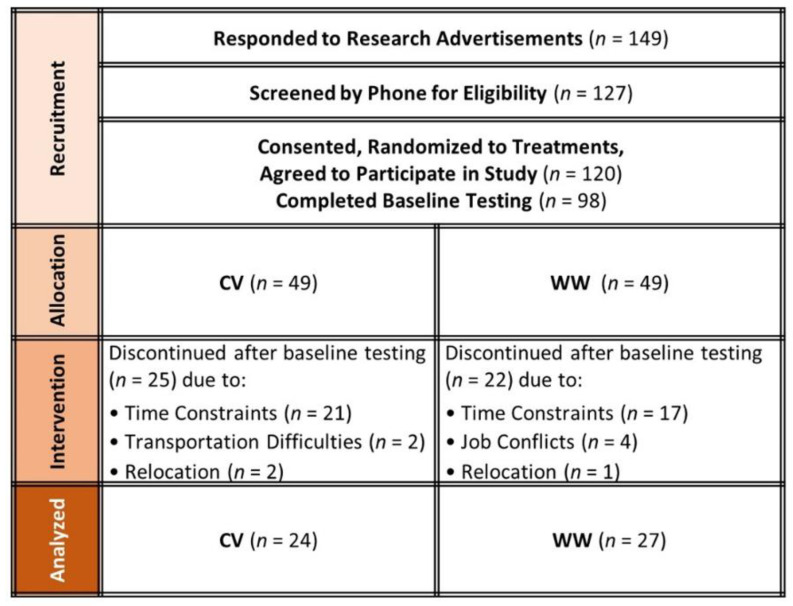
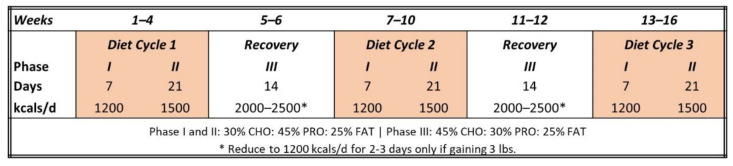
In total, 51 sedentary women (age 34.5 ± 7.7 yrs.; weight 90.0 ± 14.5 kg; BMI 34.0 ± 5.1 kg/m; 46.5 ± 7.0% fat) were matched and randomized to participate in the Weight Watchers Momentum™ (WW) or Curves (CV) Fitness and Weight Management program for 16 weeks. Participants in the WW group ( = 27) were provided a point-based diet program, received weekly progress checks and counseling, and were encouraged to exercise. Participants in the CV group ( = 24) followed a menu-based higher protein/low-fat diet (1200 kcal/d) for 1 week; 1500 kcal/d diet for 3 weeks; and 2000-2500 kcals/d for 2 weeks that was repeated three times (except the last segment) while participating in a supervised circuit-style resistance training program (3 d/wk). A general linear model (GLM) with repeated measures was used to analyze data and are presented as mean changes from baseline (mean [UL, LL]).
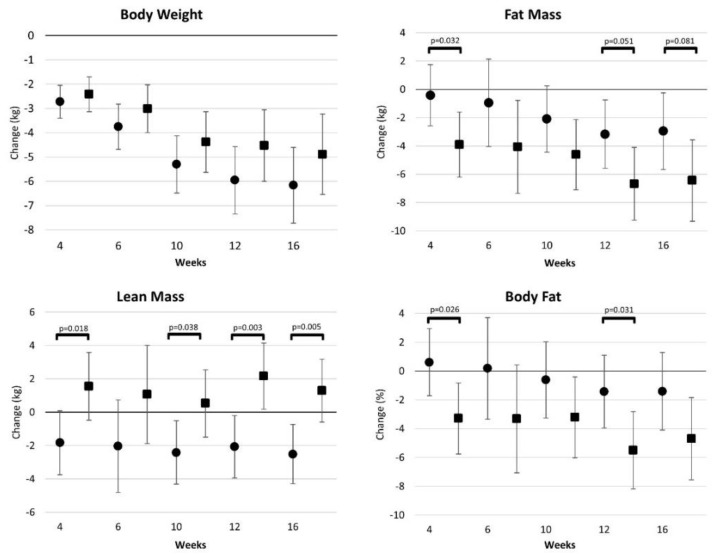
Supervised CV training resulted in greater amounts of vigorous and total physical activity. After 16 weeks, both groups lost weight (WW -6.1 [-7.8, -4.6], CV -4.9 [-6.2, -3.2] kg, = 0.264). Participants in the CV group observed greater reductions in fat mass (WW -2.9 [-6.7, -0.2], CV -6.4 [-9.2, -3.6] kg, = 0.081) and increases in lean mass (WW -2.5 [-4.3, -0.7], CV 1.3 [-0.6, 3.2] kg, = 0.005) resulting in more favorable changes in percent body fat (WW -1.4 [-4.1, 1.2], CV -4.7 [-7.5, -1.8]%, = 0.098). Both groups observed improvements in peak aerobic capacity and muscular endurance, although bench press lifting volume was greater in the CV group. Those in the CV group experienced a greater increase in HDLc and reduction in the CHL-HDLc ratio and triglycerides.
Both interventions promoted weight loss and improvements in fitness and markers of health. The CV program, which included supervised resistance training and higher protein diet menus, promoted greater fat loss, increases in lean mass, and improvements in percent body fat and blood lipids.
clinicaltrials.gov, #NCT04372771, registered retrospectively 1 May 2020.
比较两种流行的减肥方法在减肥、身体成分和久坐肥胖女性健康指标方面的效果。
共有 51 名久坐不动的女性(年龄 34.5±7.7 岁;体重 90.0±14.5 公斤;BMI 34.0±5.1 公斤/平方米;体脂率 46.5±7.0%)进行匹配和随机分组,参加 Weight Watchers Momentum™(WW)或 Curves(CV)健身和体重管理计划 16 周。WW 组(n=27)的参与者接受基于点数的饮食计划,每周进行进度检查和咨询,并鼓励进行锻炼。CV 组(n=24)遵循基于菜单的高蛋白/低脂肪饮食(1200 千卡/天)1 周;1500 千卡/天的饮食 3 周;2000-2500 千卡/天的饮食 2 周,重复 3 次(最后一段除外),同时参加监督的循环式阻力训练计划(每周 3 天)。采用重复测量的一般线性模型(GLM)分析数据,并以基线(均值[UL,LL])的平均变化表示。
CV 监督训练导致更大的剧烈和总体力活动量。16 周后,两组体重均减轻(WW -6.1[-7.8,-4.6],CV -4.9[-6.2,-3.2]公斤,=0.264)。CV 组参与者的体脂量减少更多(WW -2.9[-6.7,-0.2],CV -6.4[-9.2,-3.6]公斤,=0.081),瘦体重增加更多(WW -2.5[-4.3,-0.7],CV 1.3[-0.6,3.2]公斤,=0.005),导致体脂百分比的变化更有利(WW -1.4[-4.1,1.2],CV -4.7[-7.5,-1.8]%,=0.098)。两组均观察到有氧能力峰值和肌肉耐力的改善,尽管 CV 组的卧推举重量更大。CV 组的高密度脂蛋白胆固醇(HDLc)增加更多,高密度脂蛋白胆固醇与甘油三酯比值(CHL-HDLc)和甘油三酯降低更多。
两种干预措施均促进体重减轻和健康指标的改善。包括监督阻力训练和高蛋白饮食菜单的 CV 方案促进了更多的脂肪减少、瘦体重增加以及体脂百分比和血脂的改善。
clinicaltrials.gov,#NCT04372771,2020 年 5 月 1 日回溯性注册。