
具有温度稳定纳米间隙的量子隧穿湿度计。
Quantum Tunneling Hygrometer with Temperature Stabilized Nanometer Gap.
作者信息
Banerjee A, Likhite R, Kim H, Mastrangelo C H
机构信息
University of Utah, 201 Presidents Cir, Salt Lake City, UT, 84112, United States of America.
出版信息
Sci Rep. 2020 Mar 10;10(1):4440. doi: 10.1038/s41598-020-60484-7.
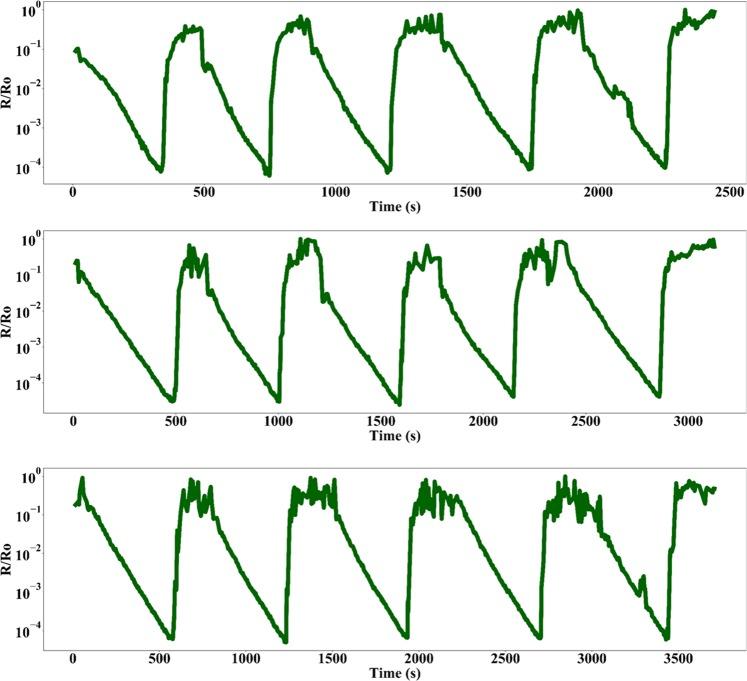
We present the design, fabrication and response of a humidity sensor based on electrical tunneling through temperature-stabilized nanometer gaps. The sensor consists of two stacked metal electrodes separated by ~2.5 nm of vertical air gap. Upper and lower electrodes rest on separate 1.5 μm thick polyimide patches with nearly identical thermal expansion but different gas absorption characteristics. When exposed to a humidity change, the patch under the bottom electrode swells but the patch under the top electrode does not, as it is covered with a water-vapor diffusion barrier ~8 nm of AlO. The air gap thus decreases leading to increase in the tunneling current across the junction. The gap however is independent of temperature fluctuations as both patches expand or contract by near equal amounts. Humidity sensor action demonstrates an unassisted reversible resistance reduction R/R ~10 when the device is exposed to 20-90 RH% at a standby DC power consumption of ~0.4 pW. The observed resistance change when subject to a temperature sweep of 25-60 ° C @24% RH was ~0.0025% of the full device output range.
我们展示了一种基于通过温度稳定的纳米间隙进行电隧穿的湿度传感器的设计、制造和响应。该传感器由两个堆叠的金属电极组成,中间隔着约2.5纳米的垂直气隙。上下电极分别置于厚度为1.5微米的聚酰亚胺贴片上,这两个贴片具有几乎相同的热膨胀系数,但气体吸收特性不同。当暴露于湿度变化时,底部电极下方的贴片会膨胀,而顶部电极下方的贴片不会,因为它覆盖着一层约8纳米厚的氧化铝水汽扩散阻挡层。气隙因此减小,导致结两端的隧穿电流增加。然而,由于两个贴片的膨胀或收缩量几乎相等,气隙与温度波动无关。当该器件在约0.4皮瓦的待机直流功耗下暴露于20 - 90%相对湿度时,湿度传感器的作用表现出无辅助的可逆电阻降低R/R约为10。在24%相对湿度下,当温度在25 - 60°C范围内扫描时,观察到的电阻变化约为整个器件输出范围的0.0025%。




 Zotero 插件