Department of Environmental Biotechnology, University of Warmia and Mazury in Olsztyn, Olsztyn, Poland.
Department of Ichthyology and Aquaculture, University of Warmia and Mazury in Olsztyn, Olsztyn, Poland.
Sci Rep. 2020 Mar 10;10(1):4460. doi: 10.1038/s41598-020-61351-1.
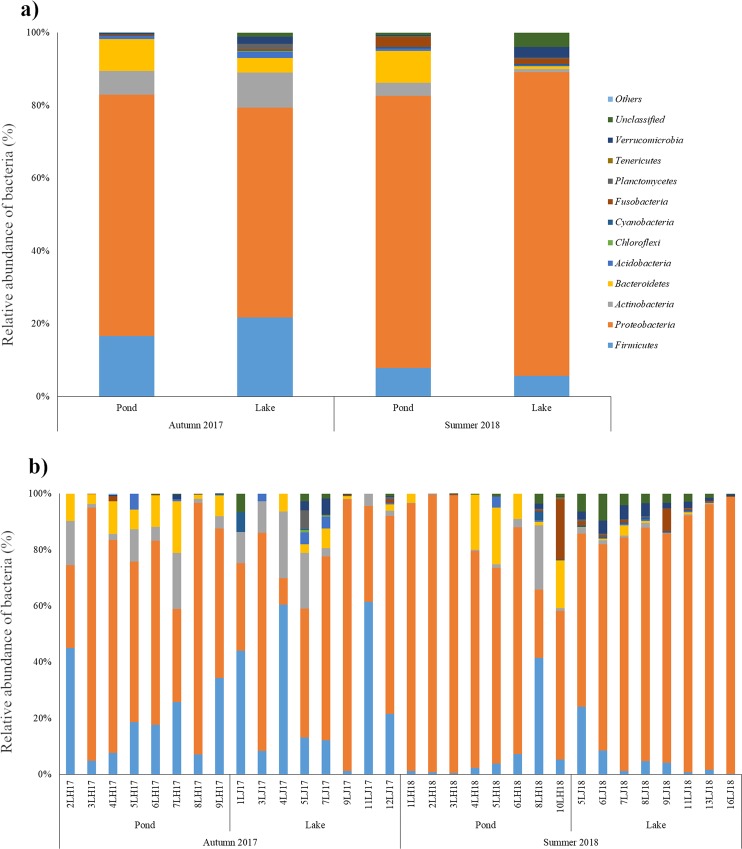
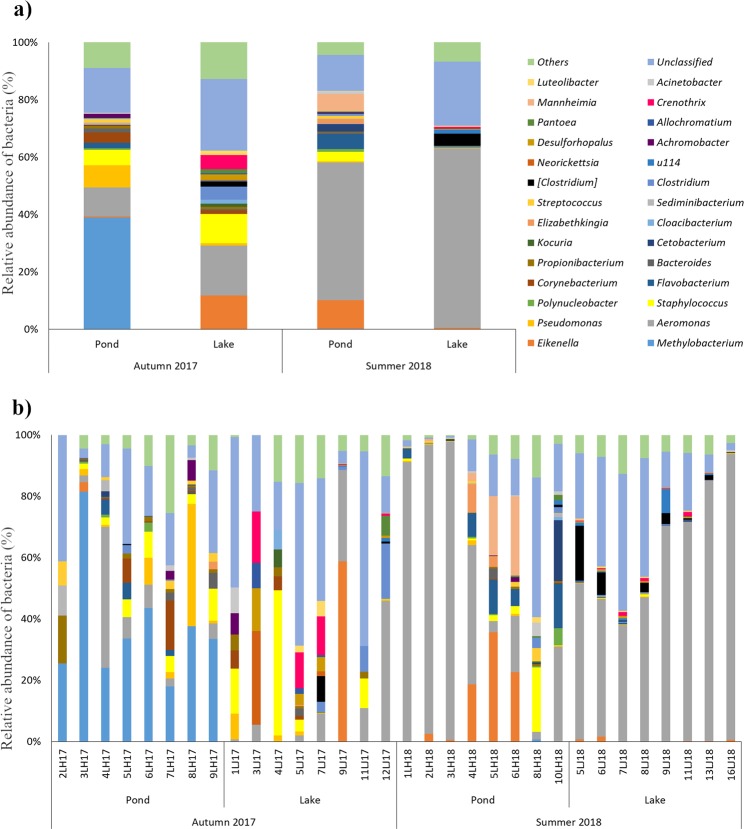
Tench (Tinca tinca L.) is one of the most valued species of the Cyprinidae. This species is commercially important and has been intensively domesticated in recent years. To avoid excessive production losses, the health of farm fish must be maintained. Characterization of the tench gut microbiome can help achieve this goal, as the gastrointestinal microbiome plays an important role in host health. As part of this characterization, investigating the influence of the environment and season will help to understand the interrelationship between host and gut microbiota. Therefore, our aim was to use high-throughput 16S rRNA gene amplicon sequencing to profile the gut microbiome of tench. We studied two populations in summer and autumn: wild tench living in a lake and tench living in a pond in a semi-intensive fish farm. We found that, in the gut microbiome of all fish, the most abundant phylum was Proteobacteria, followed by Firmicutes, Bacteroidetes and Actinobacteria. Together, these phyla constituted up to 90% of the microbial communities. The abundance of Candidatus Xiphinematobacter differed significantly between lake and pond fish in summer, but not in autumn. In pond tench, Methylobacterium abundance was significantly lower in summer than in autumn. Mean Shannon, Chao1 indices and observed OTU's indicated that microbial biodiversity was greater in the gut of lake fish than in that of pond fish. Beta-diversity analysis showed significant divergence between groups with both weighted and unweighted UniFrac distance matrices. Principal coordinates analysis revealed that more of the variance in microbial diversity was attributable to environment than to season. Although some of the diversity in lake tench gut microbiota could be attributable to feeding preferences of individual fish, our results suggest that environment is the main factor in determining gut microbiome diversity in tench.
丁鱥(Tinca tinca L.)是鲤科中最受重视的物种之一。近年来,该物种作为商业品种得到了集约化养殖。为了避免过度的生产损失,必须保持养殖鱼类的健康。丁鱥肠道微生物组的特征分析有助于实现这一目标,因为胃肠道微生物组在宿主健康中起着重要作用。作为特征分析的一部分,研究环境和季节的影响将有助于了解宿主和肠道微生物群之间的相互关系。因此,我们的目的是使用高通量 16S rRNA 基因扩增子测序来描述丁鱥的肠道微生物组。我们在夏季和秋季研究了两个种群:生活在湖泊中的野生丁鱥和生活在半集约化养鱼场池塘中的丁鱥。我们发现,在所有鱼类的肠道微生物组中,最丰富的门是变形菌门,其次是厚壁菌门、拟杆菌门和放线菌门。这四个门共同构成了高达 90%的微生物群落。夏季时,湖鱼和池塘鱼的肠道微生物组中 Candidatus Xiphinematobacter 的丰度存在显著差异,但在秋季则没有。在池塘丁鱥中,Methylobacterium 的丰度在夏季显著低于秋季。平均 Shannon、Chao1 指数和观察到的 OTU 表明,湖泊鱼类肠道中的微生物多样性大于池塘鱼类。β多样性分析表明,在加权和非加权 UniFrac 距离矩阵上,两组之间存在显著差异。主坐标分析表明,环境对微生物多样性的变化有更大的影响,而季节的影响较小。尽管湖泊丁鱥肠道微生物组的一些多样性可能归因于个体鱼类的摄食偏好,但我们的结果表明,环境是决定丁鱥肠道微生物组多样性的主要因素。