Marie Curie Research Centre, Division of Population Medicine, Cardiff University, 8th Floor Neuadd Meirionydd, Heath Park Way, Cardiff, CF14 4YS, UK.
School of Dentistry, Cardiff University, University Hospital Wales, Heath Park, Cardiff, CF14 4XY, UK.
BMC Palliat Care. 2020 Mar 12;19(1):29. doi: 10.1186/s12904-020-0532-4.
Bereavement support is a core part of palliative care. However, the evidence base is limited by a lack of consistency in the outcomes used to evaluate services and models of support, which makes it difficult to compare approaches. Core Outcome Sets (COS) represent the minimum that should be measured in research into specific conditions or services. The aim of this study was to use a stakeholders' perspective to develop a COS for evaluating bereavement support for adults in adult palliative care settings.
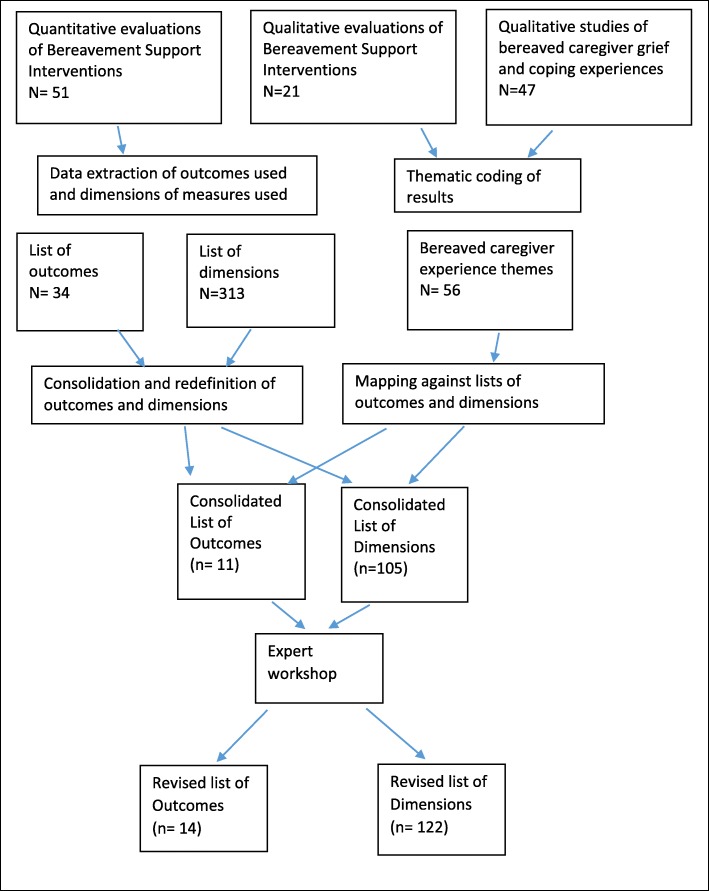
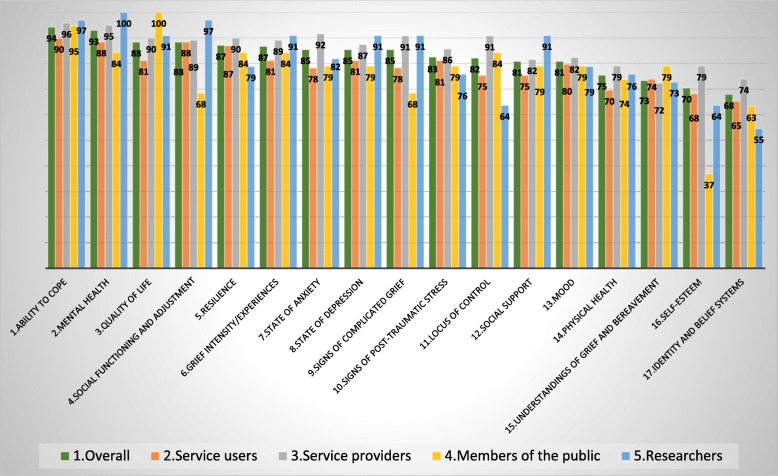
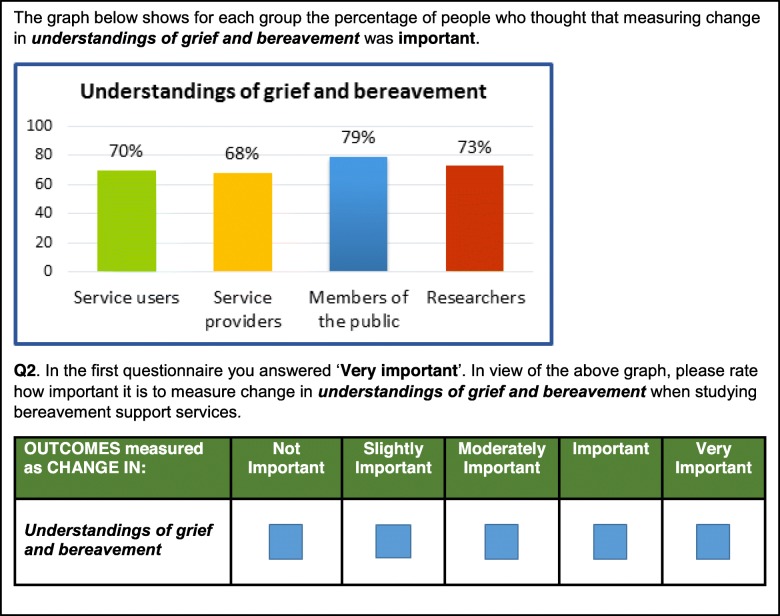
A list of outcomes relevant to bereavement support was created following a systematic review of the quantitative and qualitative literature. At an expert workshop 21 stakeholders discussed their views on the most important outcomes and compared these to and critiqued the lists constructed from the review. These lists and discussions informed a two round international DELPHI survey (n = 240) designed to reach consensus on which outcomes/outcome dimensions should be included in the COS. To prioritise and validate the items emerging from the survey, participants at a subsequent consensus day ranked the relative importance of these items (n = 23). A final feedback exercise with these consensus day participants was conducted to confirm the selection of outcomes and dimensions.
'Ability to cope with grief' and 'Quality of life and mental wellbeing' were selected as two core outcomes. Twenty-one different dimensions to explore when assessing these outcomes were also identified. The coping related dimensions have been categorised as: Negative and overwhelming grief; Communication and connectedness; Understanding, accepting and finding meaning in grief; Finding balance between grief and life going forwards; Accessing appropriate support. Those relating to quality of life and wellbeing have been categorised as; Participation in work and/or regular activities; Relationships and social functioning; Positive mental wellbeing and Negative mental and emotional state.
This COS outlines a more consistent way forward for bereavement researchers and practitioners, whilst also orientating towards public health and resilience-based approaches to bereavement care. Further work is planned to identify and develop measures which are specific to this core outcome set, and which will facilitate the future comparability of bereavement services and interventions.
丧亲支持是姑息治疗的核心部分。然而,由于用于评估服务和支持模式的结果缺乏一致性,证据基础有限,因此难以比较方法。核心结局集(COS)代表在特定疾病或服务的研究中应测量的最低标准。本研究旨在从利益相关者的角度出发,为成人姑息治疗环境中的成人丧亲支持制定一个 COS。
在对定量和定性文献进行系统回顾后,创建了一个与丧亲支持相关的结局清单。在一个专家研讨会上,21 名利益相关者讨论了他们对最重要结局的看法,并将这些看法与从综述中构建的清单进行了比较和批评。这些清单和讨论为两轮国际 DELPHI 调查(n=240)提供了信息,旨在就应将哪些结局/结局维度纳入 COS 达成共识。为了对调查中出现的项目进行优先级排序和验证,随后的共识日参与者对这些项目的相对重要性进行了排名(n=23)。对这些共识日参与者进行了最后的反馈练习,以确认结局和维度的选择。
“应对悲伤的能力”和“生活质量和心理健康”被选为两个核心结局。还确定了 21 个不同的维度来评估这些结局。与应对相关的维度已被分类为:负面和压倒性的悲伤;沟通和联系;理解、接受和在悲伤中找到意义;在悲伤和生活向前之间找到平衡;获得适当的支持。与生活质量和幸福感相关的维度已被分类为:参与工作和/或常规活动;人际关系和社交功能;积极的心理健康和消极的心理和情绪状态。
这个 COS 为丧亲研究人员和从业者制定了一个更一致的前进道路,同时也面向公共卫生和基于韧性的丧亲关怀方法。计划进一步开展工作,确定和制定特定于这一核心结局集的措施,这将促进未来丧亲服务和干预措施的可比性。