Gastroenterology, Department of Medical Sciences and Public health, Policlinico Universitario di Monserrato, University of Cagliari, 09042 Monserrato (CA), Italy.
Department of Medical Sciences and Public Health, University of Cagliari, 09242 Monserrato (CA), Italy.
Nutrients. 2020 Mar 8;12(3):716. doi: 10.3390/nu12030716.
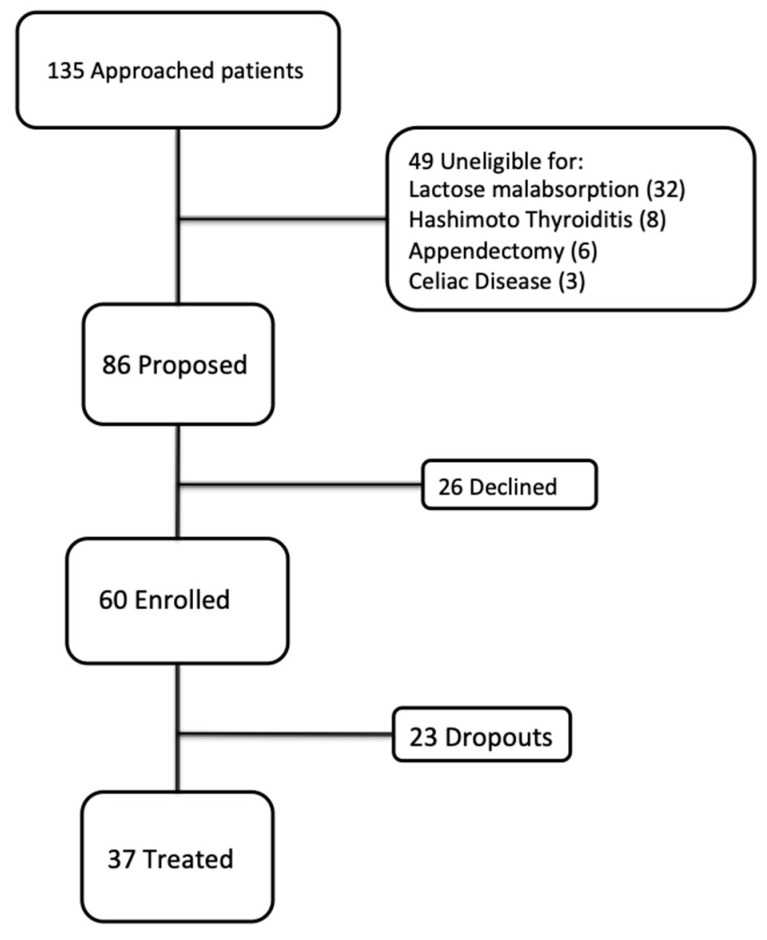
The low Fermentable oligosaccharides, disaccharides, monosaccharides, and polyols (FODMAP) diet has demonstrated excellent results in terms of symptom control and health-related quality of life (HRQoL) in irritable bowel syndrome (IBS) sufferers, but patients have complained about unsatisfying taste, difficulty in following the diet, and time consumption. To investigate the feasibility of the low FODMAP diet in an Italian (Sardinian) cohort, sixty consecutive eligible outpatients (11 men and 49 women) with IBS were enrolled and followed a low FODMAP diet (gluten allowed, restriction phase of four weeks, reintroduction phase of four weeks). Food habits were assessed using 24-hour dietary recall, Bristol Stool Scale for stool consistency, Visual Analogue Scale for abdominal bloating, VAS (Visual Analogue Scale) for abdominal pain, IBS Severity Scoring System for perceived disease severity, and a 12-item Short Form Survey for HRQoL (psychological component summary + mental component summary) were applied at baseline (T0) and at the end of each phase (T1-four weeks and T2-eight weeks). Statistical analysis was performed by dividing the cohort into diarrhoea-dominant IBS (IBS-D) and other IBS subtypes (selected IBS-others). Comparisons between T1 and T2 vs. T0 and T2 vs. T1 were performed. The low FODMAP diet lowered VASp (VAS pain), VASb (VAS bloating), and IBS SSS (IBS Severity Scoring System), and increased PCS (Physical Component Summary) and MCS (Mental Component Summary) in both subgroups. Bristol Stool Scale (BSS) only improved in the IBS-D subgroup. The dropout mean values for MCS were higher than treated subjects and the percentage of unemployment was lower in the dropouts. According to the dropout features, the low FODMAP diet seems to show greater feasibility for patients with more time to dedicate to the diet (unemployed, homemakers, housewives, or students), more motivation, and more severe clinical features, independent of their place of residence.
低发酵寡糖、双糖、单糖和多元醇(FODMAP)饮食在肠易激综合征(IBS)患者的症状控制和健康相关生活质量(HRQoL)方面取得了优异的效果,但患者抱怨味道不佳、难以遵循饮食以及时间消耗。为了研究低 FODMAP 饮食在意大利(撒丁岛)队列中的可行性,招募了 60 名连续符合条件的门诊 IBS 患者(11 名男性和 49 名女性),并遵循低 FODMAP 饮食(允许食用 gluten,限制阶段四周,再引入阶段四周)。使用 24 小时膳食回忆、粪便稠度布里斯托尔粪便量表、腹部膨隆的视觉模拟量表、腹痛的视觉模拟量表、感知疾病严重程度的 IBS 严重程度评分系统以及 12 项简短形式调查对饮食进行评估)用于 HRQoL(心理成分总结+心理成分总结)在基线(T0)和每个阶段结束时(T1-四周和 T2-八周)。通过将队列分为腹泻主导型 IBS(IBS-D)和其他 IBS 亚型(选择的 IBS-其他)来进行统计分析。比较 T1 和 T2 与 T0 和 T2 与 T1。低 FODMAP 饮食降低了 VASp(VAS 疼痛)、VASb(VAS 膨隆)和 IBS SSS(IBS 严重程度评分系统),并增加了 PCS(物理成分摘要)和 MCS(心理成分摘要)在两个亚组中。Bristol Stool Scale(BSS)仅在 IBS-D 亚组中得到改善。MCS 的辍学平均值高于治疗组,辍学组的失业率也较低。根据辍学特征,低 FODMAP 饮食似乎对有更多时间投入饮食的患者(失业者、家庭主妇、家庭主妇或学生)、更多动力和更严重的临床特征更可行,而与他们的居住地无关。