International Centre for Neuromorphic Engineering, MARCS Institute, Western Sydney University, Werrington, NSW 2747, Australia.
Sensors (Basel). 2020 Mar 13;20(6):1600. doi: 10.3390/s20061600.
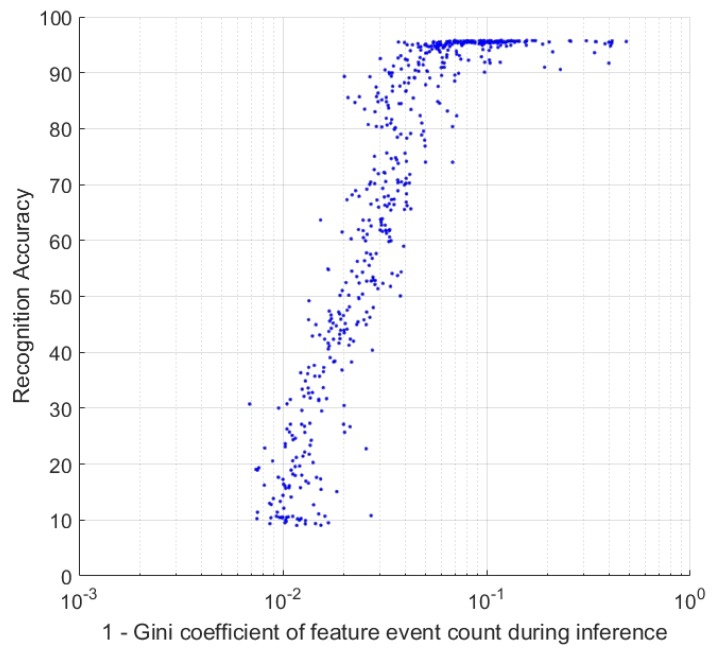
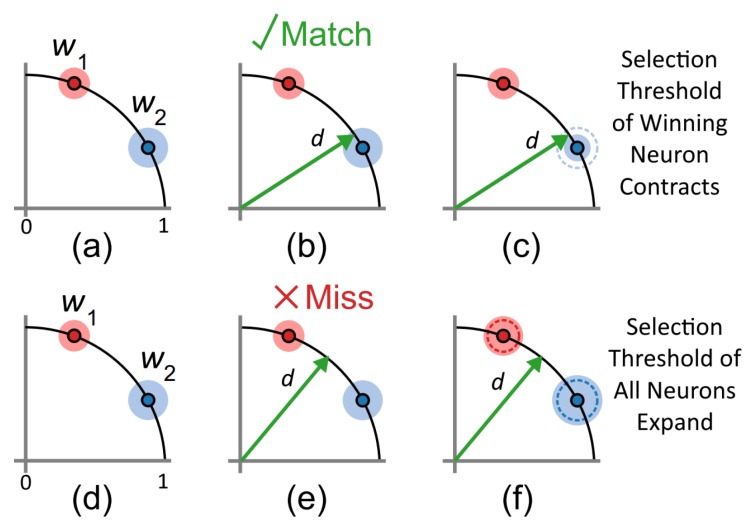
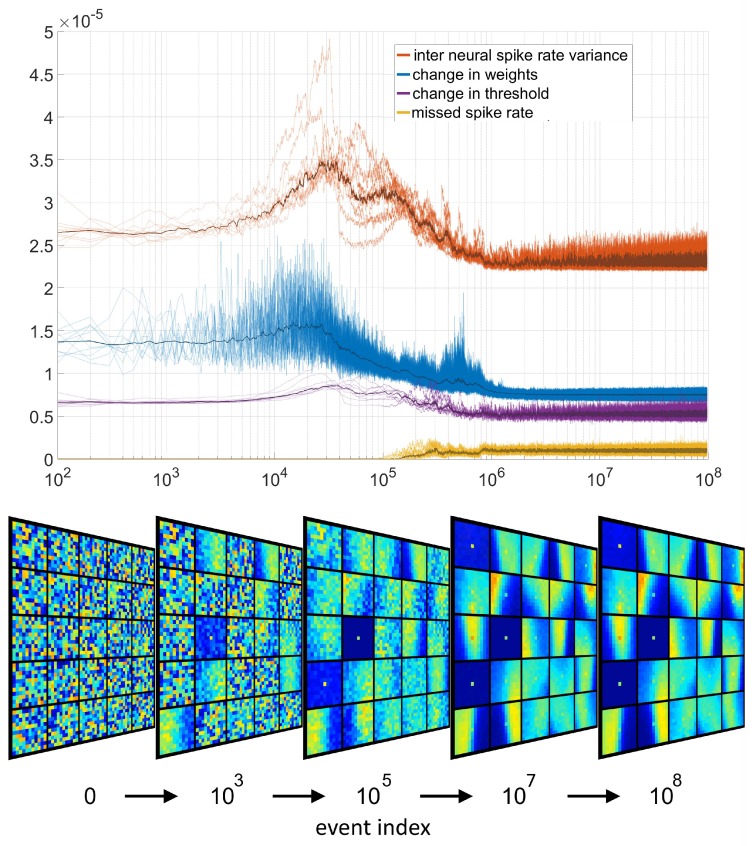
Unsupervised feature extraction algorithms form one of the most important building blocks in machine learning systems. These algorithms are often adapted to the event-based domain to perform online learning in neuromorphic hardware. However, not designed for the purpose, such algorithms typically require significant simplification during implementation to meet hardware constraints, creating trade offs with performance. Furthermore, conventional feature extraction algorithms are not designed to generate useful intermediary signals which are valuable only in the context of neuromorphic hardware limitations. In this work a novel event-based feature extraction method is proposed that focuses on these issues. The algorithm operates via simple adaptive selection thresholds which allow a simpler implementation of network homeostasis than previous works by trading off a small amount of information loss in the form of missed events that fall outside the selection thresholds. The behavior of the selection thresholds and the output of the network as a whole are shown to provide uniquely useful signals indicating network weight convergence without the need to access network weights. A novel heuristic method for network size selection is proposed which makes use of noise events and their feature representations. The use of selection thresholds is shown to produce network activation patterns that predict classification accuracy allowing rapid evaluation and optimization of system parameters without the need to run back-end classifiers. The feature extraction method is tested on both the N-MNIST (Neuromorphic-MNIST) benchmarking dataset and a dataset of airplanes passing through the field of view. Multiple configurations with different classifiers are tested with the results quantifying the resultant performance gains at each processing stage.
无监督特征提取算法是机器学习系统中最重要的构建块之一。这些算法通常被适配到基于事件的领域,以便在神经形态硬件上进行在线学习。然而,由于不是专门为此目的设计的,此类算法在实施过程中通常需要进行重大简化,以满足硬件约束,从而在性能方面做出权衡。此外,传统的特征提取算法并不是为了生成有用的中间信号而设计的,这些信号在神经形态硬件限制的背景下才有价值。在这项工作中,提出了一种新的基于事件的特征提取方法来解决这些问题。该算法通过简单的自适应选择阈值来运行,与以前的工作相比,通过在选择阈值之外的错过事件的形式牺牲少量信息丢失来实现网络动态平衡的更简单实现,从而允许实现更简单的网络动态平衡。选择阈值的行为和网络的整体输出被证明提供了独特的有用信号,指示网络权重收敛,而无需访问网络权重。提出了一种新的网络大小选择启发式方法,该方法利用噪声事件及其特征表示。结果表明,选择阈值的使用产生了可预测分类准确性的网络激活模式,从而无需运行后端分类器即可快速评估和优化系统参数。该特征提取方法在 N-MNIST(神经形态 MNIST)基准数据集和飞机穿过视场的数据集上进行了测试。使用不同的分类器测试了多个配置,结果量化了每个处理阶段的性能增益。