School of Nursing, University of Wisconsin-Madison, Madison, WI 53705, USA.
Research Institute of Nursing Science and College of Nursing, Seoul National University, Seoul 03080, Korea.
Int J Environ Res Public Health. 2020 Mar 14;17(6):1889. doi: 10.3390/ijerph17061889.
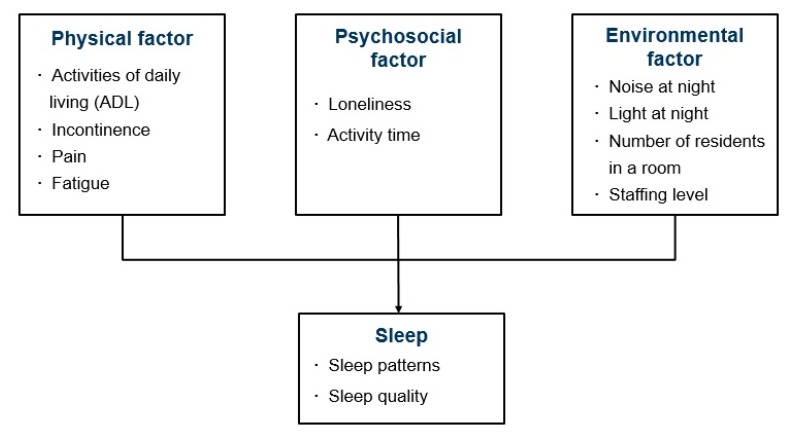
Long-term care residents often experience sleep disturbances as they are vulnerable to a variety of physical, psychosocial, and environmental factors that contribute to sleep disturbances. However, few studies have examined the combined impact of multiple factors on sleep among long-term care residents. This study aimed to identify the factors that influence sleep efficiency and sleep quality based on a modified senescent sleep model. A total of 125 residents were recruited from seven long-term care facilities in South Korea. Sleep patterns and sleep quality were collected using 3-day sleep logs and the Minimal Insomnia Screening Scale for Korean adults (KMISS), respectively. The mean sleep efficiency was 84.6% and the mean score on sleep quality was 15.25. A multiple linear regression analysis showed that greater dependence in activities of daily living (ADL), higher pain, and light at night were related to lower sleep efficiency. Higher pain and fatigue, less activity time, noise and light at night, and lower nighttime staffing levels were related to poorer sleep quality. This study highlights that psychosocial and environmental factors as well as physical factors could influence sleep for long-term care residents. Our findings could be foundational evidence for multi-faceted sleep intervention program development in long-term care settings.
长期护理居民经常经历睡眠障碍,因为他们容易受到各种身体、心理社会和环境因素的影响,这些因素会导致睡眠障碍。然而,很少有研究调查多种因素对长期护理居民睡眠的综合影响。本研究旨在根据改良的衰老睡眠模型,确定影响睡眠效率和睡眠质量的因素。共有 125 名居民从韩国的 7 个长期护理机构招募。睡眠模式和睡眠质量分别使用 3 天睡眠日志和韩国成年人最小失眠筛查量表 (KMISS) 收集。平均睡眠效率为 84.6%,睡眠质量平均得分为 15.25。多元线性回归分析表明,日常生活活动 (ADL) 依赖性较高、疼痛程度较高和夜间光线较强与睡眠效率较低有关。较高的疼痛和疲劳、较少的活动时间、夜间噪音和光线以及夜间人员配备水平较低与较差的睡眠质量有关。本研究强调,心理社会和环境因素以及身体因素可能会影响长期护理居民的睡眠。我们的研究结果可能为长期护理环境中多方面睡眠干预计划的制定提供基础证据。