Department of Population Health Sciences, Bristol Medical School, University of Bristol, Bristol, UK
Department of Population Health Sciences, Bristol Medical School, University of Bristol, Bristol, UK.
BMJ Open. 2020 Mar 16;10(3):e030556. doi: 10.1136/bmjopen-2019-030556.
Few contemporary studies have examined peer and social drivers of alcohol use during mid-adolescence. We sought to explore young people's perspectives on socio-cultural influences relating to alcohol use behaviour during this period.
Qualitative research study.
Semi-structured one-to-one (n=25), paired (n=4) or triad (n=1) interviews and one focus group (n=6) were conducted with 30 young people aged 14 to 15 (13 males, 17 females) recruited from 4 schools, and 12 participants (aged 14 to 18, 8 males, 4 females) recruited from two youth groups in an urban centre in the West of England. Nineteen participants abstained from alcohol use, 9 were occasional or moderate drinkers and 14 drank alcohol more regularly. Interviews were audio-recorded, transcribed verbatim and analysed thematically using NVivo V.10, through a lens of social influence and social norms theories.
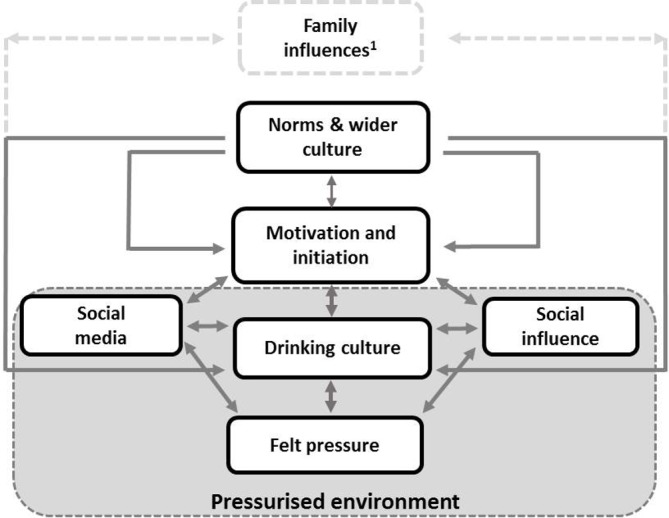
Alcohol consumption was associated with being cool, mature and popular, while enabling escape from reality and boosting confidence and enjoyment. Positive expectancies, alongside opportunity, contributed to motivating initiation, but social influences were paramount, with participants describing a need to 'fit in' with friends to avoid social exclusion. Such influences positioned drinking at parties as a normative social practice, providing opportunities for social learning and the strengthening of peer norms. Social media presented young people with positive alcohol-associated depictions of social status, enjoyment and maturity. This intersection of influences and norms generated a pressurised environment and a sense of unease around resisting pressures, which could elicit stigmatising insults.
Cultural norms, social influences and social media intersect to create a pressurised environment around alcohol use during mid-adolescence, driving the escalation in the prevalence of excessive consumption at this stage. New interventions need to address normative influences to enable the prevention of excessive alcohol use during adolescence.
很少有当代研究探讨青少年中期同伴和社会因素对饮酒行为的影响。我们试图探讨年轻人对这一时期与饮酒行为相关的社会文化影响的看法。
定性研究。
对 4 所学校的 30 名 14 至 15 岁(13 名男性,17 名女性)青少年,以及英格兰西部一个城市中心的两个青年团体招募的 12 名参与者(年龄 14 至 18 岁,8 名男性,4 名女性)进行了一对一(n=25)、一对二(n=4)或三对一(n=1)访谈和一次焦点小组(n=6)。19 名参与者不饮酒,9 名偶尔或适度饮酒,14 名参与者更频繁地饮酒。访谈进行了录音、逐字记录,并使用 NVivo V.10 进行主题分析,通过社会影响和社会规范理论的视角进行分析。
饮酒与酷、成熟和受欢迎有关,同时还可以逃避现实,增强自信和享受感。积极的期望,再加上机会,促使年轻人开始饮酒,但社会影响至关重要,参与者描述了需要与朋友“打成一片”,以避免被社会排斥。这种影响使在聚会上饮酒成为一种规范的社会行为,为社交学习和加强同伴规范提供了机会。社交媒体向年轻人展示了积极的与饮酒相关的社会地位、享受和成熟的形象。这种影响和规范的交织,营造了一个充满压力的环境,让年轻人对抵制压力感到不安,这可能会引发侮辱性的言语攻击。
文化规范、社会影响和社交媒体相互交织,在青少年中期的饮酒行为周围营造了一个充满压力的环境,导致这一阶段过度饮酒的流行率上升。新的干预措施需要解决规范影响,以防止青少年时期过度饮酒。