Department of Chemistry, Massachusetts Institute of Technology, 77 Massachusetts Avenue, Cambridge, Massachusetts 02139, United States.
Department of Chemistry and Chemical Biology, Harvard University, 12 Oxford Street, Cambridge, Massachusetts 02138, United States.
Biochemistry. 2020 Apr 14;59(14):1442-1453. doi: 10.1021/acs.biochem.0c00001. Epub 2020 Mar 30.
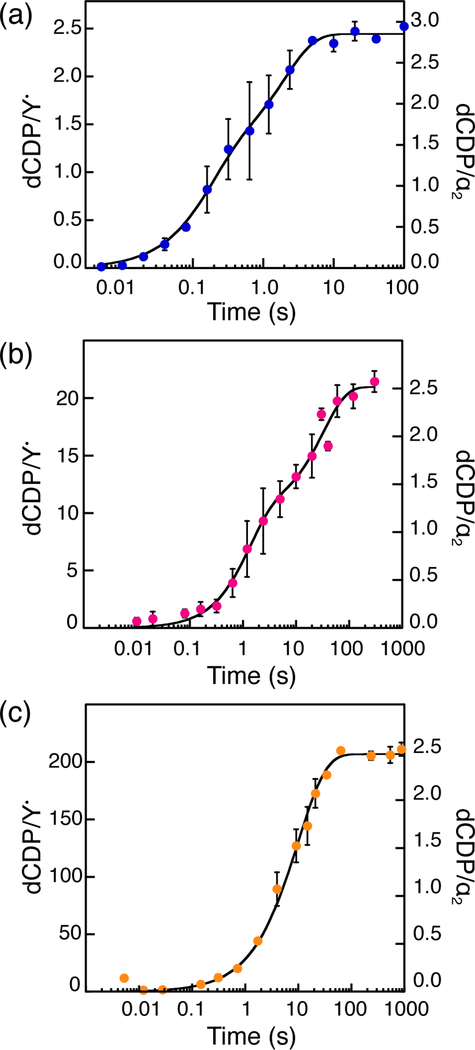
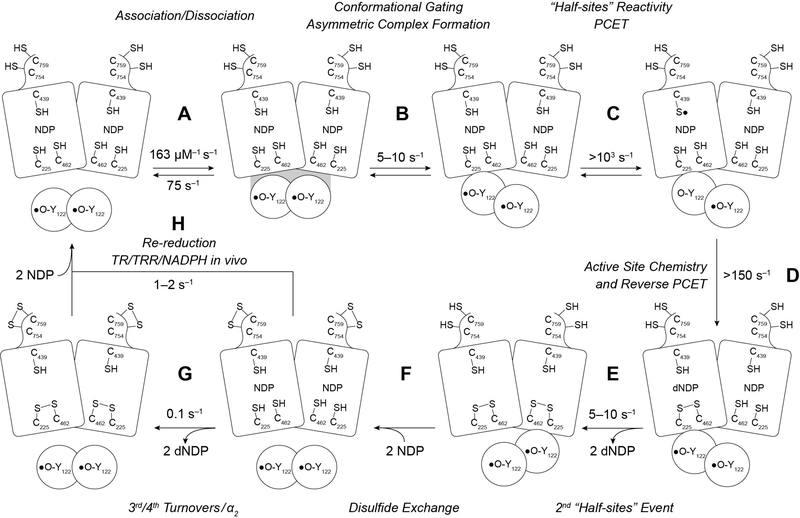
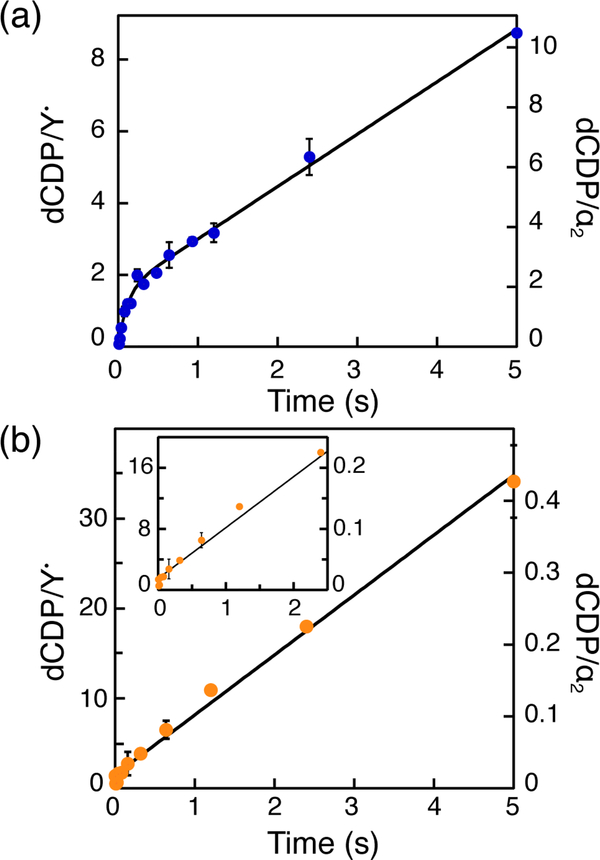
Ribonucleotide reductases (RNRs) catalyze the conversion of nucleotides (NDP) to deoxynucleotides (dNDP), in part, by controlling the ratios and quantities of dNTPs available for DNA replication and repair. The active form of class Ia RNR is an asymmetric αβ complex in which α contains the active site and β contains the stable diferric-tyrosyl radical cofactor responsible for initiating the reduction chemistry. Each dNDP is accompanied by disulfide bond formation. We now report that, under conditions, β can initiate turnover in α catalytically under both "one" turnover (no external reductant, though producing two dCDPs) and multiple turnover (with an external reductant) assay conditions. In the absence of reductant, rapid chemical quench analysis of a reaction of α, substrate, and effector with variable amounts of β (1-, 10-, and 100-fold less than α) yields 3 dCDP/α at all ratios of α:β with a rate constant of 8-9 s, associated with a rate-limiting conformational change. Stopped-flow fluorescence spectroscopy with a fluorophore-labeled β reveals that the rate constants for subunit association (163 ± 7 μM s) and dissociation (75 ± 10 s) are fast relative to turnover, consistent with catalytic β. When assaying in the presence of an external reducing system, the turnover number is dictated by the ratio of α:β, their concentrations, and the concentration and nature of the reducing system; the rate-limiting step can change from the conformational gating to a step or steps involving disulfide rereduction, dissociation of the inhibited αβ state, or both. The issues encountered with RNR are likely of importance in all class I RNRs and are central to understanding the development of screening assays for inhibitors of these enzymes.
核糖核苷酸还原酶(RNR)通过控制用于 DNA 复制和修复的 dNTP 的比例和数量,部分催化核苷酸(NDP)转化为脱氧核苷酸(dNDP)。Ia 类 RNR 的活性形式是一个不对称的αβ 复合物,其中α包含活性位点,β包含稳定的二铁酪氨酸自由基辅因子,负责引发还原化学。每个 dNDP 都伴随着二硫键的形成。我们现在报告,在某些条件下,β可以在α催化下启动周转,无论是在“一次”周转(没有外部还原剂,但产生两个 dCDP)还是多次周转(有外部还原剂)测定条件下。在没有还原剂的情况下,通过快速化学猝灭分析α、底物和效应物与不同量β(α的 1-、10-和 100 倍)的反应,在所有α:β比例下都得到 3 个 dCDP/α,速率常数为 8-9 s,与限速构象变化相关。带有荧光标记β的停流荧光光谱学研究表明,亚基缔合(163 ± 7 μM s)和解离(75 ± 10 s)的速率常数相对于周转是快速的,这与催化β一致。当在外部还原系统存在下进行测定时,周转率由α:β的比例、它们的浓度以及还原系统的浓度和性质决定;限速步骤可以从构象门控改变为涉及二硫键再还原、抑制的αβ 状态的解离或两者都有的步骤。在 RNR 中遇到的问题可能对所有 I 类 RNR 都很重要,并且是理解这些酶抑制剂筛选测定的核心。