Pu Xiangdong, Li Zhen, Tian Ya, Gao Ranran, Hao Lijun, Hu Yating, He Chunnian, Sun Wei, Xu Meimei, Peters Reuben J, Van de Peer Yves, Xu Zhichao, Song Jingyuan
Key Laboratory of Chinese Medicine Resources Conservation, State Administration of Traditional Chinese Medicine of the People's Republic of China, Institute of Medicinal Plant Development, Chinese Academy of Medical Sciences & Peking Union Medical College, Beijing, 100193, China.
Department of Plant Biotechnology and Bioinformatics, Ghent University, 9052, Ghent, Belgium.
New Phytol. 2020 Aug;227(3):930-943. doi: 10.1111/nph.16552. Epub 2020 Apr 18.
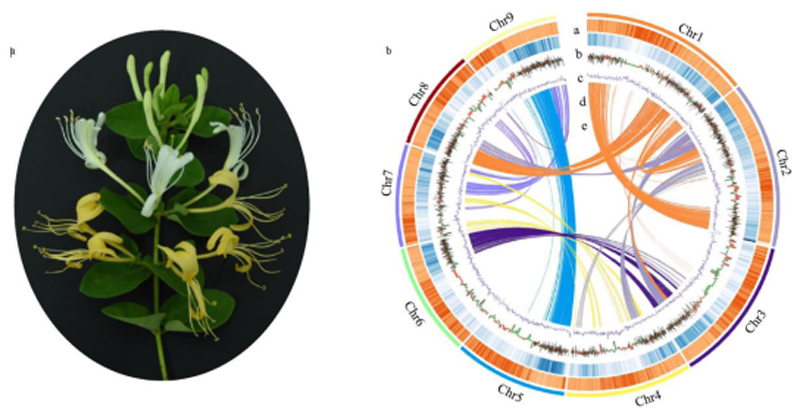
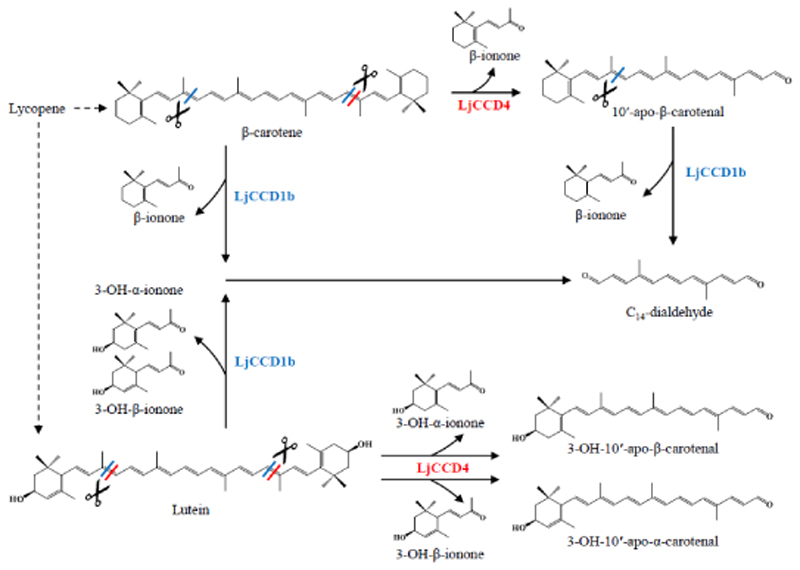
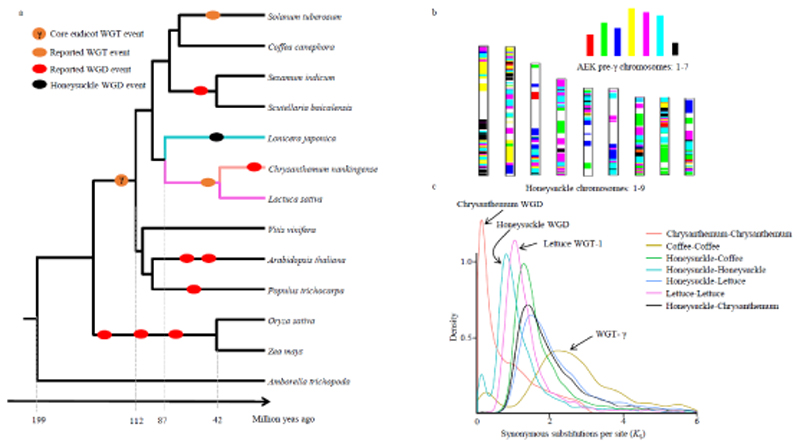
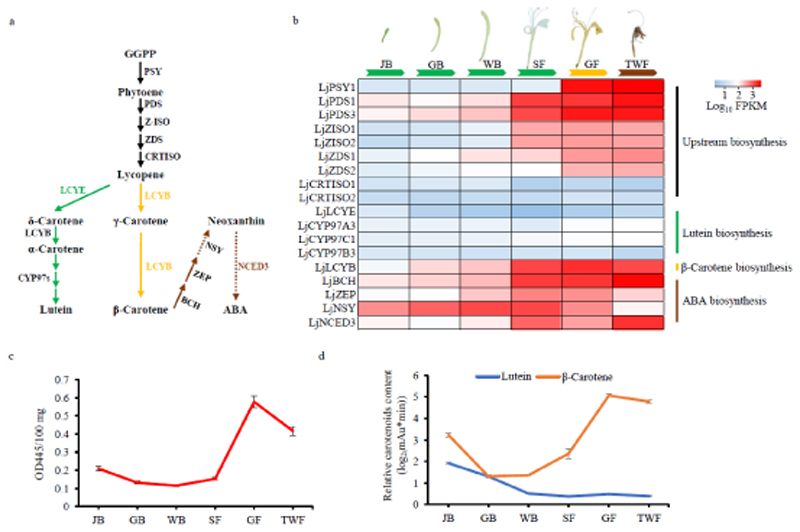
Lonicera japonica is a widespread member of the Caprifoliaceae (honeysuckle) family utilized in traditional medical practices. This twining vine honeysuckle also is a much-sought ornamental, in part due to its dynamic flower coloration, which changes from white to gold during development. The molecular mechanism underlying dynamic flower coloration in L. japonica was elucidated by integrating whole genome sequencing, transcriptomic analysis and biochemical assays. Here, we report a chromosome-level genome assembly of L. japonica, comprising nine pseudochromosomes with a total size of 843.2 Mb. We also provide evidence for a whole-genome duplication event in the lineage leading to L. japonica, which occurred after its divergence from Dipsacales and Asterales. Moreover, gene expression analysis not only revealed correlated expression of the relevant biosynthetic genes with carotenoid accumulation, but also suggested a role for carotenoid degradation in L. japonica's dynamic flower coloration. The variation of flower color is consistent with not only the observed carotenoid accumulation pattern, but also with the release of volatile apocarotenoids that presumably serve as pollinator attractants. Beyond novel insights into the evolution and dynamics of flower coloration, the high-quality L. japonica genome sequence also provides a foundation for molecular breeding to improve desired characteristics.
忍冬是忍冬科(金银花)中一种分布广泛的植物,在传统医学实践中有所应用。这种缠绕藤本金银花也是一种备受追捧的观赏植物,部分原因在于其花朵颜色变化动态,在发育过程中从白色变为金色。通过整合全基因组测序、转录组分析和生化测定,阐明了忍冬动态花色形成的分子机制。在此,我们报告了忍冬的染色体水平基因组组装,包括九条假染色体,总大小为843.2 Mb。我们还提供了证据,表明在导致忍冬的谱系中发生了一次全基因组复制事件,该事件发生在其与川续断目和菊目分化之后。此外,基因表达分析不仅揭示了相关生物合成基因与类胡萝卜素积累的相关性表达,还表明类胡萝卜素降解在忍冬动态花色形成中发挥了作用。花色的变化不仅与观察到的类胡萝卜素积累模式一致,还与挥发性脱落类胡萝卜素的释放一致,这些脱落类胡萝卜素可能起到吸引传粉者的作用。除了对花色进化和动态有新的见解外,高质量的忍冬基因组序列也为分子育种以改善所需性状提供了基础。