Department of Community Health, Faculty of Medicine and Health Sciences, Universiti Putra Malaysia, Selangor, Malaysia.
Department of Psychiatry, Faculty of Medicine and Health Sciences, Universiti Putra Malaysia, Selangor, Malaysia.
PLoS One. 2020 Mar 19;15(3):e0230363. doi: 10.1371/journal.pone.0230363. eCollection 2020.
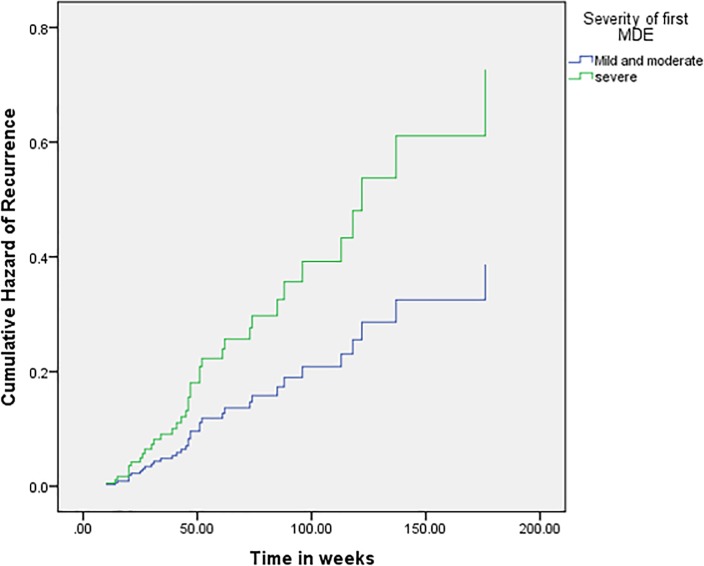
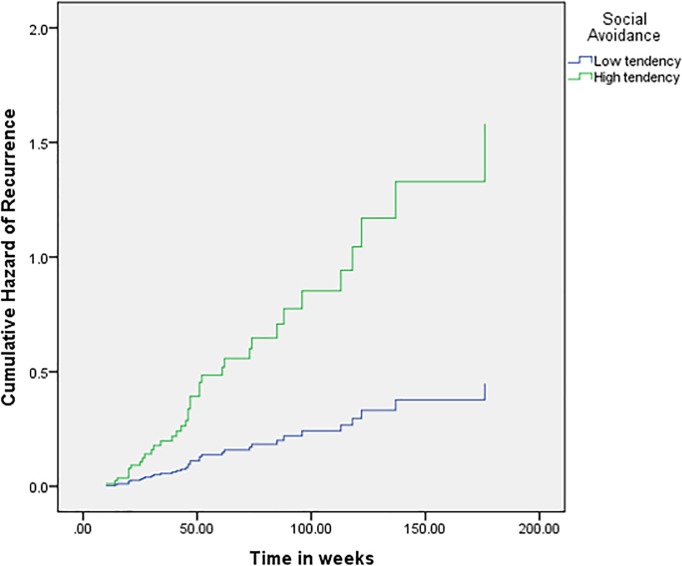
A total of 201 patients with major depressive disorder from four hospitals in Malaysia were followed up for 5 years to determine the prognostic factors of recurrent major depressive disorder that could potentially contribute to improving the management of MDD patients. For each individual patient, at the time of recruitment as part of a case-control study, information was collected on recent threatening life events, personality and social and occupational functioning, while blood samples were collected to genotype single nucleotide polymorphisms of vitamin D receptor (VDR), zinc transporter-3 (ZnT3), dopamine transporter-1 (DAT1), brain-derived neurotropic factor (BDNF), serotonin receptor 1A (HT1A) and 2A (HT2A) genes. Kaplan-Meier and Cox-regression were used to estimate hazard functions for recurrence of major depressive disorder. Individuals with severe MDD in previous major depressive episodes had five and a half times higher hazard of developing recurrence compared to mild and moderate MDD (HR = 5.565, 95% CI = 1.631-18.994, p = 0.006). Individuals who scored higher on social avoidance had three and a half times higher hazard of recurrence of MDD (HR = 3.525, 95% CI = 1.349-9.209; p = 0.010). There was significant interaction between ApaI +64978C>A single nucleotide polymorphism and severity. The hazard ratio increased by 6.4 times from mild and moderate to severe MDD for A/A genotype while that for C/A genotype increased by 11.3 times. Social avoidance and severity of depression at first episode were prognostic of recurrence. Screening for personality factors at first encounter with MDD patients needs to be considered as part of the clinical practice. For those at risk of recurrence in relation to social avoidance, the psychological intervention prescribed should be customized to focus on this modifiable factor. Prompt and appropriate management of severe MDD is recommended to reduce risk of recurrence.
共有 201 名来自马来西亚四家医院的重度抑郁症患者接受了 5 年的随访,以确定可能有助于改善重度抑郁症患者管理的复发性重度抑郁症的预后因素。对于每个个体患者,在作为病例对照研究一部分招募时,收集了近期威胁生命事件、人格以及社会和职业功能的信息,同时采集了血液样本以检测维生素 D 受体 (VDR)、锌转运蛋白-3 (ZnT3)、多巴胺转运蛋白-1 (DAT1)、脑源性神经营养因子 (BDNF)、5-羟色胺受体 1A (HT1A) 和 2A (HT2A) 基因的单核苷酸多态性。Kaplan-Meier 和 Cox 回归用于估计重度抑郁症复发的危险函数。与轻度和中度 MDD 相比,先前重度抑郁发作中患有严重 MDD 的个体复发的危险高五倍半 (HR = 5.565,95%CI = 1.631-18.994,p = 0.006)。社会回避得分较高的个体患 MDD 复发的危险高三倍半 (HR = 3.525,95%CI = 1.349-9.209;p = 0.010)。ApaI +64978C>A 单核苷酸多态性与严重程度之间存在显著的交互作用。对于 A/A 基因型,从轻度和中度到重度 MDD 的危险比增加了 6.4 倍,而对于 C/A 基因型,危险比增加了 11.3 倍。首次发作时的社会回避和抑郁严重程度是复发的预后因素。首次遇到 MDD 患者时需要考虑筛查人格因素,作为临床实践的一部分。对于那些因社会回避而有复发风险的患者,应根据该可改变因素定制心理干预措施。建议对重度 MDD 进行及时和适当的治疗,以降低复发风险。