Neuropsychiat Epidemiol & Clin Res, Univ Montpellier, INSERM, Montpellier, France
Neuropsychiat Epidemiol & Clin Res, Univ Montpellier, INSERM, Montpellier, France.
BMJ Open. 2020 Mar 18;10(3):e033751. doi: 10.1136/bmjopen-2019-033751.
Despite the recent awareness of the environment impact on brain ageing, the influence of the neighbourhood socioeconomic status on cognitive impairment remains unclear. Here, we investigated the effects of individual and neighbourhood deprivation on cognitive impairment in middle-aged and young-old people.
Cross-sectional study.
21 Health Screening Centres in the entire French metropolitan territory.
A total of 44 648 participants (age range: 45 to 69 years) from the French CONSTANCES cohort were included in the analyses.
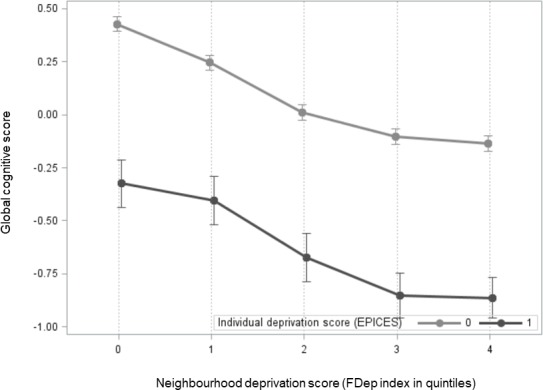
Associations between the overall cognitive score (based on a standardised battery of cognitive tests administered by neuropsychologists) and individual deprivation (Evaluation of Deprivation and Inequalities in Health Screening Centres; EPICES score) and geographical deprivation (French Deprivation Index; FDep index).
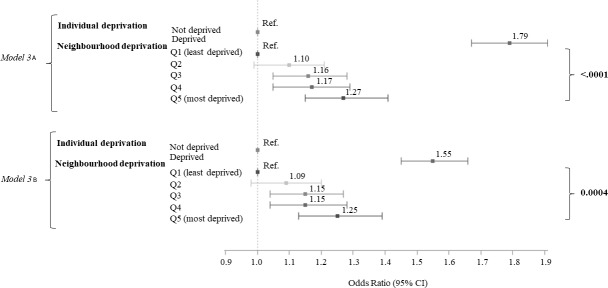
Based on the EPICES score (validated cut-off ≥30.17), 12% of participants were considered to be deprived. After mutual adjustment, individual and geographical deprivation were associated with higher cognitive impairment in a multilevel logistic regression analysis that was also adjusted for sociodemographic, lifestyle and health factors. Specifically, individual deprivation was associated with an odds increase of 55% (OR=1.55, 95% CI: 1.45 to 1.66). The risk of global cognitive impairment progressively increased with the neighbourhood deprivation level, evaluated by the FDep index (reference Q1; Q2: OR=1.09, 95% CI: 0.98 to 1.20; Q3: OR=1.15, 95% CI: 1.04 to 1.27; Q4: OR=1.15, 95% CI: 1.04 to 1.28; Q5: OR=1.25, 95% CI: 1.13 to 1.39).
Our results suggest that the neighbourhood socioeconomic deprivation level is associated with cognitive impairment, independently of the individual deprivation level. A better understanding of this association could help to define new prevention strategies to target high-risk residents and high-risk geographical areas in order to reduce social health inequalities.
尽管人们最近已经意识到环境对大脑衰老的影响,但邻里社会经济地位对认知障碍的影响仍不清楚。在这里,我们研究了个体和邻里贫困对中年和年轻老年人认知障碍的影响。
横断面研究。
法国整个大都市地区的 21 个健康筛查中心。
共纳入来自法国 CONSTANCES 队列的 44648 名参与者(年龄范围:45 至 69 岁)进行分析。
根据由神经心理学家进行的标准化认知测试组合得出的整体认知评分(基于认知测试标准组合的评分)与个体贫困(健康筛查中心的贫困和不平等评估;EPICES 评分)和地理贫困(法国贫困指数;FDep 指数)之间的关联。
根据 EPICES 评分(验证性截断值≥30.17),12%的参与者被认为贫困。在相互调整后,个体和地理贫困与多水平逻辑回归分析中的更高认知障碍相关,该分析还调整了社会人口统计学、生活方式和健康因素。具体而言,个体贫困与认知障碍的风险增加 55%相关(OR=1.55,95%CI:1.45 至 1.66)。随着邻里贫困水平的评估(通过 FDep 指数),整体认知障碍的风险逐渐增加(参考 Q1;Q2:OR=1.09,95%CI:0.98 至 1.20;Q3:OR=1.15,95%CI:1.04 至 1.27;Q4:OR=1.15,95%CI:1.04 至 1.28;Q5:OR=1.25,95%CI:1.13 至 1.39)。
我们的研究结果表明,邻里社会经济贫困水平与认知障碍有关,而与个体贫困水平无关。更好地理解这种关联可以帮助确定新的预防策略,以针对高危居民和高风险地理区域,从而减少社会健康不平等。