Department of Psychology, Indiana University Purdue University-Indianapolis, Indianapolis, Indiana, USA.
Department of Psychology, Richard L. Roudebush VAMC, Indianapolis, Indiana, USA.
Eur Psychiatry. 2020 Mar 23;63(1):e34. doi: 10.1192/j.eurpsy.2020.30.
Formal thought disorder (FTD) and social functioning impairments are core symptoms of schizophrenia. Although both have been observed for over a century, the strength of the relationship between FTD and social functioning remains unclear. Furthermore, a variety of methodological approaches have been used to assess these constructs-which may contribute to inconsistency in reported associations. This meta-analysis aimed to: (a) systematically test the relationship between FTD and social functioning and (b) determine if the methodology used to assess FTD and/or social functioning moderates this relationship.
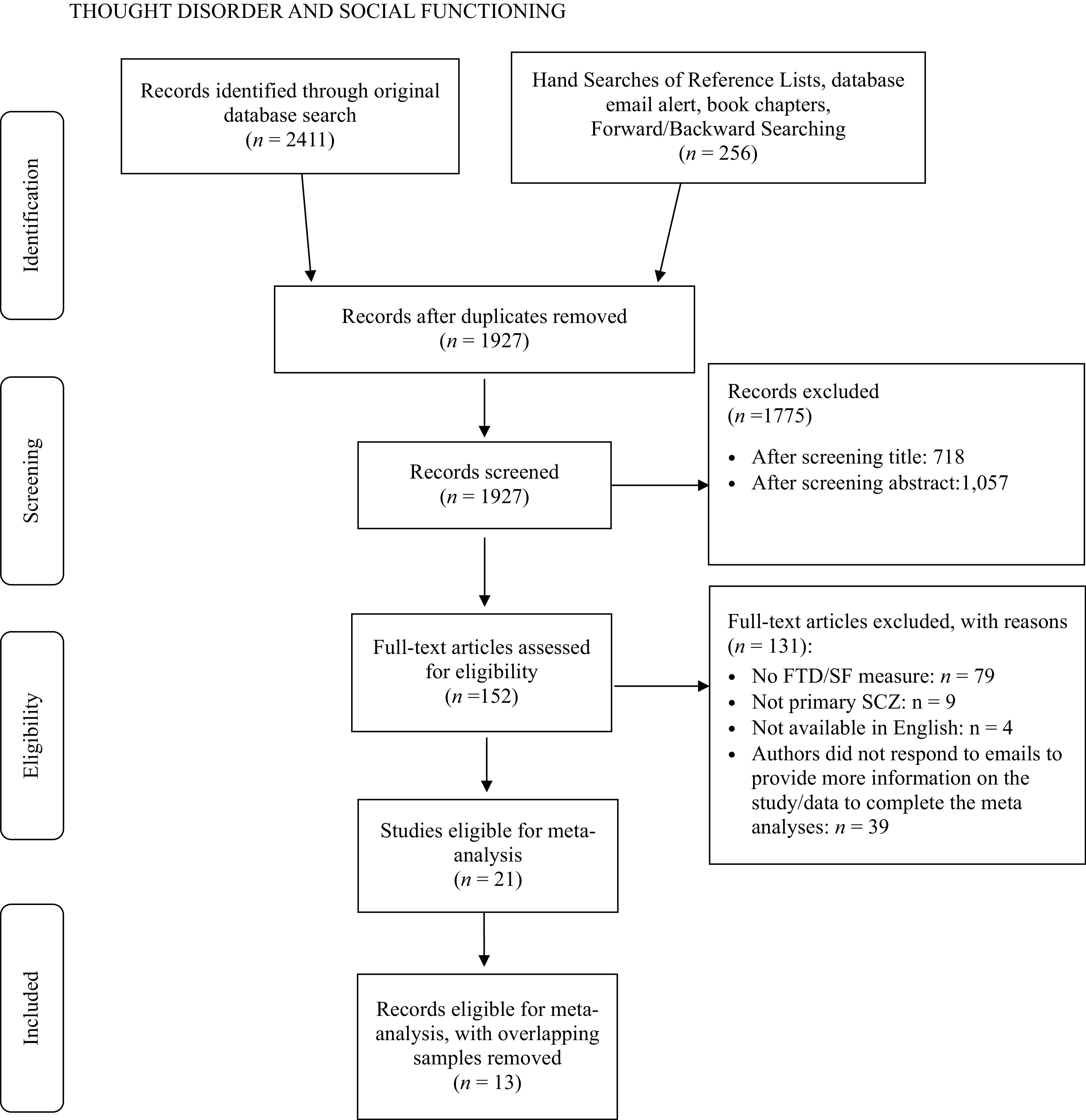
Following Preferred Reporting Items for Systematic reviews and Meta-analyses (PRISMA) guidelines, a targeted literature search was conducted on studies examining the relationship between FTD and social functioning. Correlations were extracted and used to calculate weighted mean effect sizes using a random effects model.
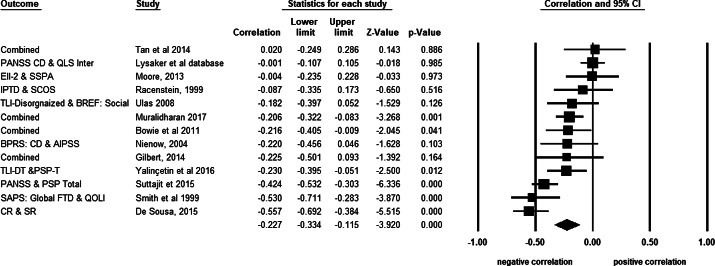
A total of 1,478 participants across 13 unique studies were included in this meta-analysis. A small-medium inverse association (r = -0.23, p < 0.001) was observed between FTD and social functioning. Although heterogeneity analyses produced a significant Q-statistic (Q = 52.77, p = <0.001), the relationship between FTD and social functioning was not moderated by methodology, study quality, demographic variables, or clinical factors.
Findings illustrate a negative association between FTD and social functioning. Despite differences in the methodological approach used and type of information assessed, measurement type and clinical factors did not moderate the relationship between FTD and social functioning. Future studies should explore whether other variables, such as cognitive processes (e.g., social cognition), may account for variability in associations between these constructs.
思维形式障碍(FTD)和社会功能障碍是精神分裂症的核心症状。尽管这两种症状已经被观察了一个多世纪,但 FTD 和社会功能之间的关系强度仍不清楚。此外,人们已经使用了各种方法学方法来评估这些结构,这可能导致报告的关联不一致。本荟萃分析旨在:(a)系统测试 FTD 和社会功能之间的关系,(b)确定用于评估 FTD 和/或社会功能的方法是否调节这种关系。
根据系统评价和荟萃分析的首选报告项目(PRISMA)指南,对研究 FTD 和社会功能之间关系的研究进行了有针对性的文献搜索。提取相关性,并使用随机效应模型计算加权平均效应大小。
共有 13 项独特研究的 1478 名参与者纳入本荟萃分析。FTD 和社会功能之间观察到小-中等负相关(r = -0.23,p < 0.001)。尽管异质性分析产生了显著的 Q 统计量(Q = 52.77,p < 0.001),但 FTD 和社会功能之间的关系不受方法学、研究质量、人口统计学变量或临床因素的调节。
研究结果表明 FTD 和社会功能之间存在负相关。尽管使用的方法学方法和评估的信息类型存在差异,但测量类型和临床因素并未调节 FTD 和社会功能之间的关系。未来的研究应探讨其他变量(例如认知过程[例如,社会认知])是否可以解释这些结构之间关联的可变性。