Rudrapatna Vivek A, Glicksberg Benjamin S, Avila Patrick, Harding-Theobald Emily, Wang Connie, Butte Atul J
Bakar Computational Health Sciences Institute, University of California, San Francisco, CA, United States.
Division of Gastroenterology, Department of Medicine, University of California, San Francisco, CA, United States.
BMJ Open Qual. 2020 Mar;9(1). doi: 10.1136/bmjoq-2019-000856.
Medical billing data are an attractive source of secondary analysis because of their ease of use and potential to answer population-health questions with statistical power. Although these datasets have known susceptibilities to biases, the degree to which they can distort the assessment of quality measures such as colorectal cancer screening rates are not widely appreciated, nor are their causes and possible solutions.
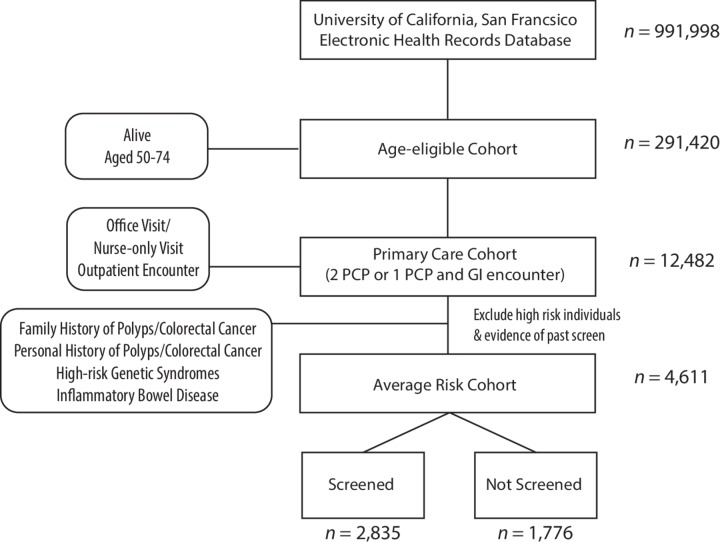
Using a billing code database derived from our institution's electronic health records, we estimated the colorectal cancer screening rate of average-risk patients aged 50-74 years seen in primary care or gastroenterology clinic in 2016-2017. 200 records (150 unscreened, 50 screened) were sampled to quantify the accuracy against manual review.
Out of 4611 patients, an analysis of billing data suggested a 61% screening rate, an estimate that matches the estimate by the Centers for Disease Control. Manual review revealed a positive predictive value of 96% (86%-100%), negative predictive value of 21% (15%-29%) and a corrected screening rate of 85% (81%-90%). Most false negatives occurred due to examinations performed outside the scope of the database-both within and outside of our institution-but 21% of false negatives fell within the database's scope. False positives occurred due to incomplete examinations and inadequate bowel preparation. Reasons for screening failure include ordered but incomplete examinations (48%), lack of or incorrect documentation by primary care (29%) including incorrect screening intervals (13%) and patients declining screening (13%).
Billing databases are prone to substantial bias that may go undetected even in the presence of confirmatory external estimates. Caution is recommended when performing population-level inference from these data. We propose several solutions to improve the use of these data for the assessment of healthcare quality.
医疗计费数据因其易于使用且有潜力通过统计功效回答人群健康问题,是二次分析的一个有吸引力的来源。尽管这些数据集已知易受偏差影响,但它们在多大程度上会扭曲诸如结直肠癌筛查率等质量指标的评估,并未得到广泛认识,其原因和可能的解决方案也未得到广泛认识。
利用从我们机构的电子健康记录中获取的计费代码数据库,我们估计了2016 - 2017年在初级保健或胃肠病学诊所就诊的50 - 74岁平均风险患者的结直肠癌筛查率。抽取200条记录(150条未筛查,50条已筛查)以量化与人工审核相比的准确性。
在4611名患者中,计费数据分析显示筛查率为61%,这一估计与疾病控制中心的估计相符。人工审核显示阳性预测值为96%(86% - 100%),阴性预测值为21%(15% - 29%),校正后的筛查率为85%(81% - 90%)。大多数假阴性是由于在数据库范围之外进行的检查——包括我们机构内外——但21%的假阴性在数据库范围内。假阳性是由于检查不完整和肠道准备不足。筛查失败的原因包括已开单但检查不完整(48%)、初级保健缺乏或记录不正确(29%),包括筛查间隔不正确(13%)以及患者拒绝筛查(13%)。
计费数据库容易出现重大偏差,即使存在外部确认估计,这些偏差也可能未被发现。在从这些数据进行人群水平推断时建议谨慎。我们提出了几种解决方案,以改进这些数据在医疗质量评估中的使用。