Tian Hongrui, Yang Wei, Hu Yanjun, Liu Zhen, Chen Lei, Lei Liang, Zhang Fan, Cai Fen, Xu Huawen, Liu Mengfei, Guo Chuanhai, Chen Yun, Xiao Ping, Chen Junhui, Ji Ping, Fang Zhengyu, Liu Fangfang, Liu Ying, Pan Yaqi, Dos-Santos-Silva Isabel, He Zhonghu, Ke Yang
Key laboratory of Carcinogenesis and Translational Research (Ministry of Education/Beijing), Laboratory of Genetics, Peking University Cancer Hospital & Institute, Beijing, China.
Cancer Hospital of Shantou University Medical College, Guangdong Province, China.
EClinicalMedicine. 2020 Mar 20;20:100312. doi: 10.1016/j.eclinm.2020.100312. eCollection 2020 Mar.
We aimed to establish a Medical-Insurance-System-based Cancer Surveillance System (MIS-CASS) in China and evaluate the completeness and timeliness of this system through reporting cancer incidence rates using claims data in two regions in northern and southern China.
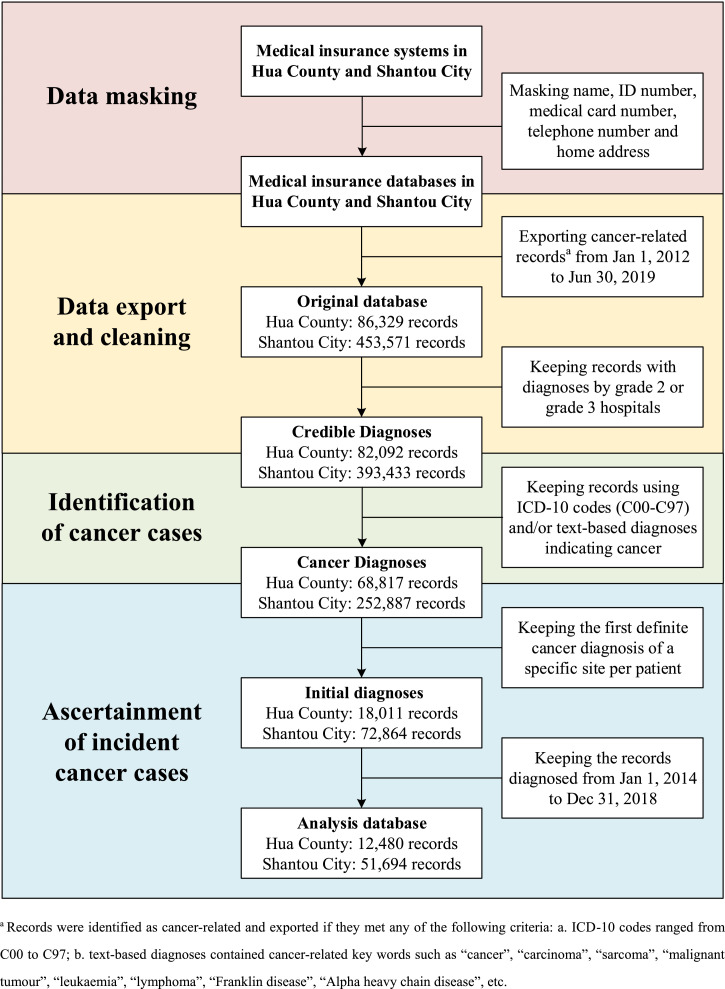
We extracted claims data from medical insurance systems in Hua County of Henan Province, and Shantou City in Guangdong Province in China from Jan 1, 2012 to Jun 30, 2019. These two regions have been considered to be high risk regions for oesophageal cancer. We developed a rigorous procedure to establish the MIS-CASS, which includes data extraction, cleaning, processing, case ascertainment, privacy protection, etc. Text-based diagnosis in conjunction with ICD-10 codes were used to determine cancer diagnosis.
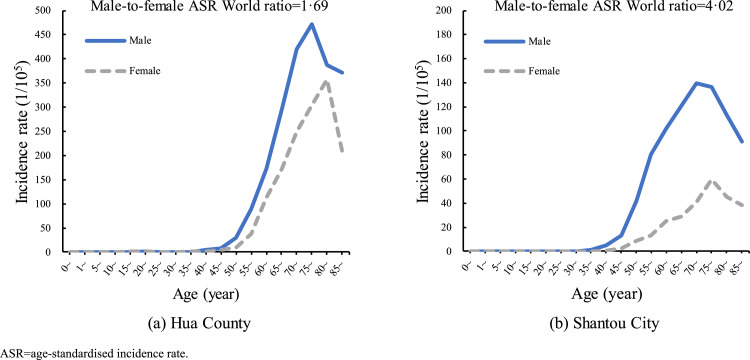
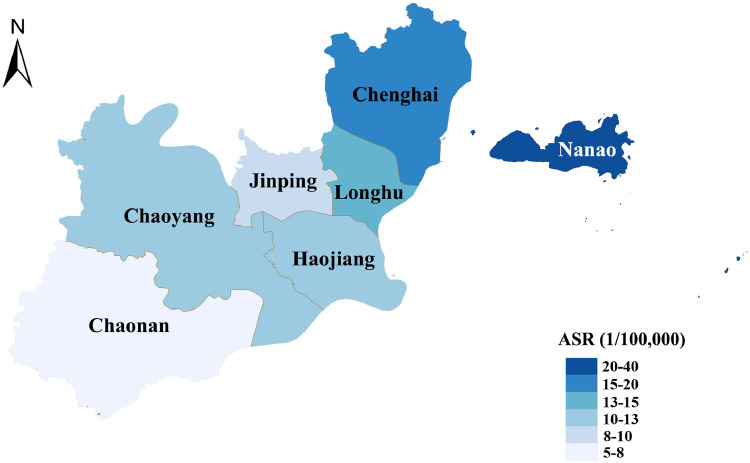
In 2018, the overall age-standardised (Segi population) incidence rates (ASR World) of cancer in Hua County and Shantou City were 167·39/100,000 and 159·78/100,000 respectively. In both of these areas, lung cancer and breast cancer were the most common cancers in males and females respectively. Hua County is a high-risk region for oesophageal cancer (ASR World: 25·95/100,000), whereas Shantou City is not a high-risk region for oesophageal cancer (ASR World: 11·43/100,000). However, Nanao island had the highest incidence of oesophageal cancer among all districts and counties in Shantou (ASR World: 36·39/100,000). The age-standardised male-to-female ratio for oesophageal cancer was lower in Hua County than in Shantou (1·69 vs. 4·02). A six-month lag time was needed to report these cancer incidences for the MIS-CASS.
MIS-CASS efficiently reflects cancer burden in real-time, and has the potential to provide insight for improvement of cancer surveillance in China.
The National Key R&D Program of China (2016YFC0901404), the Digestive Medical Coordinated Development Center of Beijing Municipal Administration of Hospitals (XXZ0204), the Sanming Project of Shenzhen (SZSM201612061), and the Shantou Science and Technology Bureau (190829105556145, 180918114960704).
我们旨在在中国建立一个基于医疗保险系统的癌症监测系统(MIS-CASS),并通过利用中国北方和南方两个地区的理赔数据报告癌症发病率,评估该系统的完整性和及时性。
我们提取了中国河南省滑县和广东省汕头市医疗保险系统2012年1月1日至2019年6月30日期间的理赔数据。这两个地区被认为是食管癌的高风险地区。我们制定了一套严格的程序来建立MIS-CASS,包括数据提取、清理、处理、病例确定、隐私保护等。结合ICD-10编码的文本诊断用于确定癌症诊断。
2018年,滑县和汕头市癌症的总体年龄标准化(世标人口)发病率(世界ASR)分别为167.39/10万和159.78/10万。在这两个地区,肺癌和乳腺癌分别是男性和女性中最常见的癌症。滑县是食管癌的高风险地区(世界ASR:25.95/10万),而汕头市不是食管癌的高风险地区(世界ASR:11.43/10万)。然而,南澳岛在汕头市所有区县中食管癌发病率最高(世界ASR:36.39/10万)。滑县食管癌的年龄标准化男女比例低于汕头市(1.69对4.02)。MIS-CASS报告这些癌症发病率需要6个月的延迟时间。
MIS-CASS能够有效地实时反映癌症负担,并有可能为改善中国的癌症监测提供见解。
国家重点研发计划(2016YFC0901404)、北京市医院管理局消化医学协同发展中心(XXZ0204)、深圳市三名工程(SZSM201612061)以及汕头市科学技术局(190829105556145、180918114960704)。