Institute for Addiction Science, Department of Preventive Medicine, University of Southern California Keck School of Medicine, Los Angeles, CA, United States; Department of Psychology, University of Southern California, Los Angeles, CA, United States.
Institute for Addiction Science, Department of Preventive Medicine, University of Southern California Keck School of Medicine, Los Angeles, CA, United States.
Addict Behav. 2020 Aug;107:106403. doi: 10.1016/j.addbeh.2020.106403. Epub 2020 Mar 19.
Identifying e-cigarette product characteristics that moderate the effects of non-tobacco flavors and nicotine on user appeal can inform regulations issued in tandem with e-cigarette nicotine and flavor policies aimed to protect young adult health. An e-cigarette device's electrical power affects the amount of solution aerosolized per puff, leading to more concentrated or diluted aerosol, which may alter product appeal. This laboratory experiment tested whether e-cigarette device power moderated the independent and interactive effects of non-tobacco flavors and nicotine on appeal in young adults.
In a within-subject design single-visit protocol, young adult e-cigarette users (N = 100) administered standardized doses of e-cigarette solutions varying in flavor (fruit, menthol, tobacco) and nicotine (nicotine-containing [6 mg/mL], nicotine-free). Solutions were administered via a variable-voltage tank-style device at low (7.3 W[3.3 V@1.5 Ω resistance]) and high (12.3 W[4.3 V@1.5 Ω resistance]) power settings. Participants rated each dose's appeal (0-100 scale).
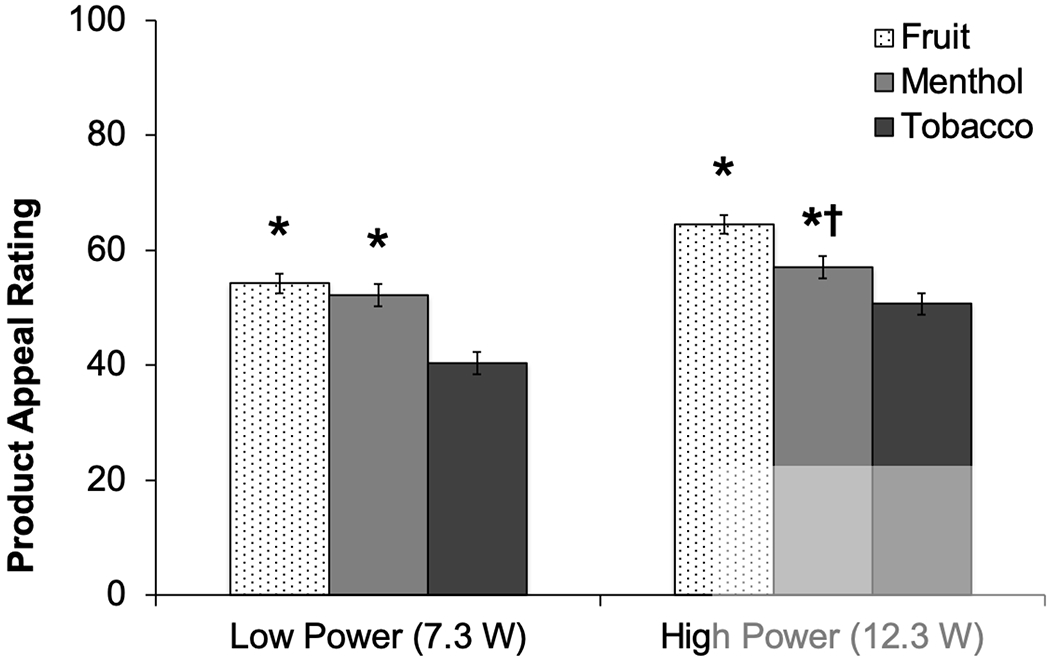
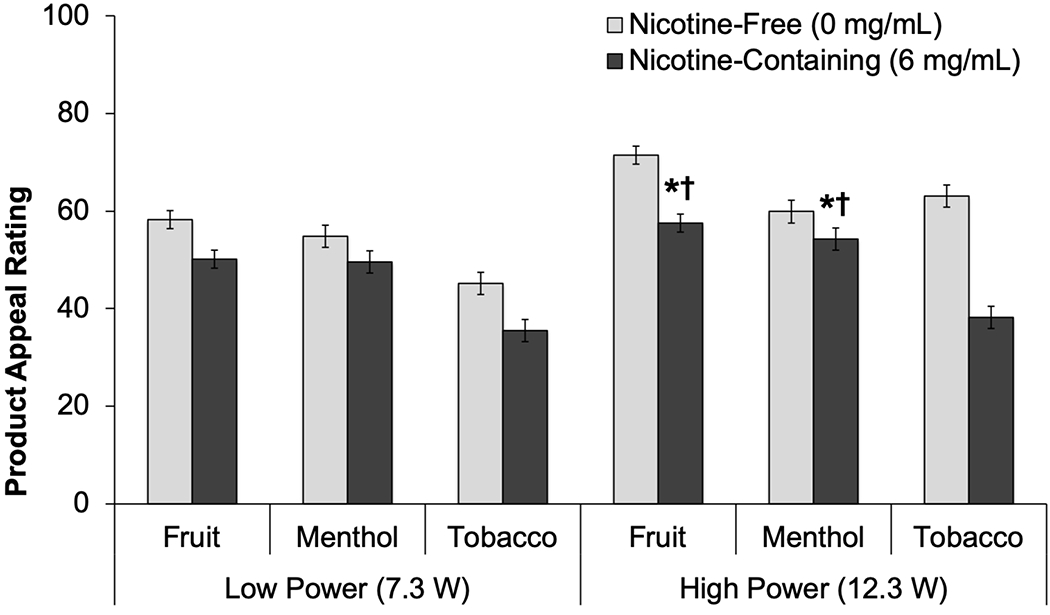
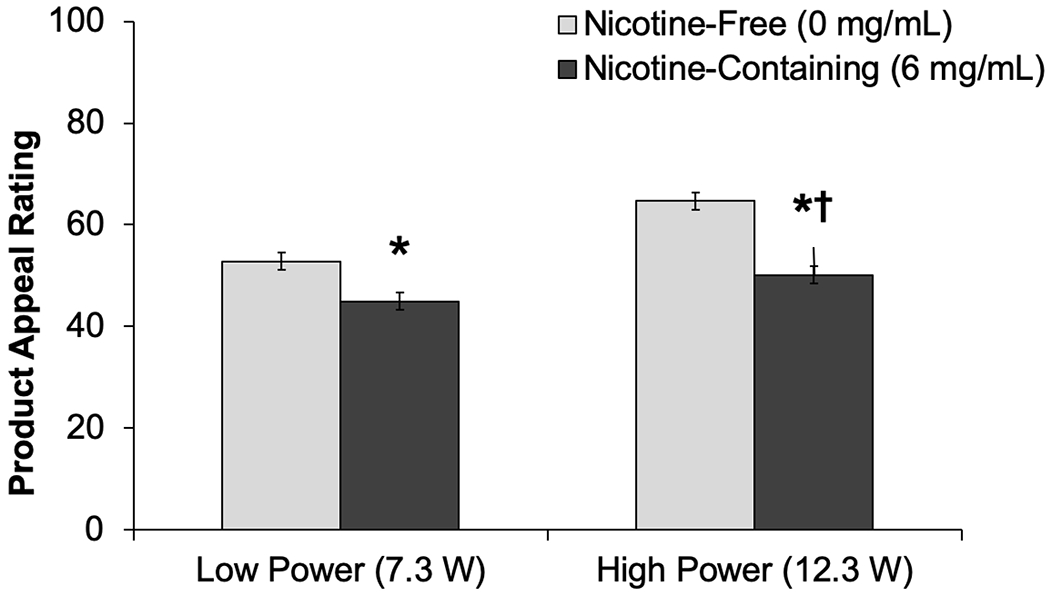
The high (vs. low) power setting attenuated the appeal-enhancing effects of menthol (vs. tobacco) flavors (Menthol × Power, estimate = -5.44, P = .03). Power did not moderate the appeal-enhancing effects of fruit flavors. High (vs. low) power amplified the appeal-reducing effects of nicotine-containing (vs. nicotine-free) solutions (Nicotine × Power, estimate = 6.69, P < .001) and augmented the extent to which fruit and menthol flavors suppressed nicotine's appeal-reducing effects (Flavor × Nicotine × Power, estimates = 9.40-14.85, Ps≤0.03).
E-cigarette device power appears to moderate flavor- and nicotine-induced changes in product appeal in nuanced ways, including by augmenting the ability of non-tobacco flavors to mask nicotine's appeal-reducing effects. Regulatory restrictions on high-powered e-cigarette devices warrant consideration in efforts to protect young adult health.
确定电子烟产品特性,这些特性可以调节非烟草口味和尼古丁对用户吸引力的影响,这可以为与电子烟尼古丁和口味政策同时发布的法规提供信息,这些政策旨在保护年轻成年人的健康。电子烟设备的电源会影响每口产生的溶液气溶胶量,导致气溶胶更集中或更稀释,从而可能改变产品的吸引力。这项实验室实验测试了电子烟设备的电源是否调节了非烟草口味和尼古丁对年轻人吸引力的独立和交互影响。
在一项基于个体的单次访问方案中,年轻的成年电子烟使用者(N=100)通过可变电压罐式设备,以低(7.3W[3.3V@1.5Ω电阻])和高(12.3W[4.3V@1.5Ω电阻])功率设置,施用不同口味(水果、薄荷、烟草)和尼古丁含量(含尼古丁[6mg/mL]、不含尼古丁)的电子烟溶液标准剂量。参与者对每种剂量的吸引力(0-100 分制)进行评分。
高(低)功率设置减弱了薄荷(烟草)口味增强吸引力的效果(薄荷×功率,估计=-5.44,P=0.03)。功率没有调节水果口味增强吸引力的效果。高(低)功率放大了含尼古丁(不含尼古丁)溶液降低吸引力的效果(尼古丁×功率,估计=6.69,P<.001),并增加了水果和薄荷口味抑制尼古丁降低吸引力效果的程度(口味×尼古丁×功率,估计值=9.40-14.85,P≤0.03)。
电子烟设备的电源似乎以细微的方式调节了口味和尼古丁引起的产品吸引力变化,包括增强了非烟草口味掩盖尼古丁降低吸引力效果的能力。限制大功率电子烟设备的法规值得在保护年轻成年人健康的努力中考虑。