Dini Irene, Graziani Giulia, Fedele Francesca Luisa, Sicari Andrea, Vinale Francesco, Castaldo Luigi, Ritieni Alberto
Department of Pharmacy, University of Naples Federico II, Via Domenico Montesano 49, 80141 Napoli, Italy.
LINFA SCARL. Via Zona Industriale Porto San Salvo, 89900 Vibo Valentia, Italy.
Antioxidants (Basel). 2020 Mar 27;9(4):284. doi: 10.3390/antiox9040284.
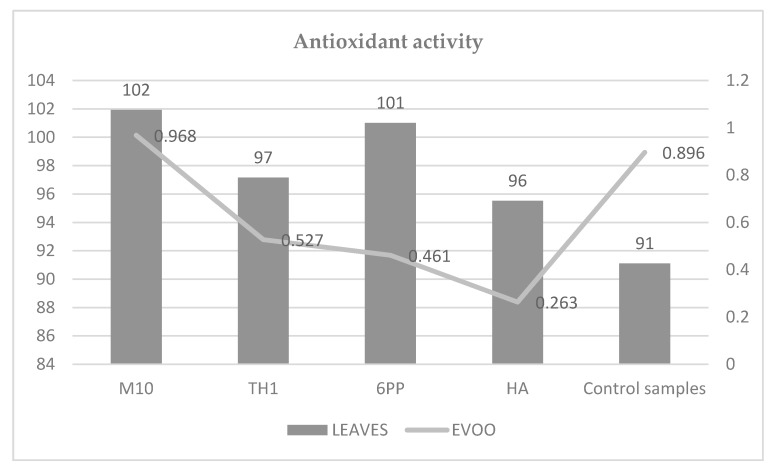
Olive trees are grown on five continents. Fertilization of fields, pest control management, olive leaves, olive pomaces, and olive mill wastewaters have a substantial environmental impact. It is possible to reduce this problem by using organic products to cultivate and decrease olive oil processing waste by recovering the bioactive molecules. In this work, the effects of biostimulation, with beneficial microbes belonging to the genera, and with secondary metabolites (6PP and the HA) were evaluated on the phenolic profile and the antioxidant potential of extra-virgin olive oil (EVOO) and olive leaf samples to make them more commercially attractive as a source of phytochemicals useful for the pharmaceutical, cosmetic, and food industries. Phenolics were identified and quantified by a spectrometer method using Q Exactive Orbitrap UHPLC-MS/MS (Ultra High Pressure Liquid Chromatography). Antioxidant activity was evaluated spectrophotometrically by the DPPH test. The use of Trichoderma strains, 6PP (6-Pentyl--Pyrone) and HA (Harzianic Acid), was demonstrated as an effective strategy to increase the leaves' economic value as a source of phytochemicals (flavonoids, lignans, and oleuropein) useful for food, pharmaceutical, and cosmetic industries.
橄榄树生长在五大洲。田间施肥、病虫害防治管理、橄榄叶、橄榄果渣和橄榄油厂废水对环境有重大影响。通过使用有机产品进行种植,并通过回收生物活性分子来减少橄榄油加工废料,有可能减少这一问题。在这项工作中,评估了用属于特定属的有益微生物以及次生代谢产物(6PP和哈茨木酸)进行生物刺激,对特级初榨橄榄油(EVOO)和橄榄叶样品的酚类成分及抗氧化潜力的影响,以使它们作为对制药、化妆品和食品工业有用的植物化学物质来源更具商业吸引力。通过使用Q Exactive Orbitrap超高效液相色谱-质谱联用仪(UHPLC-MS/MS)的光谱仪方法对酚类物质进行鉴定和定量。通过DPPH试验分光光度法评估抗氧化活性。已证明使用木霉菌株、6PP(6-戊基-α-吡喃酮)和HA(哈茨木酸)是提高橄榄叶作为对食品、制药和化妆品工业有用的植物化学物质(黄酮类、木脂素和橄榄苦苷)来源的经济价值的有效策略。