Dini Irene, Marra Roberta, Cavallo Pierpaolo, Pironti Angela, Sepe Immacolata, Troisi Jacopo, Scala Giovanni, Lombari Pasquale, Vinale Francesco
Department of Pharmacy, University of Naples Federico II, 80141 Naples, Italy.
Department of Agricultural Sciences, University of Naples Federico II, Portici, 80055 Naples, Italy.
Metabolites. 2021 Mar 31;11(4):213. doi: 10.3390/metabo11040213.
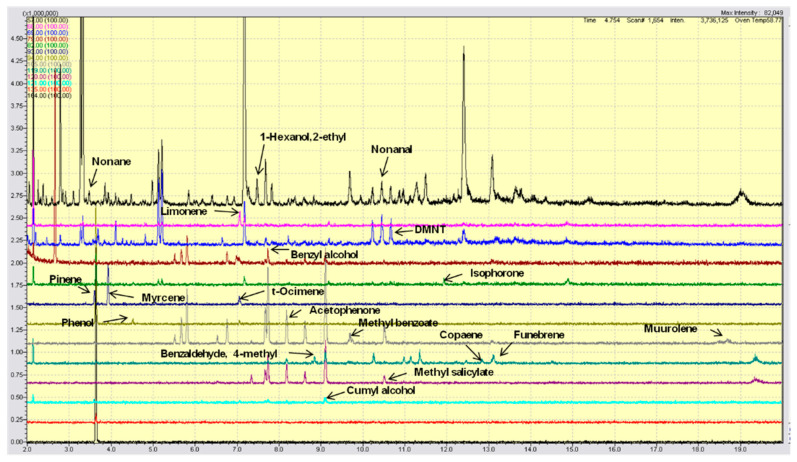
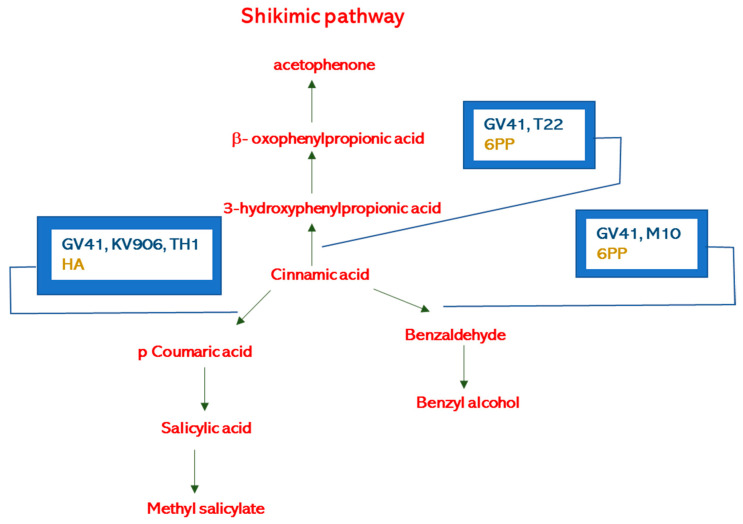
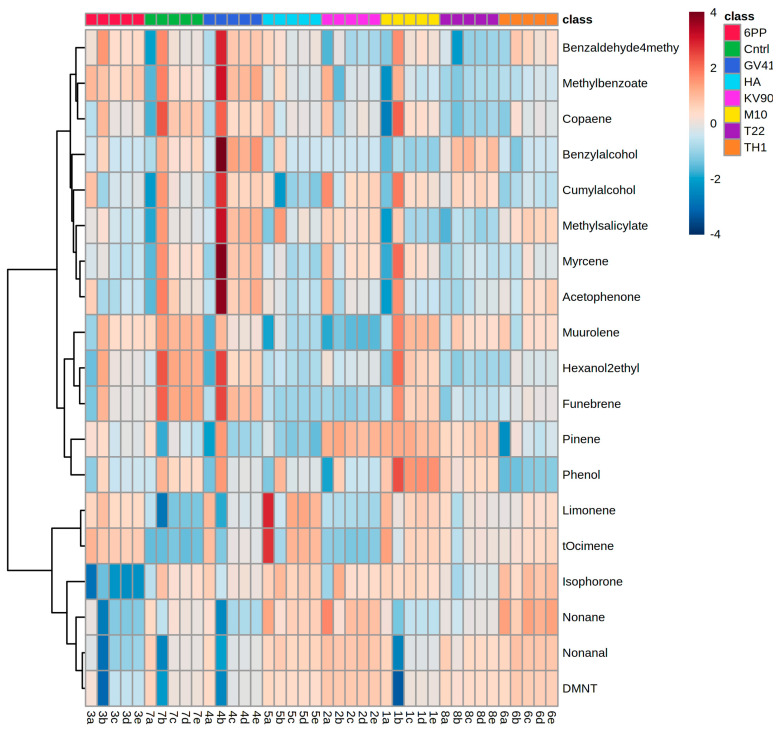
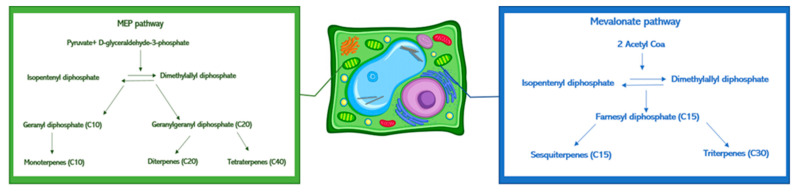
Plants emit volatile organic compounds (VOCs) that induce metabolomic, transcriptomic, and behavioral reactions in receiver organisms, including insect pollinators and herbivores. VOCs' composition and concentration may influence plant-insect or plant-plant interactions and affect soil microbes that may interfere in plant-plant communication. Many fungi act as biocontrol agents of phytopathogens and plant growth promoters. Moreover, they can stimulate plant defense mechanisms against insect pests. This study evaluated VOCs' emission by olive trees ( L.) when selected fungi or metabolites were used as soil treatments. strains M10, T22, and TH1, strain KV906, strain GV41, and their secondary metabolites harzianic acid (HA), and 6-pentyl-α-pyrone (6PP) were applied to olive trees. Charcoal cartridges were employed to adsorb olive VOCs, and gas chromatography mass spectrometry (GC-MS) analysis allowed their identification and quantification. A total of 45 volatile compounds were detected, and among these, twenty-five represented environmental pollutants and nineteen compounds were related to olive plant emission. strains and metabolites differentially enhanced VOCs production, affecting three biosynthetic pathways: methylerythritol 1-phosphate (MEP), lipid-signaling, and shikimate pathways. Multivariate analysis models showed a characteristic fingerprint of each plant-fungus/metabolite relationship, reflecting a different emission of VOCs by the treated plants. Specifically, strain M10 and the metabolites 6PP and HA enhanced the monoterpene syntheses by controlling the MEP pathway. Strains GV41, KV906, and the metabolite HA stimulated the hydrocarbon aldehyde formation (nonanal) by regulating the lipid-signaling pathway. Finally, strains GV41, M10, T22, TH1, and the metabolites HA and 6PP improve aromatic syntheses at different steps of the shikimate pathway.
植物会释放挥发性有机化合物(VOCs),这些化合物会在受体生物中引发代谢组学、转录组学和行为反应,受体生物包括昆虫传粉者和食草动物。VOCs的组成和浓度可能会影响植物与昆虫或植物与植物之间的相互作用,并影响可能干扰植物间通讯的土壤微生物。许多真菌可作为植物病原体的生物防治剂和植物生长促进剂。此外,它们还能刺激植物对害虫的防御机制。本研究评估了在选用真菌或代谢物作为土壤处理剂时,油橄榄(L.)释放VOCs的情况。将菌株M10、T22和TH1、菌株KV906、菌株GV41及其次生代谢物哈茨木酸(HA)和6-戊基-α-吡喃酮(6PP)施用于油橄榄树。使用活性炭管吸附油橄榄的VOCs,并通过气相色谱-质谱联用(GC-MS)分析对其进行鉴定和定量。共检测到45种挥发性化合物,其中25种为环境污染物,19种化合物与油橄榄植株的释放有关。菌株和代谢物不同程度地增强了VOCs的产生,影响了三条生物合成途径:甲基赤藓糖醇1-磷酸(MEP)途径、脂质信号途径和莽草酸途径。多变量分析模型显示了每种植物-真菌/代谢物关系的特征指纹图谱,反映了经处理植物释放VOCs的差异。具体而言,菌株M10以及代谢物6PP和HA通过控制MEP途径增强了单萜的合成。菌株GV41、KV906以及代谢物HA通过调节脂质信号途径刺激了烃醛(壬醛)的形成。最后,菌株GV41、M10、T22、TH1以及代谢物HA和6PP在莽草酸途径的不同步骤促进了芳香族化合物的合成。