Department of Nutrition Harvard T.H. Chan School of Public Health Boston MA.
Channing Division of Network Medicine Department of Medicine Brigham and Women's Hospital and Harvard Medical School Boston MA.
J Am Heart Assoc. 2020 Apr 7;9(7):e013877. doi: 10.1161/JAHA.119.013877. Epub 2020 Apr 1.
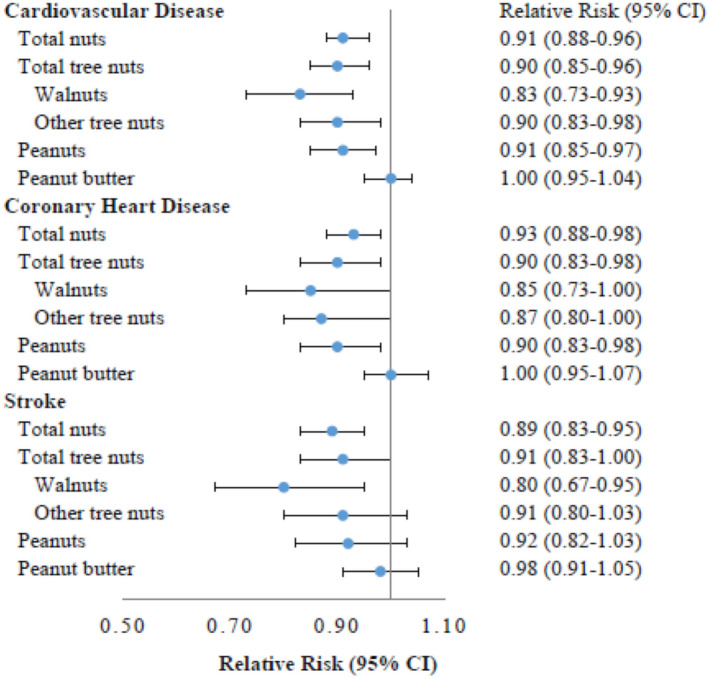
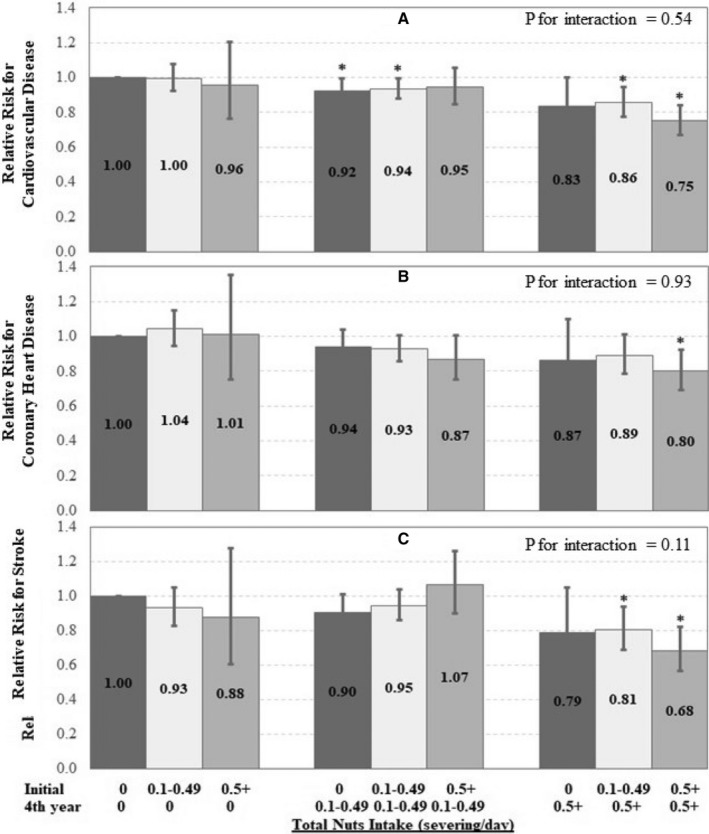
Background We aim to evaluate the association of within-individual changes in consumption of total and specific types of nuts and the subsequent risk of incident cardiovascular disease (CVD) in US men and women. Methods and Results We included 34 103 men from the HPFS (Health Professionals Follow-Up Study) (1986-2012), 77 815 women from the NHS (Nurses' Health Study) (1986-2012), and 80 737 women from the NHS II (1991-2013). We assessed nut consumption every 4 years using validated food frequency questionnaires. We used multivariable Cox proportional hazards regression models to examine the association between 4-year changes in nut consumption and risk of confirmed CVD end points in the subsequent 4 years. Per 0.5 serving/day increase in total nut consumption was associated with lower risk of CVD (relative risk [RR], 0.92; 95% CI, 0.86-0.98), coronary heart disease (RR, 0.94; 95% CI, 0.89-0.99), and stroke (RR, 0.89; 95% CI, 0.83-0.95). Compared with individuals who remained nonconsumers in a 4-year interval, those who had higher consumption of total nuts (≥0.5 servings/day) had a lower risk of CVD (RR, 0.75; 95% CI, 0.67-0.84), coronary heart disease (RR, 0.80; 95% CI, 0.69-0.93), and stroke (RR, 0.68; 95% CI, 0.57-0.82) in next 4 years. Individuals who decreased nut consumption by ≥0.50 servings/day had a higher risk of developing CVD (RR, 1.14; 95% CI, 0.99-1.32), coronary heart disease (RR, 1.06; 95% CI, 0.88-1.28), and stroke (RR, 1.28; 95% CI, 1.02-1.60) when compared with those who maintained their nut consumption. Conclusions Increasing total consumption of nuts and intake of individual types of nuts (eg, walnuts, other tree nuts, and peanuts) was associated with a subsequent lower risk of CVD. These data support the role of nut intake in the primary prevention of CVD. Registration URL: http://www.clinicaltrials.gov. Unique identifiers: NCT00005152 and NCT00005182.
背景 我们旨在评估个体中坚果总摄入量和特定类型坚果摄入量的变化与随后发生心血管疾病(CVD)风险之间的关联,该研究对象为美国男性和女性。
方法和结果 我们纳入了来自 HPFS(卫生专业人员随访研究)(1986-2012 年)的 34103 名男性、来自 NHS(护士健康研究)(1986-2012 年)的 77815 名女性和 NHS II(1991-2013 年)的 80737 名女性。我们每 4 年使用经过验证的食物频率问卷评估坚果的摄入量。我们使用多变量 Cox 比例风险回归模型来研究在接下来的 4 年中,4 年内坚果消费变化与确诊 CVD 终点之间的关联。与总坚果摄入量每增加 0.5 份/天相关的 CVD(相对风险 [RR],0.92;95%CI,0.86-0.98)、冠心病(RR,0.94;95%CI,0.89-0.99)和中风(RR,0.89;95%CI,0.83-0.95)风险降低。与在 4 年间隔内仍不食用坚果的个体相比,那些在 4 年内食用更多总坚果(≥0.5 份/天)的个体 CVD(RR,0.75;95%CI,0.67-0.84)、冠心病(RR,0.80;95%CI,0.69-0.93)和中风(RR,0.68;95%CI,0.57-0.82)的风险更低。与维持坚果摄入量相比,摄入量减少≥0.50 份/天的个体发生 CVD(RR,1.14;95%CI,0.99-1.32)、冠心病(RR,1.06;95%CI,0.88-1.28)和中风(RR,1.28;95%CI,1.02-1.60)的风险更高。
结论 增加坚果总摄入量和特定类型坚果(如核桃、其他树坚果和花生)的摄入量与随后较低的 CVD 风险相关。这些数据支持坚果摄入量在 CVD 一级预防中的作用。
http://www.clinicaltrials.gov。唯一标识符:NCT00005152 和 NCT00005182。