Chaithra Sudhakar Pushpa, Prasad Shweta, Holla Vikram Venkappayya, Stezin Albert, Kamble Nitish, Yadav Ravi, Pal Pramod Kumar
Department of Neurology, National Institute of Mental Health and Neurosciences, Bangalore, India.
Department of Clinical Neurosciences, National Institute of Mental Health and Neurosciences, Bangalore, India.
J Mov Disord. 2020 May;13(2):118-126. doi: 10.14802/jmd.19066. Epub 2020 Apr 6.
Non-motor symptoms (NMSs) significantly contribute to increased morbidity and poor quality of life in patients with parkinsonian disorders. This study aims to explore the profile of NMSs in patients with progressive supranuclear palsy (PSP) using the validated Non-Motor Symptom Scale (NMSS).
Seventy-six patients with PSP were evaluated in this study. Motor symptoms and NMSs were evaluated using the PSP Rating Scale (PSPRS), Unified Parkinson's Disease Rating Scale-III, Montreal Cognitive Assessment, Hamilton Depression (HAM-D) and Anxiety Rating Scales, Parkinson's Disease Sleep Scale (PDSS) and NMSS. NMS severity and prevalence were also compared between patients with PSP-Richardson syndrome (PSP-RS) and those with PSP-parkinsonism.
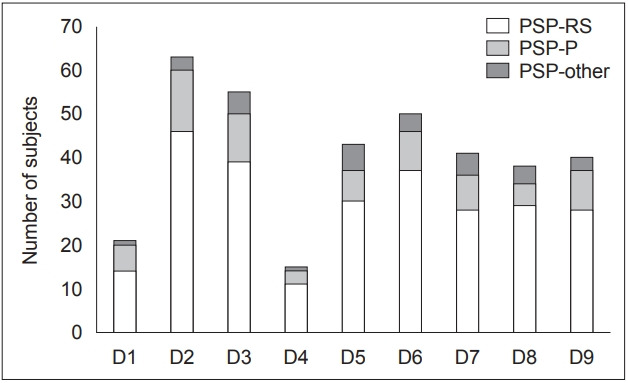
All subjects in this cohort reported at least 2 NMSs. The most prevalent NMSs in patients with PSP were in the domains of sleep/fatigue, mood/cognition, and sexual function. The least prevalent NMSs were in the domains of cardiovascular including falls, and perceptual problems/hallucinations. Significant correlations were observed between the NMSS scores and HAM-D, PDSS, PSPRS scores and PSPRS sub-scores. The severity of NMSs was unrelated to the duration of illness. Patients with PSP-RS reported a higher severity of drooling, altered smell/taste, depression and altered interest in sex and a higher prevalence of sexual dysfunction.
NMSs are commonly observed in patients with PSP, and the domains of sleep, mood and sexual function are most commonly affected. These symptoms contribute significantly to disease morbidity, and clinicians should pay adequate attention to identifying and addressing these symptoms.
非运动症状(NMSs)显著导致帕金森病患者发病率增加和生活质量下降。本研究旨在使用经过验证的非运动症状量表(NMSS)探讨进行性核上性麻痹(PSP)患者的非运动症状特征。
本研究评估了76例PSP患者。使用PSP评定量表(PSPRS)、统一帕金森病评定量表-III、蒙特利尔认知评估量表、汉密尔顿抑郁量表(HAM-D)和焦虑评定量表、帕金森病睡眠量表(PDSS)和NMSS评估运动症状和非运动症状。还比较了PSP-理查森综合征(PSP-RS)患者和PSP-帕金森综合征患者的非运动症状严重程度和患病率。
该队列中的所有受试者均报告至少有2种非运动症状。PSP患者中最常见的非运动症状出现在睡眠/疲劳、情绪/认知和性功能领域。最不常见的非运动症状出现在心血管领域,包括跌倒,以及感知问题/幻觉。观察到NMSS评分与HAM-D、PDSS、PSPRS评分和PSPRS子评分之间存在显著相关性。非运动症状的严重程度与病程无关。PSP-RS患者报告流涎、嗅觉/味觉改变、抑郁和性兴趣改变的严重程度更高,性功能障碍的患病率更高。
PSP患者中常见非运动症状,睡眠、情绪和性功能领域最常受到影响。这些症状对疾病发病率有显著影响,临床医生应充分重视识别和处理这些症状。