Molecular Ecology Group (MEG), Water Research Institute, National Research Council of Italy, Verbania Pallanza, Italy.
Technische Universität Dresden Institut für Hydrobiologie, Dresden, Germany.
PLoS Biol. 2020 Apr 3;18(4):e3000698. doi: 10.1371/journal.pbio.3000698. eCollection 2020 Apr.
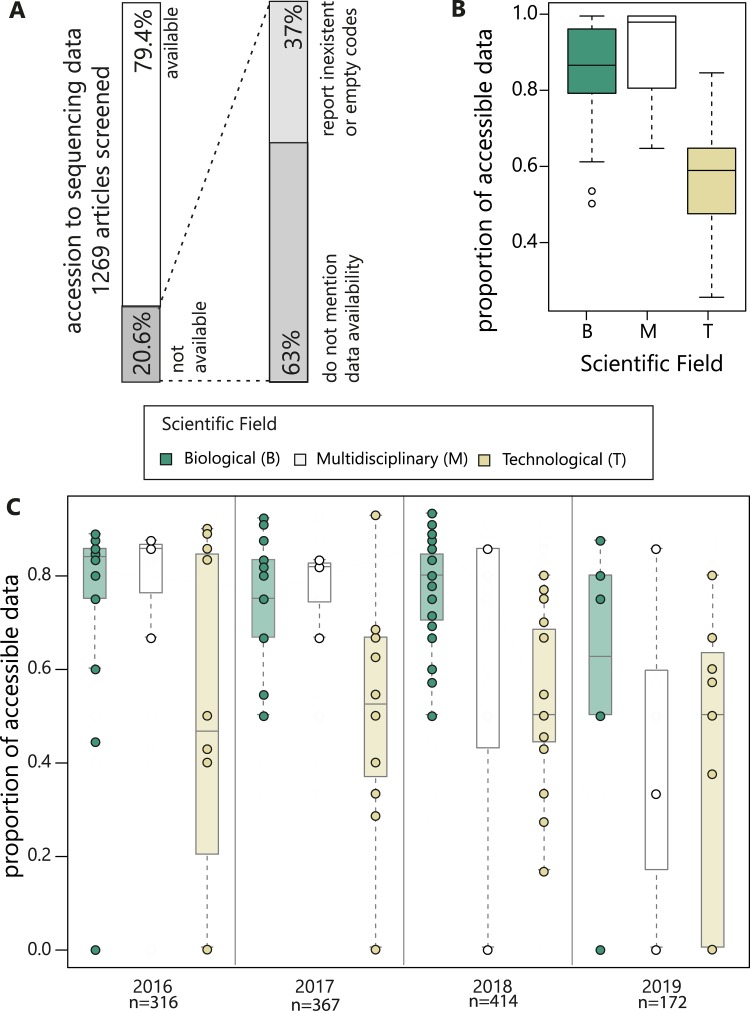
Have you ever sought to use metagenomic DNA sequences reported in scientific publications? Were you successful? Here, we reveal that metagenomes from no fewer than 20% of the papers found in our literature search, published between 2016 and 2019, were not deposited in a repository or were simply inaccessible. The proportion of inaccessible data within the literature has been increasing year-on-year. Noncompliance with Open Data is best predicted by the scientific discipline of the journal. The number of citations, journal type (e.g., Open Access or subscription journals), and publisher are not good predictors of data accessibility. However, many publications in high-impact factor journals do display a higher likelihood of accessible metagenomic data sets. Twenty-first century science demands compliance with the ethical standard of data sharing of metagenomes and DNA sequence data more broadly. Data accessibility must become one of the routine and mandatory components of manuscript submissions-a requirement that should be applicable across the increasing number of disciplines using metagenomics. Compliance must be ensured and reinforced by funders, publishers, editors, reviewers, and, ultimately, the authors.
你是否曾试图使用科学出版物中报告的宏基因组 DNA 序列?你成功了吗?在这里,我们揭示了在我们的文献检索中发现的不少于 20%的论文的宏基因组,这些论文发表于 2016 年至 2019 年期间,没有被保存在存储库中,或者根本无法访问。文献中不可访问数据的比例逐年增加。期刊的科学学科最能预测不符合开放数据的情况。引文数量、期刊类型(例如开放获取或订阅期刊)和出版商并不是数据可访问性的良好预测指标。然而,许多高影响力因子期刊的出版物确实显示出更有可能提供可访问的宏基因组数据集。21 世纪的科学要求遵守宏基因组和更广泛的 DNA 序列数据共享的道德标准。数据可访问性必须成为稿件提交的常规和强制性组成部分之一——这一要求应适用于越来越多使用宏基因组学的学科。遵守情况必须由资助者、出版商、编辑、审稿人,最终由作者来确保和加强。