Imaging Therapy and Cancer Group, Department of Imaging Chemistry and Biology, School of Biomedical Engineering and Imaging Sciences, King's College London, London SE1 7EH, UK; Centre for Stem Cells and Regenerative Medicine, School of Basic and Medical Biosciences, King's College London, London SE1 9RT, UK.
Imaging Therapy and Cancer Group, Department of Imaging Chemistry and Biology, School of Biomedical Engineering and Imaging Sciences, King's College London, London SE1 7EH, UK.
Mol Ther. 2020 Jun 3;28(6):1392-1416. doi: 10.1016/j.ymthe.2020.03.016. Epub 2020 Mar 20.
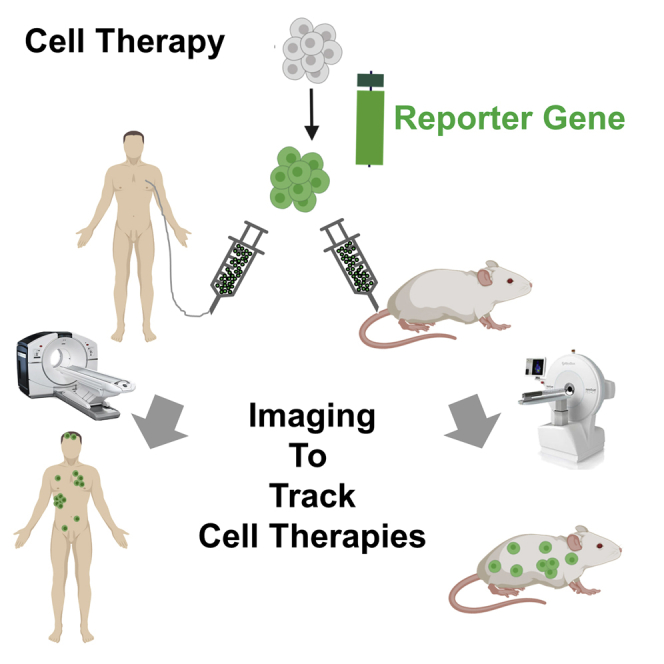
Cell therapies represent a rapidly emerging class of new therapeutics. They are intended and developed for the treatment of some of the most prevalent human diseases, including cancer, diabetes, and for regenerative medicine. Currently, they are largely developed without precise assessment of their in vivo distribution, efficacy, or survival either clinically or preclinically. However, it would be highly beneficial for both preclinical cell therapy development and subsequent clinical use to assess these parameters in situ to enable enhancements in efficacy, applicability, and safety. Molecular imaging can be exploited to track cells non-invasively on the whole-body level and can enable monitoring for prolonged periods in a manner compatible with rapidly expanding cell types. In this review, we explain how in vivo imaging can aid the development and clinical translation of cell-based therapeutics. We describe the underlying principles governing non-invasive in vivo long-term cell tracking in the preclinical and clinical settings, including available imaging technologies, reporter genes, and imaging agents as well as pitfalls related to experimental design. Our emphasis is on adoptively transferred T cell and stem cell therapies.
细胞疗法代表了一类新兴的治疗方法。它们旨在治疗一些最常见的人类疾病,包括癌症、糖尿病和再生医学。目前,它们在很大程度上是在没有精确评估其体内分布、疗效或临床或临床前生存能力的情况下开发的。然而,对于临床前细胞治疗的发展和随后的临床应用来说,评估这些参数的原位情况将非常有益,这可以提高疗效、适用性和安全性。分子成像可用于在全身水平上非侵入性地跟踪细胞,并以与快速扩展的细胞类型兼容的方式进行长时间监测。在这篇综述中,我们解释了体内成像如何帮助基于细胞的治疗方法的开发和临床转化。我们描述了在临床前和临床环境中进行非侵入性体内长期细胞跟踪的基本原理,包括可用的成像技术、报告基因和成像剂,以及与实验设计相关的缺陷。我们的重点是过继转移的 T 细胞和干细胞疗法。