Department of Biotechnology, Institute of Biology and Biotechnology, University of Rzeszów, Pigonia 1, 35-310 Rzeszow, Poland.
Department of Animal Physiology and Reproduction, Institute of Biology and Biotechnology, University of Rzeszów, Pigonia 1, 35-310 Rzeszow, Poland.
Molecules. 2020 Mar 20;25(6):1421. doi: 10.3390/molecules25061421.
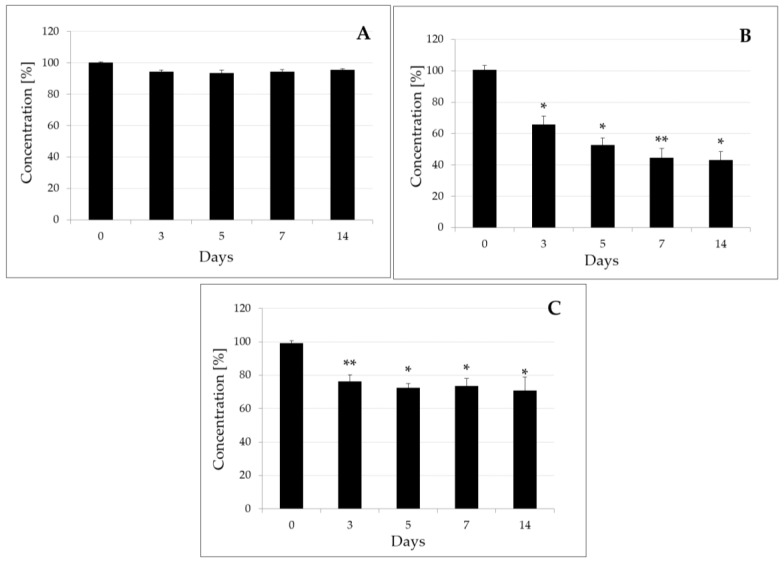
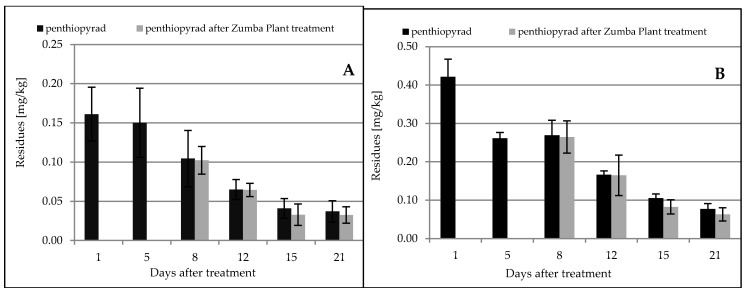
In plant protection, biological preparations are used alternately with chemical pesticides. The applied microorganism can influence the concentration of chemical substances. Laboratory and field studies were conducted to assess the influence of and on the penthiopyrad concentration. In laboratory studies, the effectiveness of penthiopyrad degradation by was approximately 5% during 14 days of the experiment. For penthiopyrad treated with strains, the degradation effectiveness ranged from 34.2% on Day 3 to 56.9% on Day 14. In experiments testing the effects of mixed culture of microorganisms, the effectiveness of penthiopyrad degradation ranged from 23.7% on Day 3 to 29.1% on Day 14. After treatment of apple trees of Gala and Golden Delicious varieties with a biological preparation, a maximum degradation of penthiopyrad of 20% was found in both varieties. Samples of apples were prepared by the quick, easy, cheap, effective, rugged and safe (QuEChERS) method, and penthiopyrad was analyzed by gas chromatography with a mass detector. A determined value of the chronic exposure to penthiopirad was 1.02% of the acceptable daily intake, both for children and for adults. The acute exposure amounted to 7.2% and 1.9% of the acute reference dose for children and adults, respectively. These values were considered to be acceptable and not threatening to health.
在植物保护中,生物制剂与化学农药交替使用。应用的微生物会影响化学物质的浓度。进行了实验室和田间研究,以评估 和 对戊吡丙醚浓度的影响。在实验室研究中,在实验的 14 天内, 对戊吡丙醚的降解效果约为 5%。对于用 菌株处理的戊吡丙醚,降解效果从第 3 天的 34.2%到第 14 天的 56.9%不等。在测试混合微生物培养物影响的实验中,戊吡丙醚的降解效果从第 3 天的 23.7%到第 14 天的 29.1%不等。用生物制剂处理 Gala 和 Golden Delicious 品种的苹果树后,在这两个品种中均发现戊吡丙醚的最大降解率为 20%。通过快速、简单、廉价、有效、坚固和安全 (QuEChERS) 方法制备苹果样品,并通过带有质量检测器的气相色谱法分析戊吡丙醚。戊吡丙醚的慢性暴露值为每日允许摄入量的 1.02%,儿童和成人的慢性暴露值相同。急性暴露值分别为儿童和成人急性参考剂量的 7.2%和 1.9%。这些值被认为是可以接受的,不会对健康构成威胁。