Batsali Aristea K, Georgopoulou Anthie, Mavroudi Irene, Matheakakis Angelos, Pontikoglou Charalampos G, Papadaki Helen A
Haemopoiesis Research Laboratory, School of Medicine, University of Crete, 71003 Heraklion, Greece.
Department of Hematology, School of Medicine, University of Crete, 71003 Heraklion, Greece.
J Clin Med. 2020 Mar 20;9(3):856. doi: 10.3390/jcm9030856.
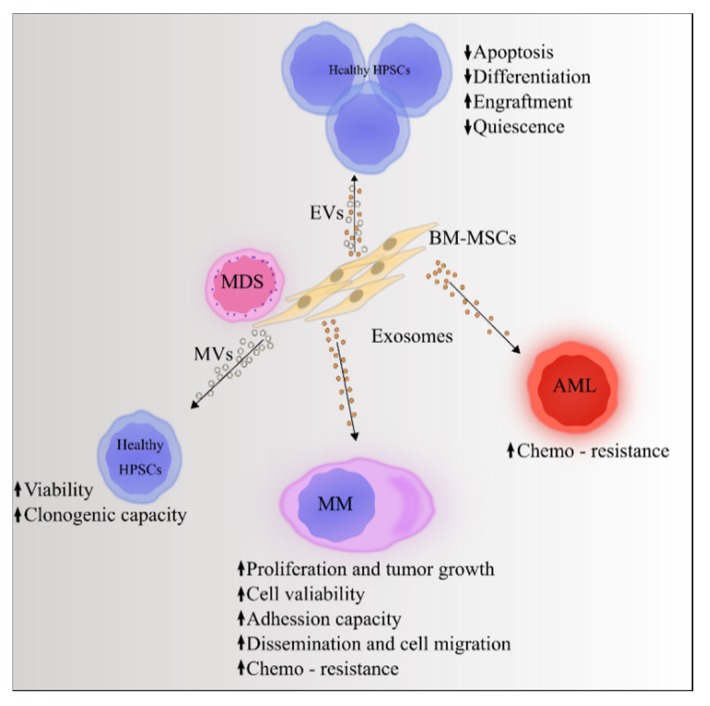
Mesenchymal stem cells (MSCs) represent a heterogeneous cellular population responsible for the support, maintenance, and regulation of normal hematopoietic stem cells (HSCs). In many hematological malignancies, however, MSCs are deregulated and may create an inhibitory microenvironment able to induce the disease initiation and/or progression. MSCs secrete soluble factors including extracellular vesicles (EVs), which may influence the bone marrow (BM) microenvironment via paracrine mechanisms. MSC-derived EVs (MSC-EVs) may even mimic the effects of MSCs from which they originate. Therefore, MSC-EVs contribute to the BM homeostasis but may also display multiple roles in the induction and maintenance of abnormal hematopoiesis. Compared to MSCs, MSC-EVs have been considered a more promising tool for therapeutic purposes including the prevention and treatment of Graft Versus Host Disease (GVHD) following allogenic HSC transplantation (HSCT). There are, however, still unanswered questions such as the molecular and cellular mechanisms associated with the supportive effect of MSC-EVs, the impact of the isolation, purification, large-scale production, storage conditions, MSC source, and donor characteristics on MSC-EV biological effects as well as the optimal dose and safety for clinical usage. This review summarizes the role of MSC-EVs in normal and malignant hematopoiesis and their potential contribution in treating GVHD.
间充质干细胞(MSCs)是一类异质性细胞群体,负责支持、维持和调节正常造血干细胞(HSCs)。然而,在许多血液系统恶性肿瘤中,MSCs功能失调,可能会形成一种抑制性微环境,能够诱导疾病的发生和/或进展。MSCs分泌包括细胞外囊泡(EVs)在内的可溶性因子,这些因子可能通过旁分泌机制影响骨髓(BM)微环境。源自MSCs的EVs(MSC-EVs)甚至可能模拟其来源的MSCs的作用。因此,MSC-EVs有助于维持BM稳态,但也可能在异常造血的诱导和维持中发挥多种作用。与MSCs相比,MSC-EVs被认为是一种更有前景的治疗工具,可用于预防和治疗异基因造血干细胞移植(HSCT)后的移植物抗宿主病(GVHD)。然而,仍有一些问题尚未得到解答,例如与MSC-EVs支持作用相关的分子和细胞机制、分离、纯化、大规模生产、储存条件、MSC来源和供体特征对MSC-EV生物学效应的影响,以及临床使用的最佳剂量和安全性。本综述总结了MSC-EVs在正常和恶性造血中的作用及其在治疗GVHD中的潜在贡献。