Department of Medical Oncology, Dana-Farber Cancer Institute, Boston, USA; Department of Medicine, Brigham and Women's Hospital, Boston, USA; Broad Institute of MIT and Harvard, Cambridge, USA; Harvard Medical School, Boston, USA; Center for Cancer Precision Medicine, Dana-Farber Cancer Institute, Boston, USA.
Broad Institute of MIT and Harvard, Cambridge, USA; Center for Cancer Precision Medicine, Dana-Farber Cancer Institute, Boston, USA.
Ann Oncol. 2020 May;31(5):590-598. doi: 10.1016/j.annonc.2020.02.008. Epub 2020 Feb 20.
Little is known about mechanisms of resistance to poly(adenosine diphosphate-ribose) polymerase inhibitors (PARPi) and platinum chemotherapy in patients with metastatic breast cancer and BRCA1/2 mutations. Further investigation of resistance in clinical cohorts may point to strategies to prevent or overcome treatment failure.
We obtained tumor biopsies from metastatic breast cancer patients with BRCA1/2 deficiency before and after acquired resistance to PARPi or platinum chemotherapy. Whole exome sequencing was carried out on each tumor, germline DNA, and circulating tumor DNA. Tumors underwent RNA sequencing, and immunohistochemical staining for RAD51 foci on tumor sections was carried out for functional assessment of intact homologous recombination (HR).
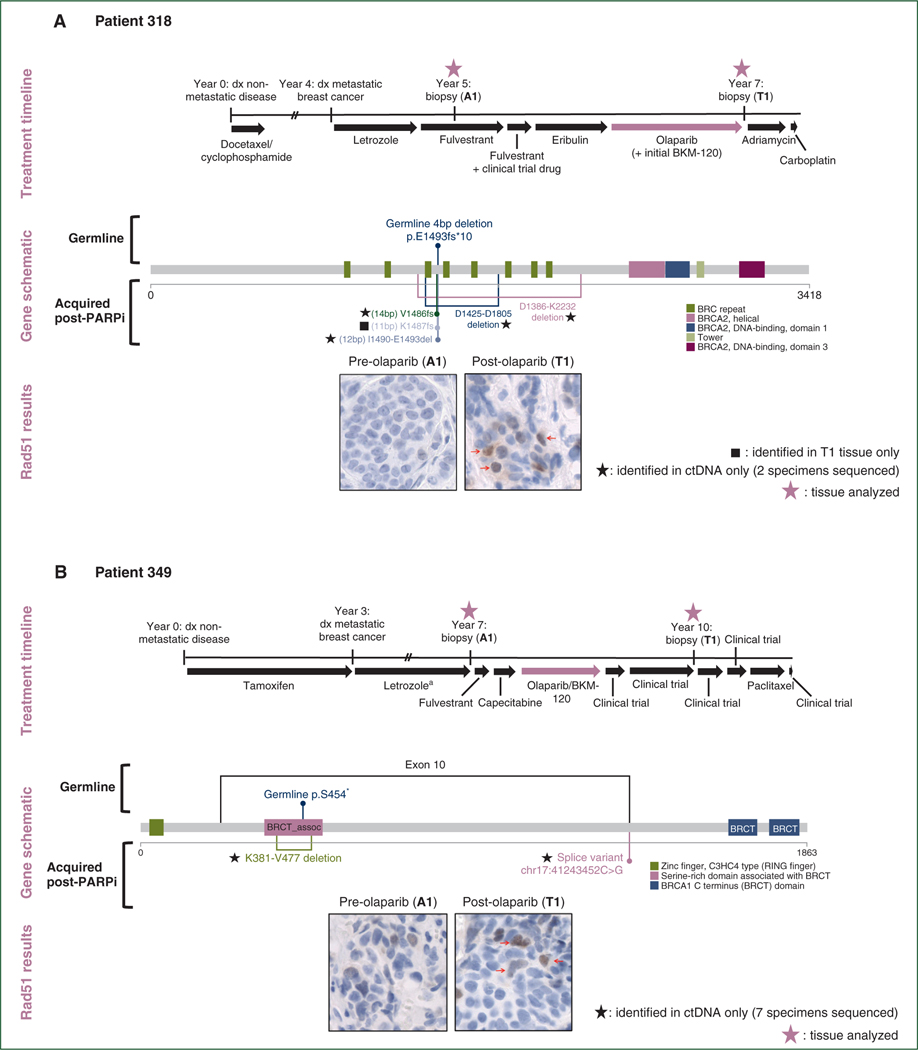
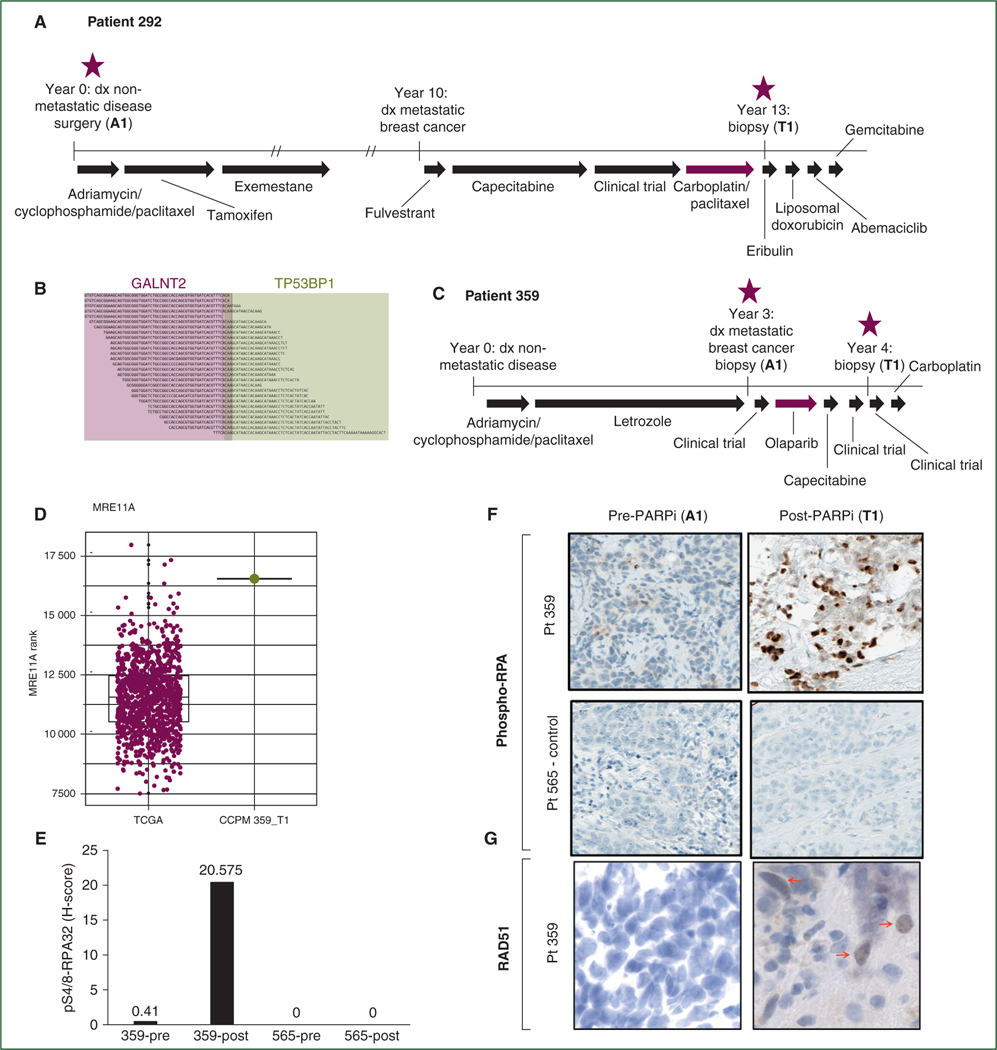
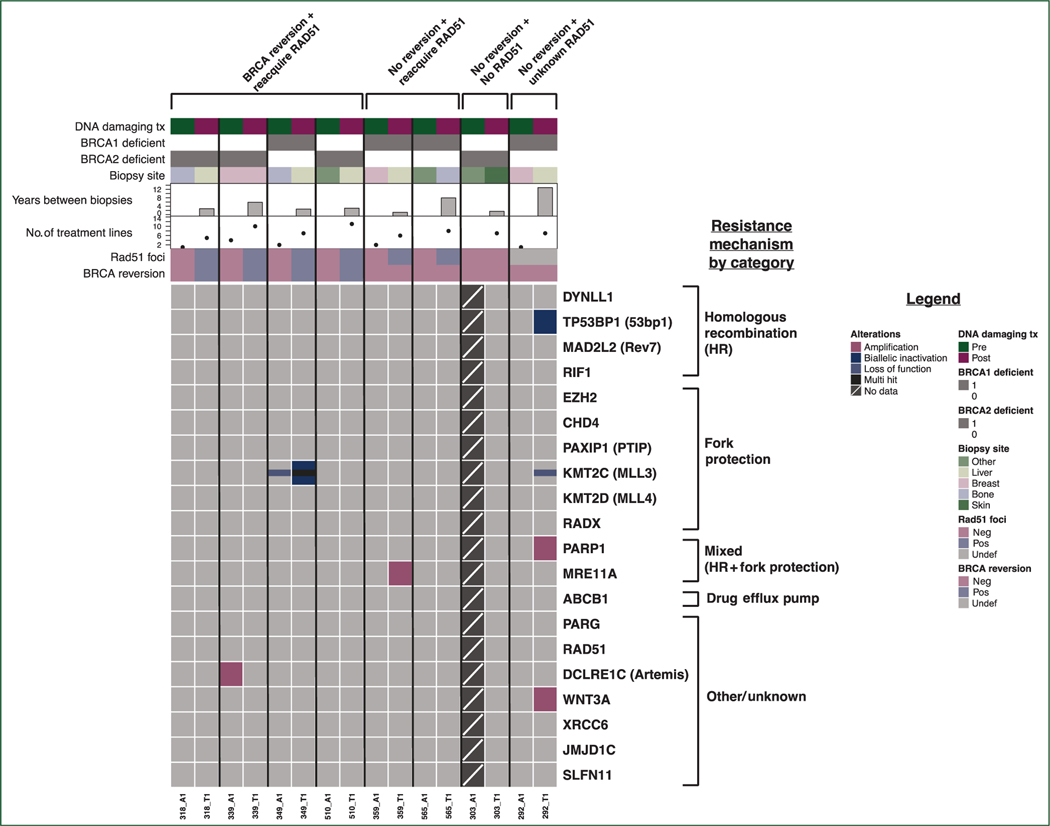
Pre- and post-resistance tumor samples were sequenced from eight patients (four with BRCA1 and four with BRCA2 mutation; four treated with PARPi and four with platinum). Following disease progression on DNA-damaging therapy, four patients (50%) acquired at least one somatic reversion alteration likely to result in functional BRCA1/2 protein detected by tumor or circulating tumor DNA sequencing. Two patients with germline BRCA1 deficiency acquired genomic alterations anticipated to restore HR through increased DNA end resection: loss of TP53BP1 in one patient and amplification of MRE11A in another. RAD51 foci were acquired post-resistance in all patients with genomic reversion, consistent with reconstitution of HR. All patients whose tumors demonstrated RAD51 foci post-resistance were intrinsically resistant to subsequent lines of DNA-damaging therapy.
Genomic reversion in BRCA1/2 was the most commonly observed mechanism of resistance, occurring in four of eight patients. Novel sequence alterations leading to increased DNA end resection were seen in two patients, and may be targetable for therapeutic benefit. The presence of RAD51 foci by immunohistochemistry was consistent with BRCA1/2 protein functional status from genomic data and predicted response to later DNA-damaging therapy, supporting RAD51 focus formation as a clinically useful biomarker.
转移性乳腺癌患者携带 BRCA1/2 突变,对于聚(二磷酸腺苷核糖)聚合酶抑制剂(PARPi)和铂类化疗药物的耐药机制知之甚少。对临床队列中的耐药性进行进一步研究,可能会为预防或克服治疗失败提供策略。
我们从接受 PARPi 或铂类化疗后获得性耐药的转移性乳腺癌伴 BRCA1/2 缺陷的患者中获取肿瘤活检标本。对每个肿瘤、胚系 DNA 和循环肿瘤 DNA 进行全外显子组测序。对肿瘤进行 RNA 测序,并对肿瘤切片上的 RAD51 焦点进行免疫组织化学染色,以评估同源重组(HR)的完整性。
对 8 名患者(4 名 BRCA1 突变,4 名 BRCA2 突变;4 名接受 PARPi 治疗,4 名接受铂类化疗)的耐药前和耐药后肿瘤样本进行了测序。在 DNA 损伤治疗进展后,4 名患者(50%)获得了至少一个体细胞回复突变,可能导致通过肿瘤或循环肿瘤 DNA 测序检测到功能性 BRCA1/2 蛋白。2 名胚系 BRCA1 缺陷患者获得了预计通过增加 DNA 末端切除恢复 HR 的基因组改变:1 名患者中 TP53BP1 缺失,另 1 名患者中 MRE11A 扩增。所有发生基因组回复的患者在耐药后均获得 RAD51 焦点,提示 HR 重建。所有在耐药后肿瘤中显示 RAD51 焦点的患者对随后的 DNA 损伤治疗均具有内在耐药性。
BRCA1/2 中的基因组回复是最常见的耐药机制,在 8 名患者中观察到 4 例。在 2 名患者中观察到导致 DNA 末端切除增加的新的序列改变,这可能对治疗有益。免疫组织化学检测到 RAD51 焦点与基因组数据中 BRCA1/2 蛋白的功能状态一致,并预测对后续 DNA 损伤治疗的反应,支持 RAD51 焦点形成作为一种有临床应用价值的生物标志物。