Department of Life and Earth Sciences, Laboratory of Physiology, Higher Teachers', Training College, University of Maroua, P.O. Box 55, Maroua, Cameroon.
Department of Animal Biology, Laboratory of Animal Physiology and Phytopharmacology, Faculty of Science, University of Dschang, P.O. Box 67, Dschang, Cameroon.
BMC Complement Med Ther. 2020 Apr 5;20(1):106. doi: 10.1186/s12906-020-02896-6.
Combretum molle R.B/G. Don (Combretaceae) is a graceful deciduous shrub, distributed especially in tropical Africa and used in traditional medicine in the treatment of malaria, diabetes, and bacterial, liver and cardiovascular deseases. To our knowledge, no long-term toxicity studies of C. molle has ever been realized yet.
The long-term toxicity study was conducted in accordance with OECD 408 guidelines with slight modifications. In fact, rats were divided in groups and treated orally with CMAE at doses of 62.5, 125 and 250 mg/kg for 6 months. The general behavior and signs of toxicity of the rats were daily observed. Body weight, food and water intake were recorded every 2 months for 6 months. At the end of treatment period, urine and blood samples were collected for hematological, biochemical and antioxidant estimations. Immediately, internal organs were collected and weighed.
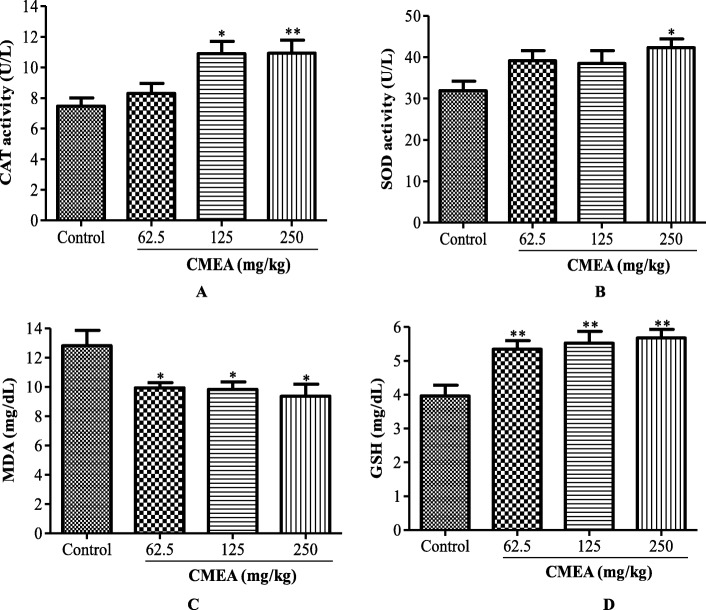
The results showed that no mortality and visible signs of the toxicity were recorded in all experimental animals. The administration of CMAE had no significant effects on body weight, organ weights, serum electrolyte, and food and water intake. However, all doses of CMAE produced an increase in high density lipoprotein cholesterol, white blood cells, platelets, glutathione, and a decrease in low density lipoprotein cholesterol and malondialdehyde rate. CMAE at doses of 125 and 250 mg/kg decreased in serum proteins and the activity of aspartate amino transferase, and increased the activity of catalase. In addition, CMAE (250 mg/kg) significantly decreased the alanine aminotransferase activity and the level of triglycerides, very low density cholesterol, total proteins and creatinine, and increased in renal clearance, red blood cells, hemoglobin, hematocrit and superoxide dismutase activity.
At the end of this study, no signs of major intoxication was noted during 6 months of treatment. These results suggest that long-term consumption of CMAE at the therapeutic dose (250 mg/kg) presents low risks to human health.
Combretum molle R.B/G. Don(使君子科)是一种优雅的落叶灌木,主要分布在热带非洲,用于治疗疟疾、糖尿病以及细菌、肝脏和心血管疾病。据我们所知,尚未对 Combretum molle 进行过长期毒性研究。
该长期毒性研究是根据 OECD 408 指南进行的,略有修改。实际上,大鼠被分为几组,口服给予 CMAE 剂量为 62.5、125 和 250mg/kg,持续 6 个月。每天观察大鼠的一般行为和毒性体征。在 6 个月内每 2 个月记录一次体重、食物和水的摄入量。在治疗期末,收集尿液和血液样本进行血液学、生物化学和抗氧化测定。立即收集和称重内脏器官。
结果表明,所有实验动物均未死亡,也未出现明显毒性症状。CMAE 的给药对体重、器官重量、血清电解质以及食物和水的摄入没有显著影响。然而,CMAE 的所有剂量均导致高密度脂蛋白胆固醇、白细胞、血小板、谷胱甘肽增加,而低密度脂蛋白胆固醇和丙二醛比率降低。CMAE 剂量为 125 和 250mg/kg 时,血清蛋白和天冬氨酸氨基转移酶活性降低,而过氧化氢酶活性增加。此外,CMAE(250mg/kg)显著降低了丙氨酸氨基转移酶活性和甘油三酯、极低密度胆固醇、总蛋白和肌酐水平,增加了肾清除率、红细胞、血红蛋白、血细胞比容和超氧化物歧化酶活性。
在 6 个月的治疗结束时,没有观察到明显的中毒迹象。这些结果表明,在治疗剂量(250mg/kg)下长期服用 CMAE 对人体健康的风险较低。