Morosow Kathrin, Kolk Martin
1Stockholm University Demography Unit, Department of Sociology, Stockholm University, 106 91 Stockholm, Sweden.
2Stockholm University Centre for Cultural Evolution, Institute for Future Studies, Stockholm, Sweden.
Eur J Popul. 2019 Apr 30;36(2):197-233. doi: 10.1007/s10680-019-09525-0. eCollection 2020 Apr.
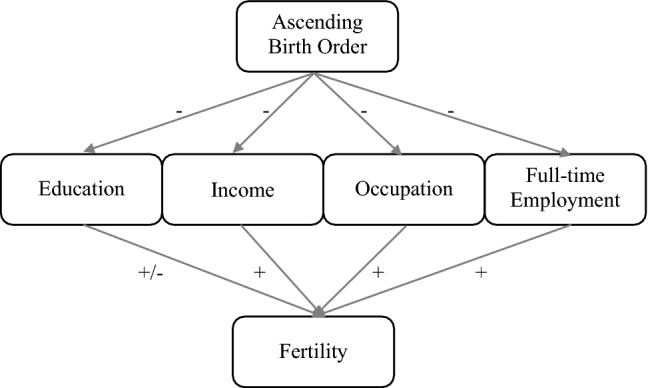
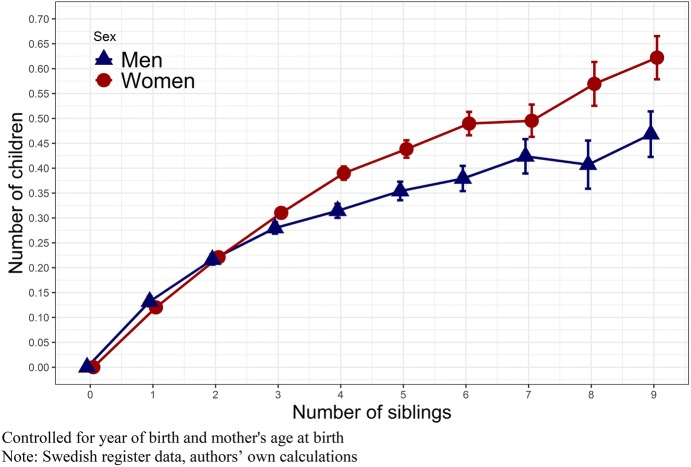
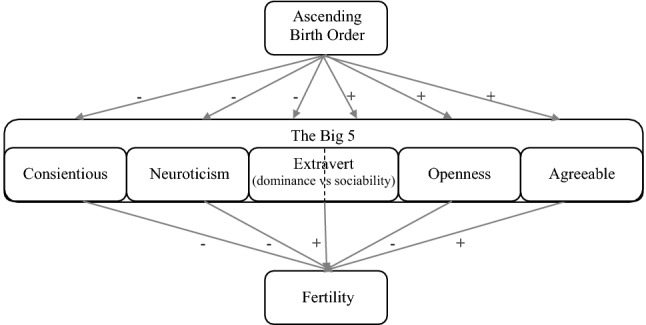
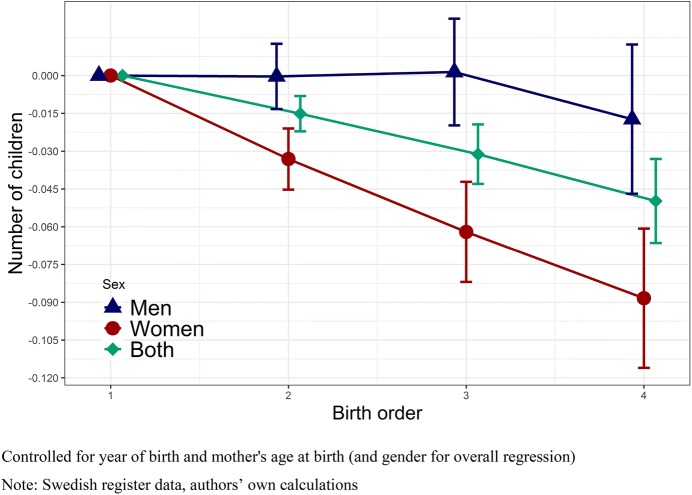
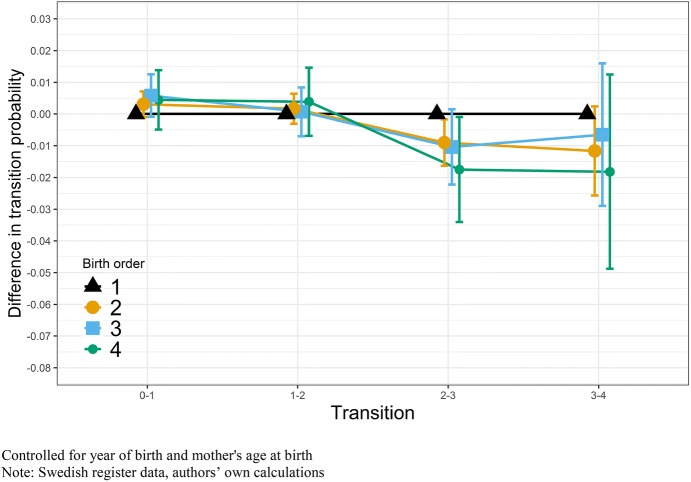
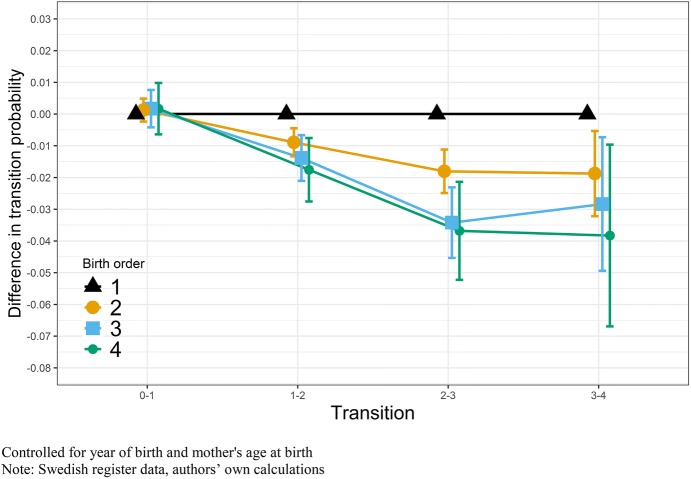
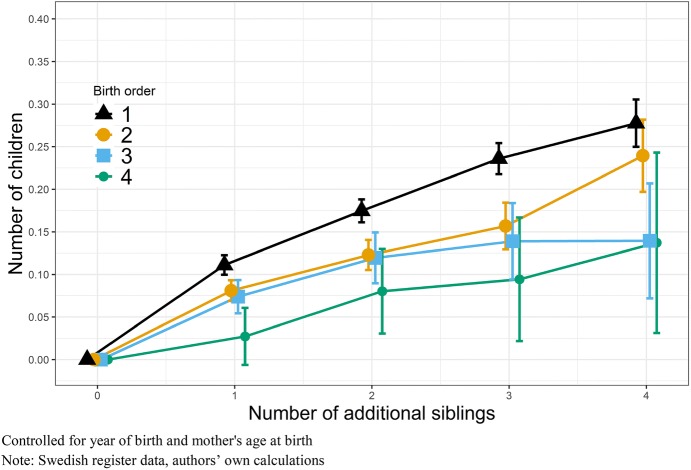
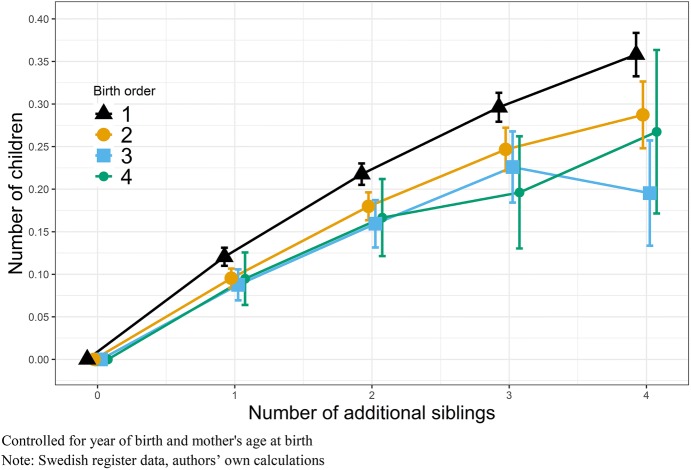
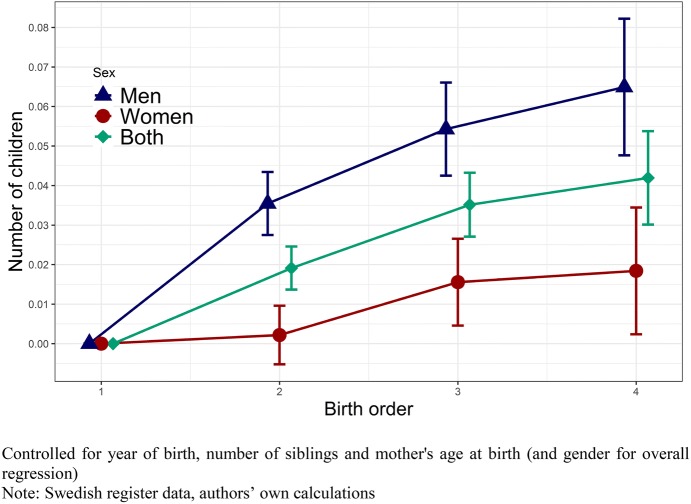
This study examines how the sibling constellation in childhood is associated with later fertility behaviour of men and women in Sweden. Administrative register data are used to investigate how birth order affects completed fertility, how the number of siblings and birth order jointly affect completed fertility, and in both cases if there are gender differences in these relationships. Our data consist of all fully biologically related siblings in Sweden whose mothers were born between 1915 and 1935 (the younger generation is born primarily in the 1940s, 1950s and 1960s; = 1,472,813). To study the direct effect of birth order on fertility, sibling comparison models are applied, while to analyse the joint effect of number of siblings and birth order, the sample was stratified by birth order. Results show that higher birth order has a negative effect on completed fertility for women; hence, earlier-born women show overall higher fertility than later-born women. Parity transitions indicate that later-born women are less likely to have two or more children, while no overall gradient for men can be found. The number of siblings is more positively associated with completed fertility for firstborn than for later-born individuals. We conclude that the position in the family of origin can be seen as an additional factor that influences fertility, although effect sizes are rather small.
本研究考察了瑞典儿童时期的兄弟姐妹构成如何与男性和女性后来的生育行为相关联。利用行政登记数据来调查出生顺序如何影响生育数量、兄弟姐妹数量和出生顺序如何共同影响生育数量,以及在这两种情况下这些关系中是否存在性别差异。我们的数据包括瑞典所有具有完全生物学关系的兄弟姐妹,他们的母亲出生于1915年至1935年之间(年轻一代主要出生于20世纪40年代、50年代和60年代;样本量=1,472,813)。为了研究出生顺序对生育的直接影响,应用了兄弟姐妹比较模型,而在分析兄弟姐妹数量和出生顺序的共同影响时,样本按出生顺序进行了分层。结果表明,较高的出生顺序对女性的生育数量有负面影响;因此,早出生的女性总体上比晚出生的女性生育率更高。生育胎次转变表明,晚出生的女性生育两个或更多孩子的可能性较小,而在男性中未发现总体梯度。与晚出生的个体相比,兄弟姐妹数量与头胎出生者的生育数量的正相关性更强。我们得出结论,尽管影响大小相当小,但原生家庭中的位置可被视为影响生育的一个额外因素。