Varela-Olalla D, Romero-Caballero A, Del Campo-Vecino J, Balsalobre-Fernández C
Department of Physical Education, Sport and Human Movement, Universidad Autónoma de Madrid, 28049 Madrid, Spain.
Sports (Basel). 2020 Apr 4;8(4):45. doi: 10.3390/sports8040045.
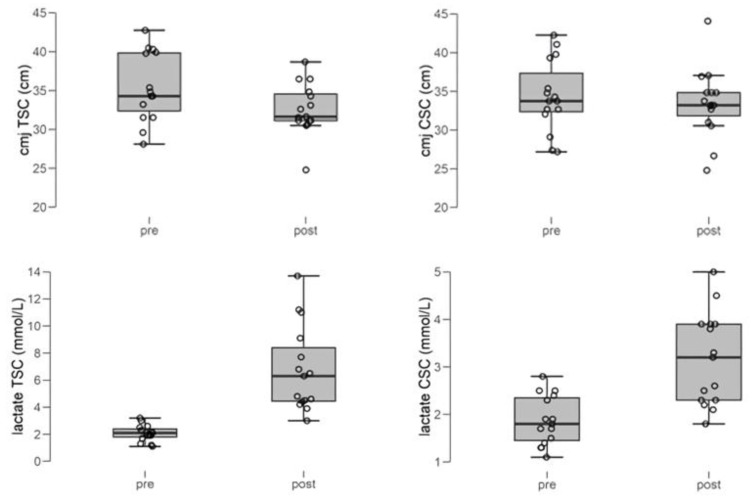
Splitting sets into clusters has been shown to maintain performance during resistance training. This study compared the acute fatigue produced by a traditional (TSC) versus a cluster (CSC) set configuration in the smith machine half squat exercise. Fifteen males performed a single bout of TSC and CSC separated by 72-96 h. In the TSC, participants performed as many repetitions as possible until reaching a 20% drop in barbell velocity (MPV), while in the CSC, they performed the same number of repetitions with 15 seconds inter-repetition rest. Effects of both protocols in MPV, countermovement jump height (CMJ), and blood lactate (BLa) were measured. Significant differences between protocols were found for MPV of the last repetition (0.4 vs 0.5 m/s TSC and CSC) and BLa (6.8 mmol/L vs 3.2 mmol/L TSC and CSC). Significant drop of velocity from the first to the last repetition of the set (19.9%), decrease in CMJ height (35.4 vs 32.6 cm), and increase in BLa (2.1 vs 6.8 mmol/L) pre-post-exercise was observed just for the TSC protocol. The results of the present study showed that CSC reduces the lactate response and mechanical fatigue produced by a single set on the half squat exercise in comparison with TSC.
在抗阻训练中,将训练组拆分为多个簇组已被证明能保持训练效果。本研究比较了在史密斯机半蹲练习中,传统组(TSC)与簇组(CSC)两种训练组设置所产生的急性疲劳情况。15名男性参与者分别进行了一轮TSC和一轮CSC训练,两轮训练间隔72 - 96小时。在TSC训练中,参与者尽可能多地重复动作,直到杠铃速度(平均峰值速度,MPV)下降20%;而在CSC训练中,他们以相同的重复次数进行训练,每次重复之间休息15秒。测量了两种训练方案对MPV、反向纵跳高度(CMJ)和血乳酸(BLa)的影响。结果发现,两种训练方案在最后一次重复动作的MPV(TSC为0.4米/秒,CSC为0.5米/秒)和BLa(TSC为6.8毫摩尔/升,CSC为3.2毫摩尔/升)方面存在显著差异。仅在TSC训练方案中观察到,从训练组的第一次重复到最后一次重复,速度显著下降(19.9%),CMJ高度降低(从35.4厘米降至32.6厘米),以及运动前后BLa增加(从2.1毫摩尔/升增至6.8毫摩尔/升)。本研究结果表明,与TSC相比,CSC能降低半蹲练习中单次训练组产生的乳酸反应和机械疲劳。