Dolce Pasquale, Marocco Davide, Maldonato Mauro Nelson, Sperandeo Raffaele
Department of Public Health, University of Naples Federico II, Naples, Italy.
Department of Humanistic Studies, University of Naples Federico II, Naples, Italy.
Front Psychol. 2020 Mar 24;11:446. doi: 10.3389/fpsyg.2020.00446. eCollection 2020.
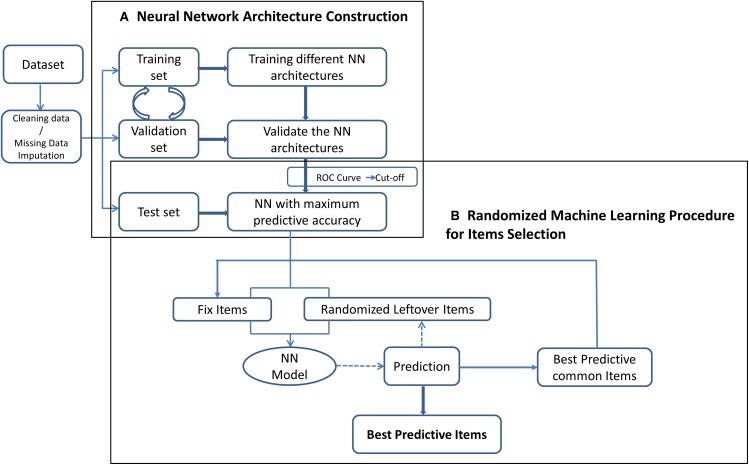
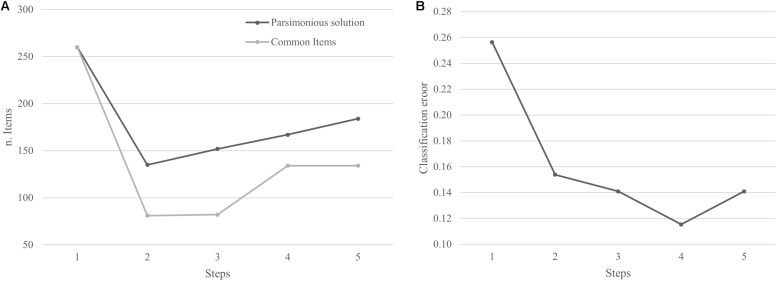
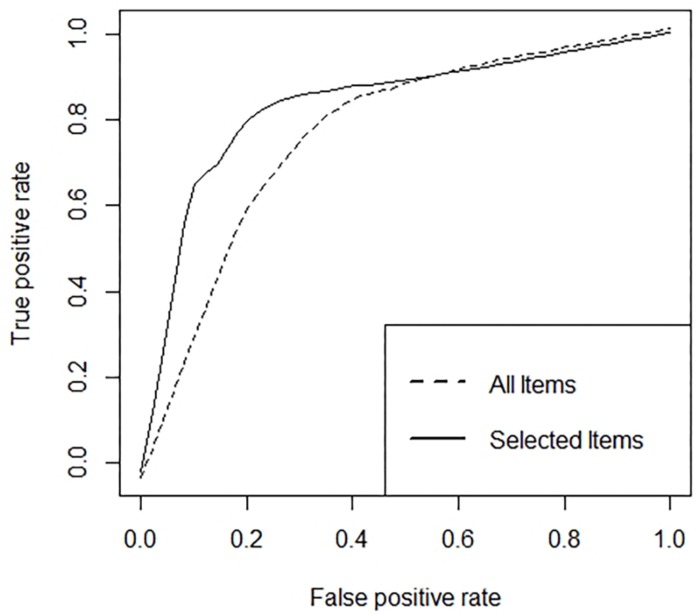
This paper presents a procedure that aims to combine explanatory and predictive modeling for the construction of new psychometric questionnaires based on psychological and neuroscientific theoretical grounding. It presents the methodology and the results of a procedure for items selection that considers both the explanatory power of the theory and the predictive power of modern computational techniques, namely exploratory data analysis for investigating the dimensional structure and artificial neural networks (ANNs) for predicting the psychopathological diagnosis of clinical subjects. Such blending allows deriving theoretical insights on the characteristics of the items selected and their conformity with the theoretical framework of reference. At the same time, it permits the selection of those items that have the most relevance in terms of prediction by therefore considering the relationship of the items with the actual psychopathological diagnosis. Such approach helps to construct a diagnostic tool that both conforms with the theory and with the individual characteristics of the population at hand, by providing insights on the power of the scale in precisely identifying out-of-sample pathological subjects. The proposed procedure is based on a sequence of steps that allows the construction of an ANN capable of predicting the diagnosis of a group of subjects based on their item responses to a questionnaire and subsequently automatically selects the most predictive items by preserving the factorial structure of the scale. Results show that the machine learning procedure selected a set of items that drastically improved the prediction accuracy of the model (167 items reached a prediction accuracy of 88.5%, that is 25.6% of incorrectly classified), compared to the predictions obtained using all the original items (260 items with a prediction accuracy of 74.4%). At the same time, it reduced the redundancy of the items and eliminated those with less consistency.
本文提出了一种程序,旨在结合解释性和预测性建模,以构建基于心理学和神经科学理论基础的新型心理测量问卷。它介绍了一种项目选择程序的方法和结果,该程序既考虑了理论的解释力,又考虑了现代计算技术的预测力,即用于研究维度结构的探索性数据分析和用于预测临床受试者心理病理诊断的人工神经网络(ANN)。这种融合有助于获得关于所选项目特征及其与参考理论框架一致性的理论见解。同时,通过考虑项目与实际心理病理诊断的关系,它允许选择那些在预测方面最相关的项目。这种方法有助于构建一种诊断工具,该工具既符合理论又符合手头人群的个体特征,通过提供关于量表在精确识别样本外病理受试者方面的效力的见解。所提出的程序基于一系列步骤,这些步骤允许构建一个能够根据一组受试者对问卷的项目回答来预测其诊断的人工神经网络,并随后通过保留量表的因子结构自动选择最具预测性的项目。结果表明,与使用所有原始项目(260个项目,预测准确率为74.4%)得到的预测相比,机器学习程序选择了一组项目,这些项目极大地提高了模型的预测准确率(167个项目达到了88.5%的预测准确率,即错误分类率为25.6%)。同时,它减少了项目的冗余并消除了一致性较低的项目。