Fontecha-Umaña Fabio, Ríos-Castillo Abel Guillermo, Ripolles-Avila Carolina, Rodríguez-Jerez José Juan
Departament de Ciència Animal i dels Aliments, Facultat de Veterinària, Universitat Autònoma de Barcelona, Travessera dels Turons s/n. Bellaterra, 08193 Barcelona, Spain.
Foods. 2020 Apr 6;9(4):442. doi: 10.3390/foods9040442.
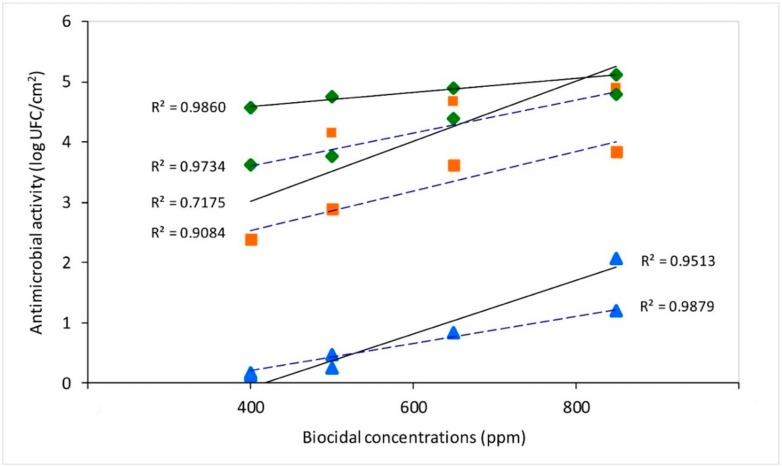
Food contact surfaces are primary sources of bacterial contamination in food industry processes. With the objective of preventing bacterial adhesion and biofilm formation on surfaces, this study evaluated the antimicrobial activity of silver (Ag-NPs) and zinc oxide (ZnO-NPs) nanoparticle-containing polyester surfaces (concentration range from 400 ppm to 850 ppm) using two kinds of bacteria, Gram-positive () and Gram-negative (), and the prevention of bacterial biofilm formation using the pathogen . The results of antimicrobial efficacy (reductions ≥ 2 log CFU/cm) showed that at a concentration of 850 ppm, ZnO-NPs were effective against only (2.07 log CFU/cm). However, a concentration of 400 ppm of Ag-NPs was effective against (4.90 log CFU/cm) and (3.84 log CFU/cm). Furthermore, a combined concentration of 850 ppm Ag-NPs and 400 ppm ZnO-NPs showed high antimicrobial efficacy against (5.80 log CFU/cm) and (4.11 log CFU/cm). The results also showed a high correlation between concentration levels and the bacterial activity of Ag-ZnO-NPs (R = 0.97 for , and R = 0.99 for ). They also showed that unlike individual action, the joint action of Ag-NPs and ZnO-NPs has high antimicrobial efficacy for both types of microorganisms. Moreover, Ag-NPs prevent the biofilm formation of in humid conditions of growth at concentrations of 500 ppm. Additional studies under different conditions are needed to test the durability of nanoparticle containing polyester surfaces with antimicrobial properties to optimize their use.
食品接触表面是食品工业加工过程中细菌污染的主要来源。为了防止细菌在表面粘附和形成生物膜,本研究使用两种细菌,革兰氏阳性菌()和革兰氏阴性菌(),评估了含银(Ag-NPs)和氧化锌(ZnO-NPs)纳米颗粒的聚酯表面(浓度范围为400 ppm至850 ppm)的抗菌活性,以及使用病原体防止细菌生物膜形成的情况。抗菌效果(减少≥2 log CFU/cm)结果表明,在850 ppm浓度下,ZnO-NPs仅对(2.07 log CFU/cm)有效。然而,400 ppm浓度的Ag-NPs对(4.90 log CFU/cm)和(3.84 log CFU/cm)有效。此外,850 ppm Ag-NPs和400 ppm ZnO-NPs的组合浓度对(5.80 log CFU/cm)和(4.11 log CFU/cm)显示出高抗菌效果。结果还表明,浓度水平与Ag-ZnO-NPs的细菌活性之间存在高度相关性(对于,R = 0.97;对于,R = 0.99)。结果还表明,与单独作用不同,Ag-NPs和ZnO-NPs的联合作用对两种类型的微生物都具有高抗菌效果。此外,在500 ppm浓度下,Ag-NPs可防止在潮湿生长条件下形成生物膜。需要在不同条件下进行进一步研究,以测试具有抗菌特性的含纳米颗粒聚酯表面的耐久性,以优化其使用。