Laboratory of Environmental Toxicology, National Institute of Chemical Physics and Biophysics, Tallinn, Estonia.
Department of Chemistry and Biotechnology, Tallinn University of Technology, Tallinn, Estonia.
Sci Rep. 2020 Aug 10;10(1):13478. doi: 10.1038/s41598-020-70169-w.
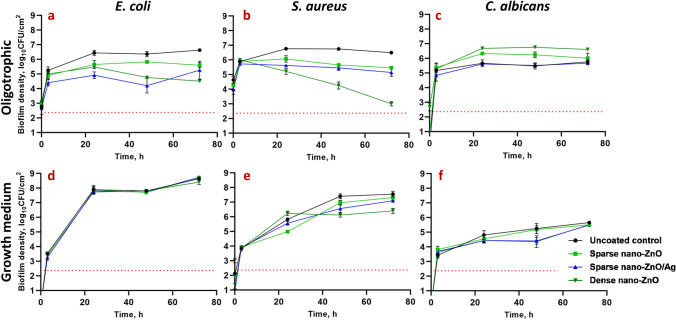
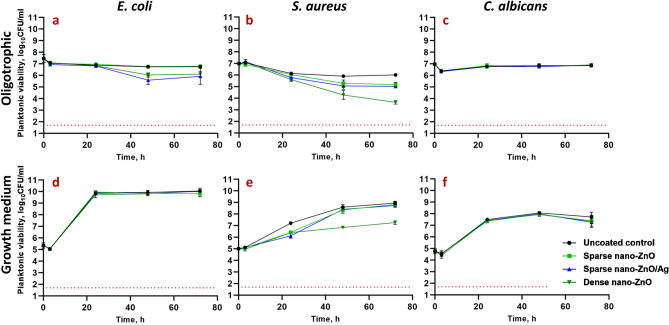
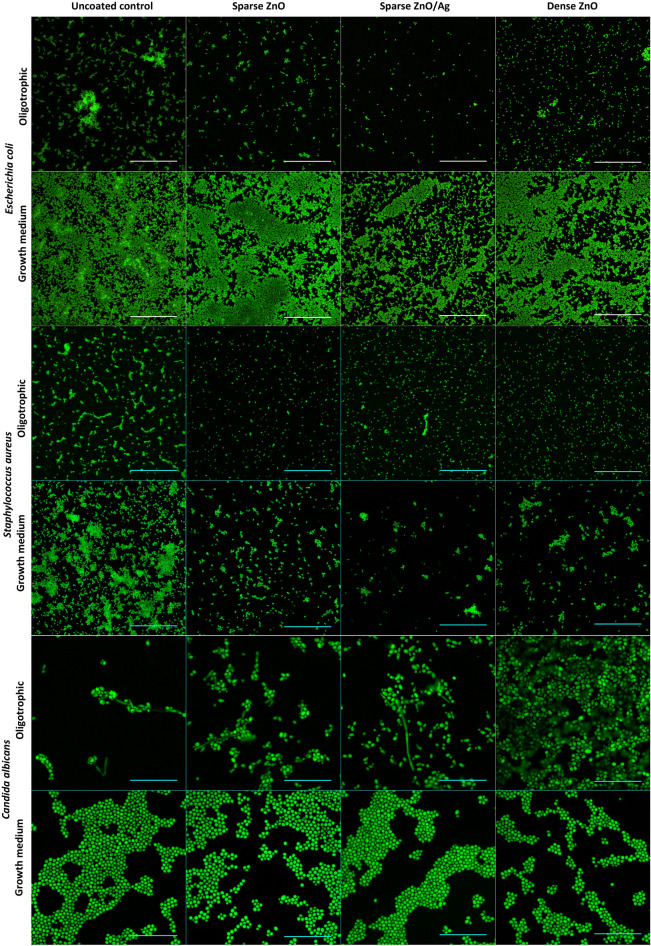
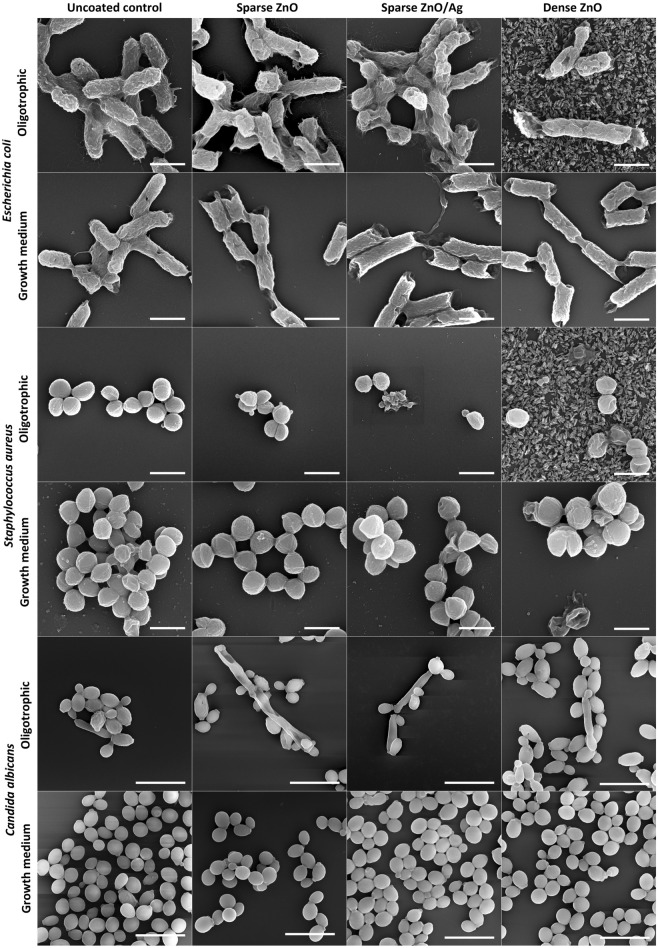
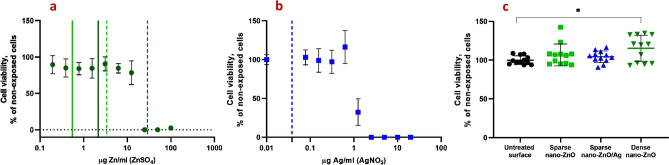
Spread of pathogenic microbes and antibiotic-resistant bacteria in health-care settings and public spaces is a serious public health challenge. Materials that prevent solid surface colonization or impede touch-transfer of viable microbes could provide means to decrease pathogen transfer from high-touch surfaces in critical applications. ZnO and Ag nanoparticles have shown great potential in antimicrobial applications. Less is known about nano-enabled surfaces. Here we demonstrate that surfaces coated with nano-ZnO or nano-ZnO/Ag composites are not cytotoxic to human keratinocytes and possess species-selective medium-dependent antibiofilm activity against Escherichia coli, Staphylococcus aureus and Candida albicans. Colonization of nano-ZnO and nano-ZnO/Ag surfaces by E. coli and S. aureus was decreased in static oligotrophic conditions (no planktonic growth). Moderate to no effect was observed for bacterial biofilms in growth medium (supporting exponential growth). Inversely, nano-ZnO surfaces enhanced biofilm formation by C. albicans in oligotrophic conditions. However, enhanced C. albicans biofilm formation on nano-ZnO surfaces was effectively counteracted by the addition of Ag. Possible selective enhancement of biofilm formation by the yeast C. albicans on Zn-enabled surfaces should be taken into account in antimicrobial surface development. Our results also indicated the importance of the use of application-appropriate test conditions and exposure medium in antimicrobial surface testing.
在医疗环境和公共场所中,病原微生物和耐药菌的传播是一个严重的公共卫生挑战。能够防止固体表面定植或阻碍可存活微生物接触转移的材料,可以为减少高接触表面病原体的转移提供手段。在抗菌应用中,氧化锌(ZnO)和银(Ag)纳米颗粒显示出巨大的潜力。然而,关于纳米增强表面的了解较少。在这里,我们证明了涂有纳米 ZnO 或纳米 ZnO/Ag 复合材料的表面对人角质形成细胞没有细胞毒性,并且对大肠杆菌、金黄色葡萄球菌和白色念珠菌具有种属选择性的依赖于介质的抗生物膜活性。在静态贫营养条件下(无浮游生长),大肠杆菌和金黄色葡萄球菌在纳米 ZnO 和纳米 ZnO/Ag 表面的定植减少。然而,在生长培养基中,对细菌生物膜几乎没有影响(支持指数生长)。相反,在贫营养条件下,纳米 ZnO 表面增强了白色念珠菌的生物膜形成。然而,Ag 的添加有效地抵消了纳米 ZnO 表面上白色念珠菌生物膜的增强形成。在抗菌表面开发中,应该考虑到在 Zn 增强表面上酵母白色念珠菌选择性增强生物膜形成的可能性。我们的研究结果还表明,在抗菌表面测试中,使用适当的应用条件和暴露介质的重要性。