Department of Biosciences, Manipal University Jaipur, Jaipur, India.
Department of Microbiology, School of Life Sciences, Central University of Rajasthan, Ajmer, India.
Front Immunol. 2020 Mar 24;11:404. doi: 10.3389/fimmu.2020.00404. eCollection 2020.
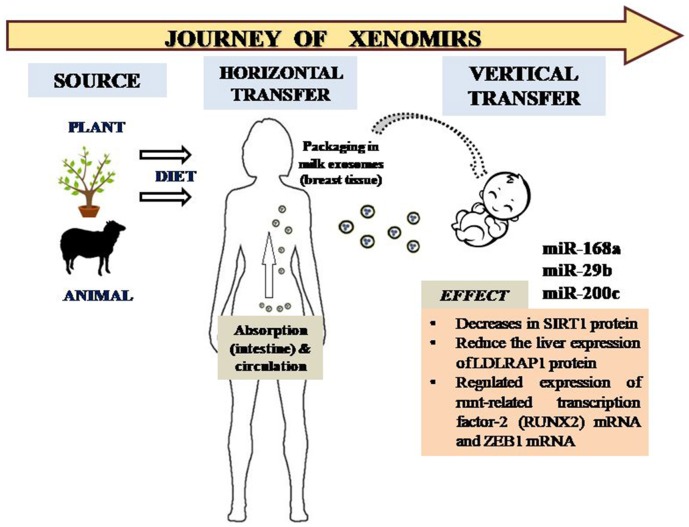
Human milk is a complex liquid that contains multifaceted compounds which provide nutrition to infants and helps to develop their immune system. The presence of secretory immunoglobulins (IgA), leucocytes, lysozyme, lactoferrin, etc., in breast milk and their role in imparting passive immunity to infants as well as modulating development of an infant's immune system is well-established. Breast milk miRNAs (microRNAs) have been found to be differentially expressed in diverse tissues and biological processes during various molecular functions. Lactation is reported to assist mothers and their offspring to adapt to an ever-changing food supply. It has been observed that certain subtypes of miRNAs exist that are codified by non-human genomes but are still present in circulation. They have been termed as xeno-miRNA (XenomiRs). XenomiRs in humans have been found from various exogenous sources. Route of entry in human systems have been mainly dietary. The possibility of miRNAs taken up into mammalian circulation through diet, and thereby effecting gene expression, is a distinct possibility. This mechanism suggests an interesting possibility that dietary foods may modulate the immune strength of infants via highly specific post-transcriptional regulatory information present in mother's milk. This serves as a major breakthrough in understanding the fundamentals of nutrition and cross-organism communication. In this review, we elaborate and understand the complex crosstalk of XenomiRs present in mother's milk and their plausible role in modulating the infant immune system against infectious and inflammatory diseases.
人乳是一种复杂的液体,其中含有多种化合物,可为婴儿提供营养,并有助于其免疫系统的发育。母乳中存在分泌型免疫球蛋白(IgA)、白细胞、溶菌酶、乳铁蛋白等,它们在赋予婴儿被动免疫以及调节婴儿免疫系统发育方面发挥着重要作用。已经发现母乳中的 miRNA(microRNA)在不同的分子功能中在不同的组织和生物过程中表现出差异表达。哺乳被认为有助于母亲及其后代适应不断变化的食物供应。据观察,某些特定类型的 miRNA 虽然由非人类基因组编码,但仍存在于循环中。它们被称为异源 miRNA(XenomiRs)。已经从各种外源来源中在人类中发现了 XenomiRs。进入人体系统的途径主要是饮食。通过饮食进入哺乳动物循环并从而影响基因表达的 miRNA 是一种可能性。这种机制提出了一种有趣的可能性,即饮食中的食物可能通过母乳中存在的高度特异性转录后调节信息来调节婴儿的免疫强度。这是理解营养和跨生物体通讯基本原理的重大突破。在这篇综述中,我们详细阐述并理解了母乳中存在的 XenomiRs 的复杂相互作用及其在调节婴儿对感染和炎症性疾病的免疫反应方面的可能作用。