White S Hoya, Del Rey A Martín, Sánchez G Rodríguez
Department of Applied Mathematics, E.T.S.I.I., Universidad de Salamanca, Avda. Fernández Ballesteros 2, 37700-Béjar, Salamanca, Spain.
Department of Applied Mathematics, E.P.S. de Ávila, Universidad de Salamanca, C/ Hornos Caleros 50, 05003-Ávila, Spain.
Appl Math Comput. 2007 Mar 1;186(1):193-202. doi: 10.1016/j.amc.2006.06.126. Epub 2006 Sep 15.
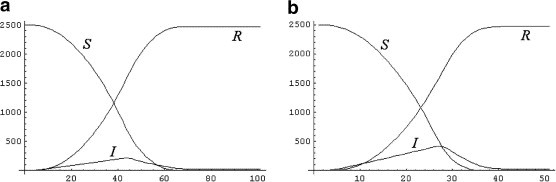
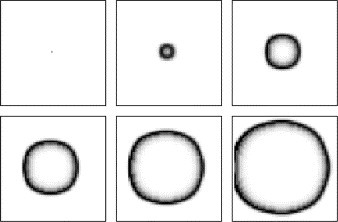
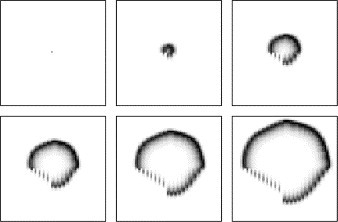
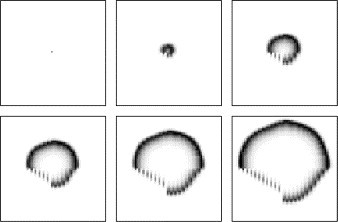
The main goal of this work is to introduce a theoretical model, based on cellular automata, to simulate epidemic spreading. Specifically, it divides the population into three classes: susceptible, infected and recovered, and the state of each cell stands for the portion of these classes of individuals in the cell at every step of time. The effect of population vaccination is also considered. The proposed model can serve as a basis for the development of other algorithms to simulate real epidemics based on real data.
这项工作的主要目标是引入一个基于细胞自动机的理论模型来模拟流行病传播。具体而言,它将人群分为三类:易感者、感染者和康复者,并且在每个时间步,每个单元格的状态代表该单元格中这些类别的个体比例。还考虑了人群接种疫苗的效果。所提出的模型可为基于真实数据模拟真实流行病的其他算法的开发提供基础。