Wu Yan, Tung Thomas C W, Niu Jian-Lei
Department of Building Services Engineering, The Hong Kong Polytechnic University, Hunghom, Kowloon, Hong Kong.
Build Environ. 2016 Apr;99:13-21. doi: 10.1016/j.buildenv.2016.01.013. Epub 2016 Jan 18.
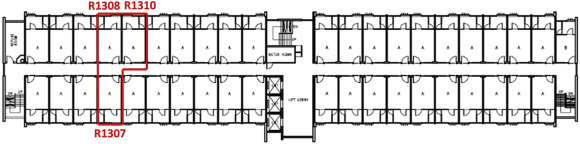
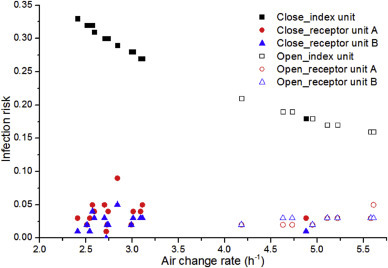
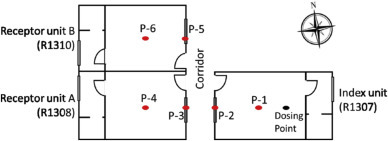
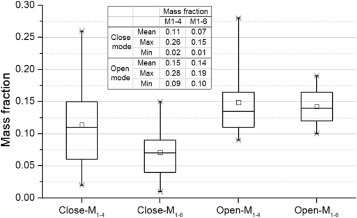
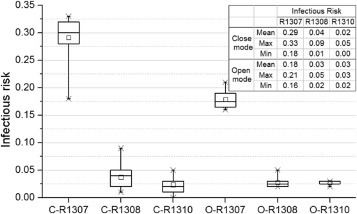
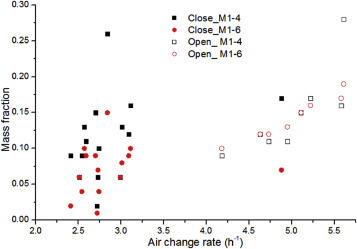
Airborne transmission is a main spread mode of respiratory infectious diseases, whose frequent epidemic has brought serious social burden. Identifying possible routes of the airborne transmission and predicting the potential infection risk are meaningful for infectious disease control. In the present study, an internal spread route between horizontal adjacent flats induced by air infiltration was investigated. On-site measurements were conducted, and tracer gas technique was employed. Two measurement scenarios, closed window mode and open window mode, were compared. Using the calculated air change rate and mass fraction, the cross-infection risk was estimated using the Wells-Riley model. It found that tracer gas concentrations in receptor rooms are one order lower than the source room, and the infection risks are also one order lower. Opening windows results in larger air change rate on the one hand, but higher mass fraction on the other hand. Higher mass fraction not necessarily results in higher infection risk as the pathogen concentration in the source room is reduced by the higher air change rate. In the present study, opening windows could significantly reduce the infection risk of the index room but slightly reduce the risks in receptor rooms. The mass fraction of air originated from the index room to the receptor units could be 0.28 and the relative cross-infection risk through the internal transmission route could be 9%, which are higher than the external spread through single-sided window flush. The study implicates that the horizontal transmission route induced by air infiltration should not be underestimated.
空气传播是呼吸道传染病的主要传播方式,其频繁流行带来了严重的社会负担。识别空气传播的可能途径并预测潜在感染风险对于传染病控制具有重要意义。在本研究中,调查了由空气渗透引起的水平相邻公寓之间的内部传播途径。进行了现场测量,并采用了示踪气体技术。比较了两种测量场景,即关闭窗户模式和打开窗户模式。利用计算出的换气率和质量分数,使用威尔斯-莱利模型估计交叉感染风险。结果发现,受体房间中的示踪气体浓度比源房间低一个数量级,感染风险也低一个数量级。一方面,开窗会导致换气率增大,但另一方面会导致质量分数升高。由于较高的换气率降低了源房间中的病原体浓度,较高的质量分数不一定会导致较高的感染风险。在本研究中,开窗可显著降低指标房间的感染风险,但对受体房间的风险降低幅度较小。从指标房间到受体单元的空气质量分数可能为0.28,通过内部传播途径的相对交叉感染风险可能为9%,这高于通过单面窗户冲洗的外部传播。该研究表明,不应低估由空气渗透引起的水平传播途径。